Discover 1 View
Table of Contents
Table of Contents
The Problem
What is financial self - awareness?
“We’re only as good with our money as our understanding of it.”
Money, since its inception, has held a place of prominence in our minds. For all its importance as a facilitator of value generation, it was still a relatively simple concept. However, personal finance, as we know it today, has evolved into an overly complicated part of our lives. As the range and complexity of financial products expand, the emerging affluent segment in India faces a growing number of financial decisions every day.
Numerous studies on personal finance have recognised that a key aspect of sound money management is awareness of our financial situation, yet it is also one that most of us tend to overlook. The corollary that follows is a lack of financial self-awareness, a major impediment to achieving financial freedom — and the most fundamental problem one encounters.
The term ‘financial self-awareness’ has been used informally in a variety of contexts through the years, but its first scholarly application was in a 2019 study published in the academic journal, Financial Planning Review, which described it as:
“…personal knowledge about one’s current financial assets, liabilities, and spending patterns.”
In other words, it means having a comprehensive and detailed insight into all aspects of one’s personal finances. The study also found that people with higher degrees of financial self-awareness tend to save more and have better control of their spending.
A higher level of financial self-awareness is linked to more positive financial choices. For instance, when deciding whether or not to take out a personal loan, it helps to have a clear sense of one's expected future cash flow position (liquidity) or the value of assets to be used as collateral, in order to make an informed choice.
For this reason, having an accurate and complete understanding of the state of our finances helps us stay financially responsible and make wise decisions. Correspondingly, research in behavioural finance has demonstrated that when people don't have a clear picture of their monetary situation, they are more likely to put off important financial decisions.
The Rationale
Why we conceptualised 1 View?
In 2019, 1 Finance commissioned
Frost & Sullivan, a growth strategy consulting and research firm, to conduct an extensive quantitative and qualitative market research study on the state of personal finances among emerging affluent Indian households.
The study set out to methodically explore and shed light on two major aspects:
The factors that influence their financial planning decisions, such as the true state of their finances and their own assessment of their financial well-being, among other important variables
The need gaps observed among consumers and financial planners
In concluding our research, we found that one of the most recurring themes in our observations was the inconvenience people face when it comes to managing and dealing with multiple financial institutions.
One major finding from the study revealed that respondents interacted with anywhere from 3 to as many as 12 touchpoints or entities to manage different aspects of their personal finances (viz., investments, loans, insurance, cash flow, etc.).
Respondents expressed concerns about having to manage multiple accounts with different custodians — a savings account in one bank, a salary account in another; fixed deposits with one bank, a home loan from another; health insurance through one intermediary, and term insurance through another.
With our personal finances scattered across multiple institutions, it has become increasingly difficult to keep track of our money movements or get a holistic view of our finances.
As individuals engage in more and more financial transactions, the requirement of keeping track of one’s financial undertakings can be felt now more than ever. There is an urgent need for a more effective method of organising and assessing personal financial data.
The understanding that the current system is flawed as it creates roadblocks for individuals looking to take charge of their finances prompted us to explore ways to consolidate a person’s financial information in a meaningful manner and led us to the conception of what we know today as ‘1 View’.
The solution
What is 1 View?
A successor to 1 Finance’s MoneySign®offering, 1 View is the second step in our members’ journey to Financial well-being.
1 View offers a detailed, holistic and real-time picture of all the various elements that make up a person’s finances. Apart from serving as a dashboard that allows members to conveniently access all their personal finance data in one place, 1 View also showcases their net worth and personal balance sheet.
The various aspects of an individual’s personal finance that 1 View brings together under one umbrella are (including but not limited to):
The current value or realisable value of
- Investments in shares, mutual funds, bonds, fixed deposits, derivatives, real estate investment trusts (REITs), unlisted equity, etc.
- Self-occupied property, leased-out property, other investments in real-estate
- Holdings in real estate, gold, commodities, currencies, collectibles, etc.
- Investment in startups
- Assets under lease finance
- Self-used or leased out vehicle
- Balance in cash and at the bank
- Any other form of personal asset
The net outstanding balance of
- Credit card balances
- Home loan
- Car loan
- Consumer durable loans
- Gold loan
- Loans taken for personal use (marriage, education, medical needs, etc.)
- Bank overdraft
- Other account payables
- Any other form of personal liabilities
Details of
- Life insurance plan
- Health insurance plan
- Other insurance plans
Current sources of revenue in cash or credited to a linked bank account such as
- Salary/business income/professional income
- Interest or dividend on investments
- Rental income
- Income from any other sources
Current expenses discharged by cash/credit card or debited from bank account such as
- Household expenses
- Lifestyle expenses
- Interest on loans
- Insurance premium
- Taxes paid
- Any other form of expenses
WHy is your
Net worth important?
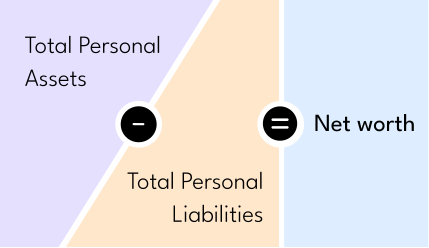
Needless to elaborate, a positive net worth figure rising year on year signifies an increase in wealth. On the other hand, a negative net worth figure implies a state where an individual’s personal liabilities exceed their personal assets, which is not a desirable outcome for any individual.
Most of us learn our net worth only at the time of tax filing. With 1 View, we get to access our current net worth figure, which is updated in real-time to reflect our present financial position.
Being aware of our net worth influences our relationship with money a lot more than we are consciously aware of. Information about ourselves — our net worth in this case — is important because it allows us to be mindful of the outcomes of our decisions and actions.
Aside from these critical financial decisions, having an understanding of our net worth aids in personal decisions like lifestyle considerations or even career decisions that may impact our income.
Personal finance is a lot more personal than financial, and being aware of your personal metrics is a superpower that instantly takes you a step further towards better financial health. Knowing yourself is half the battle won.
WHY SHOULD YOU LOOK AT
Your personal balance sheet?
Organisations draw up a balance sheet to assess their financial position on a specific date (usually March 31). However, when it comes to our own finances, compiling a balance sheet to evaluate our personal financial standing is a rare practice.
Our evaluation of our assets and liabilities is limited primarily to their tax implications. As a result, we end up only tracking our cash flows — referring to our bank statements from time to time or maintaining a single-entry ledger at our end — which marks the extent of our record-keeping efforts.
A personal balance sheet is vastly different from a cash flow statement — a statement used to track the cash activities of an individual or business. A cash flow statement lays out the amount and type of cash or bank receipts and outflows, and reflects the cash position at the end of a specific period. Additionally, a cash flow statement covers information about our liquidity position within a specific period, typically a shorter time-frame while a personal balance sheet reflects all our undertakings till date.
Monitoring solely our cash flow is fairly limiting to our financial self-awareness. A cash flow statement, however comprehensive it may be, does not offer insights into activities undertaken on credit such as incomes receivable or amounts payable — both of which have a huge bearing on our financial position.
For instance, your cash position at the end of the month may be Rs. 1 lakh but you may have EMIs laid out for the next month worth Rs. 60 thousand. Relying on a cash flow statement alone can be extremely detrimental to our financial health as it may encourage ill-informed financial decisions.
The balance sheet template lends itself as the perfect proforma — offering a complete overview of a person’s financial situation. It provides a snapshot of all the assets owned by an individual, and all the liabilities they’ve incurred, with the balance amount representing their net worth.
How often should you
Review your finances?
Components and Frequency
Assets
Equity instruments
(Stocks and equity oriented mutual funds)Monthly
Debt-oriented investmentsQuarterly
Debt-oriented investmentsQuarterly
Real estateAs Updated
Alternative investmentsMonthly