



Jio Financial Services and BlackRock Join Hands: A Game-Changing Infle...
Jio Financial Services collaborates with BlackRock, marking a transformative moment i...

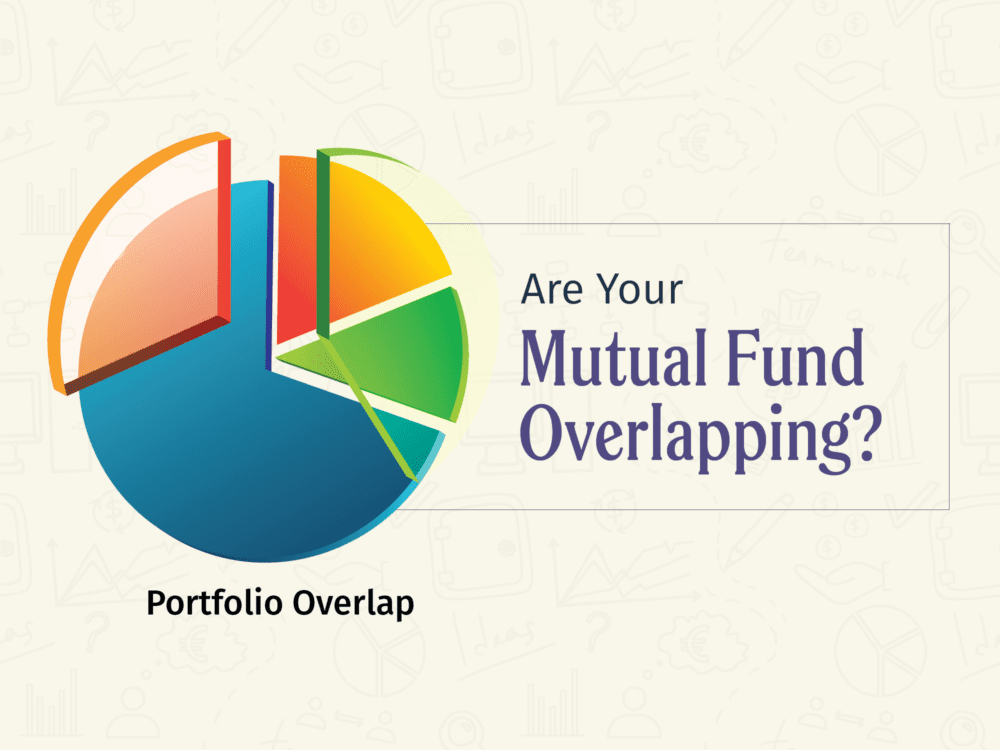
Building a well-diversified mutual fund portfolio is key to reducing risk and maximising returns. But many investors fall into the trap of over-diversifying by purchasing too many funds that end up overlapping. When multiple funds in your portfolio invest in the same securities, it can negate the benefits of diversification. So how do you know if your mutual funds are overlapping?
In this blog, we’ll explain what overlapping funds are, why they can undermine your investment strategy, and how to identify overlapping securities in your mutual fund portfolios.
We’ll also discuss tools that can analyse your funds and the steps you can take to reduce redundancy.
Overlap refers to when two or more of your mutual funds invest in the same stocks. For example, if Fund A and Fund B both have 5% invested in Tata stock, that’s considered a 5% overlap.
This frequently happens because the top 100 stocks comprise about 60% of total equity assets under management in the mutual fund industry. Fund managers tend to flock to the same big name stocks.
Too much overlap can undermine the purpose of diversification. If much of your portfolio is duplicating the same holdings, you lose out on the risk management benefit of spreading your money across a variety of assets.
Overlap can also cause you to overpay. If you’re doubling down on expensive funds that hold the same stocks, those redundant fees can eat into your returns.
The main risk of mutual fund portfolio overlap is increased exposure to specific stocks, which can amplify portfolio volatility and potential losses.
High Concentration in Top Stocks: About 60% of the industry’s equity Assets Under Management (AUM) is invested in the top 100 stocks, leading to a high concentration risk.
Overlap in Various Categories:
These facts point to a lack of diversification and potential increased risk due to market volatility impacting these concentrated stocks.
In the world of investing, knowledge is power. Our revolutionary Mutual Fund Overlap Tool gives you an unparalleled edge in optimising your portfolio.
Our tool offers a cutting-edge advantage, as it swiftly identifies any overlapping stocks between different mutual funds, providing clarity and helping you make informed choices. This saves you time and ensures that you achieve a balanced portfolio that meets your risk appetite and investment targets.
The mutual fund portfolio overlap tool meticulously reviews the contents of your mutual funds to pinpoint overlaps, ensuring that every stock is accounted for in its comprehensive analysis.
Compare up to 5 Mutual Fund Schemes: Analyse the portfolio overlap across up to five mutual fund schemes at once.
Highlights the top 5 stocks with weightage: Identify the top 5 stocks with their weightage in your portfolio, helping you understand where your investments are most concentrated.
Identify portfolio overlap: The tool reveals which schemes have significant overlap in stock weightage, aiding in refining your portfolio for better diversification and reduced redundancy.
Here’s how you can use 1 Finance’s Mutual Fund Portfolio calculator to find out whether you have an overlapping portfolio.
1.Visit : https://1finance.co.in/calculator/portfolio-review and add funds you want to compare.
For instance:
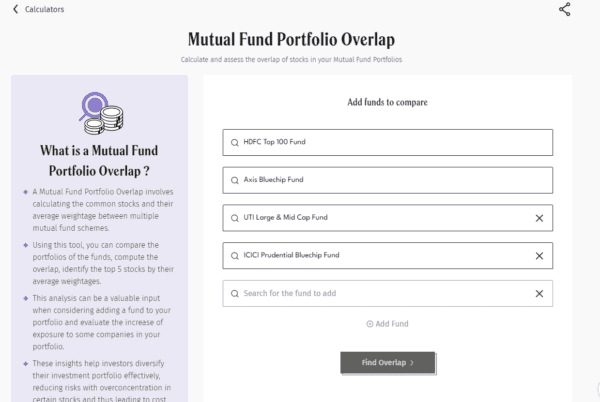
2. Once you’ve entered the mutual funds you want to compare, proceed by clicking on the “Find Overlap” button. You will get a report for overlapping funds along with their ratio.
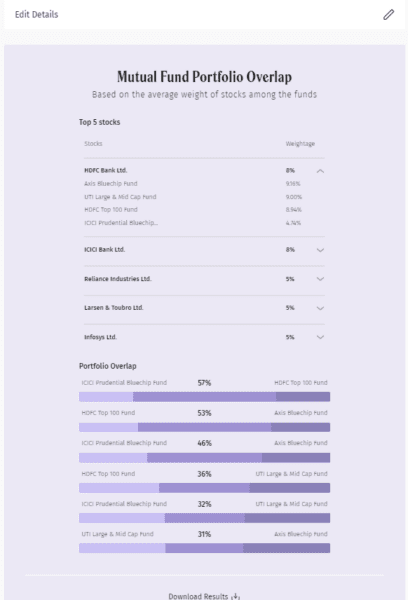
In the example provided, you would observe that many funds have substantial overlap between each other.
For example, there’s a 57% overlap between ICICI Prudential Bluechip Fund and HDFC Top 100 Fund, and other specified percentages of overlap between pairs of funds like Axis Bluechip Fund and HDFC Top 100 Fund, and so on.
These can result in counterproductive outcomes.
Reduced Diversification: One of the main purposes of investing in multiple mutual funds is to benefit from diversification, reducing the risk of having too much exposure to a single stock or sector.
A high overlap means that the investor is not gaining as much diversification as they might think because a large portion of the funds is invested in the same stocks.
Risk Concentration: If the overlapping stocks perform poorly, all funds could be negatively impacted, potentially leading to higher losses for an investor who holds both funds, compared to if they held funds with less overlap.
Redundant Costs: Mutual funds charge management fees and other expenses. If two funds have a high overlap, an investor may be paying multiple sets of fees without receiving the benefit of diversification.
Impact on Portfolio Strategy: For investors seeking to build a balanced and diversified portfolio, a high overlap might mean they need to reassess their investments and possibly choose additional funds or securities that offer exposure to different assets.
Investors who are aware of such overlap might choose to invest in just one of the overlapping funds or look for other funds that provide exposure to different stocks or sectors to achieve a more diversified portfolio.
Our user-friendly Mutual Fund Overlap Calculator makes it easy to analyse your funds and make smart optimisation decisions.
Gain insights into mutual fund portfolio overlap, helping you identify common stocks between two or more mutual fund schemes
Benefits of the Mutual Fund Overlap Calculator:
Managing a diverse yet optimised mutual fund portfolio is crucial, but doing so can be complex without the right tools.
Our user-friendly Mutual Fund Overlap Calculator takes the guesswork out of analysing your funds. With just a few clicks, you can pinpoint overlapping assets, avoid overconcentration risks, cut redundant fees, and make more strategic investment decisions.
Don’t let overlapping funds undermine your returns and diversification. Our Overlap Calculator gives you the insights to optimise your mutual fund portfolio. . Try it out and take your portfolio to the next level today!

The views in the article /blog are personal and that of the author. The idea is to create awareness and not intended to provide any product recommendations.


Jio Financial Services collaborates with BlackRock, marking a transformative moment i...
Learn why debt mutual funds can lose money even when considered safe.

Exchange-Traded Funds (ETFs) have become increasingly popular investment vehicles in ...