


The REIT revolution: History of Real Estate Investment Trusts and how ...
Learn how REITs opened real estate investing to all

 Discover your MoneySign®
Identify the personality traits and behavioural patterns that shape your financial choices.

Located on the southwestern fringes of India’s capital, Gurugram, formerly Gurgaon has emerged as one of the country’s most prominent real estate hotspots. Over the last two decades, this city, once dominated by farmland and sparsely populated localities, has undergone a rapid transformation fueled by robust infrastructure projects, a thriving corporate ecosystem, and evolving consumer preferences. Today, Gurugram is known for its high-end residential developments, gleaming commercial spaces, and pioneering role in India’s broader real estate narrative.
Whether it’s the iconic DLF Cyber City, the upscale Golf Course Road (GCR), or fast-emerging corridors like Dwarka Expressway, Gurugram’s metamorphosis has been nothing short of remarkable. In this blog, we explore Gurugram’s real estate developments, focusing on market performance, top micromarkets, the influence of economic infrastructure on property prices, and the city’s outlook in a post-pandemic world.
Source: CRE Matrix, 1 Finance Research
| DLF Cyber City and Nearby | Dwarka Expressway | New Gurugram to Manesar | New Gurugram | Old Gurugram | GCR | GCRE | Sohna | SPR |
|---|---|---|---|---|---|---|---|---|
| Sector 24 (DLF III) | Sector 105 | Sector 80 | Sector 95B | Sector 15 | Sector 56 (SushantLok II) | Sector 61 | Sector 7 | Sector 71 |
| Sector 25 (DLF II) | Sector 113 | Sector 79B | Sector 88 | Sector 12A | Sector 43 | Sector 63A | Sector 32 | Sector 73 |
| Sector 26 (DLF I) | Sector 36A | Sector 76 | Sector 82 | Sector 3 | Sector 53 | Sector 63 | Sector 36 | Sector 70 |
| Sector 28 (DLF IV) | Sector 111 | Sector 77 | Sector 93 | Sector 22 | Sector 42 | Sector 59 | Sector 4 | Sector 72 |
| Sector 37D | Sector 79 | Sector 89 | Sector 10A | Sector 54 | Sector 62 | Sector 5 | Sector 70A | Sector 106 |
| Sector 78 | Sector 91 | Sector 65 | Sector 33 | Sector 103 | Sector 86 | Sector 60 | Sector 35 | Sector 37C |
| Sector 95A | Sector 2 | Sector 108 | Sector 83 | Sector 11 | Sector 99A | Sector 95 | Sector 6 | Sector 104 |
| Sector 81 | Sector 102 | Sector 84 | Sector 112 | Sector 90 | Sector 110 | Sector 88A | Sector 113 | Sector 107 |
| Sector 85 | Sector 110A | Sector 92 | Sector 109 | Sector 89A | Sector 99 | Sector 88B | Sector 82A | Sector 81A |
Source: CRE Matrix, 1 Finance Research
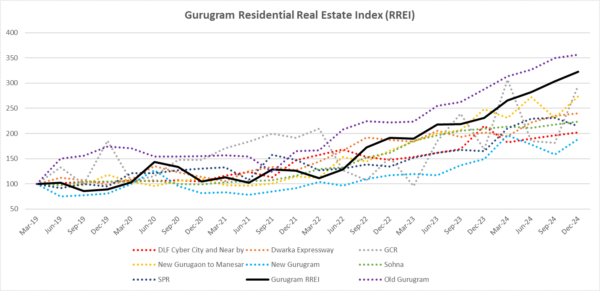
The Gurugram RREI tracks real-world housing price trends by using large-scale transaction data. By analysing new launches, absorption rates, and price changes, the Gurugram RREI captures real-time shifts in buyer sentiment and supply-demand balance. The index also reveals the macro- and micro-markets that are appreciating faster than others, providing clues potential hot spots for real estate investments
Historically, Gurugram was a quiet agricultural region adjacent to Delhi’s southwestern border. Its transformation began in the 1990s when India’s liberalised economy attracted multinational corporations (MNCs) seeking to establish operations near the national capital. Over time, the city’s favorable land policies, relatively low property costs as compared to central Delhi, and proximity to Indira Gandhi International Airport spurred large-scale corporate office projects and commercial developments.
Gurugram’s strategic advantage lies in its location. Situated less than 30 kilometers from central Delhi, it enjoys direct connectivity to the capital via highways such as National Highway 48, earlier known as NH-8 and the Delhi Metro’s Yellow Line. This accessibility has enabled the city to become a crucial part of the National Capital Region (NCR), offering abundant job opportunities in IT, finance, hospitality, and consulting.
The Haryana state government, under which Gurugram falls, has historically adopted a pro-business stance. Cities like Gurugram impose fewer layers of bureaucracy and lower costs for developers. Consequently, real estate developers have found Gurugram comparatively easier to navigate in terms of approvals, leading to a proliferation of large-scale projects and integrated townships.
Source: CRE Matrix, 1 Finance Research
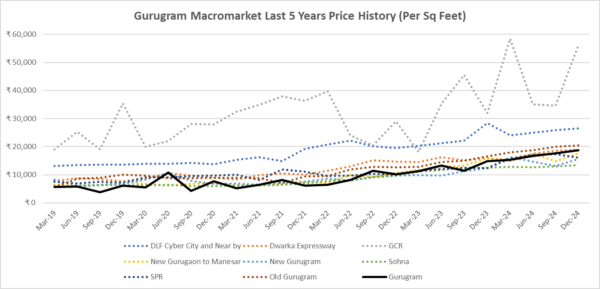
Gurugram displays some of the highest PSF rates among top Indian cities. For instance:
One of the distinguishing features of Gurugram’s market is the higher pricing in certain upscale enclaves, driven by two main factors:
In contrast to some metros where the average apartment size is shrinking, Gurugram has witnessed robust traction for 3 BHK or larger configurations. In the past four quarters, launches in these bigger unit categories outpaced smaller flats, reflecting a trend toward spacious living likely in response to post-pandemic remote work needs and an overall preference for bigger layouts among affluent buyers.
1. Dwarka Expressway
Arguably the most significant infrastructure development for Gurugram, the Dwarka Expressway, also known as the Northern Peripheral Road connects Dwarka in Delhi to various new sectors in Gurugram. Its planned eight-lane design, near-completion status, and adjacency to the Indira Gandhi International Airport have turned it into a real estate corridor with significant appreciation potential. Developers have launched numerous residential and mixed-use projects along this stretch, anticipating future demand from people seeking quick access to Delhi without high Delhi property prices.
2. Rapid Metro & Delhi Metro Extensions
3. Expressways & Arterial Roads
Besides Dwarka Expressway, Gurugram benefits from:
Returns mentioned in the above table are CAGR returns over the mentioned period
Source: CRE Matrix, 1 Finance Research
Though established sectors near DLF Cyber City or Golf Course Road remain prime, Gurugram’s real estate growth is far from static. A few micromarkets stand out:
High-End vs. Mid-Range
Preference for 3 BHK and Larger
In Gurugram, the average homebuyer often leans toward bigger units, aligned with the city’s relatively higher disposable income segments. This stands in contrast to some other metros, where 2 BHK or even 1 BHK usually dominates.
1. Corporate & Commercial Hub
2. Luxury Launches & Execution Timelines
Gurugram has seen a spate of luxury launches in the last few quarters, particularly in 3 BHK or bigger units. Additionally, construction execution has reportedly improved in recent years – older projects launched before 2022 faced an average delay of up to 20 months, but those launched in 2022 or later have been finishing closer to schedule. Some projects even run ahead of schedule by 10–40 months, a major confidence booster for both domestic and NRI investors.
3. Infrastructure-First Development Model
The city’s planning approach typically involves establishing robust arterial routes and then allowing residential and commercial clusters to develop around them. While challenges in zoning, water supply, and urban sprawl persist, planned expansions like the proposed connectivity to the Delhi-Mumbai Expressway could further augment Gurugram’s attractiveness.
4. Shift in User Preferences
Post-pandemic, many professionals want homes with better ventilation, space for home offices, and community amenities. Gurugram’s township projects frequently cater to these needs with on-site gyms, co-working lounges, and open green spaces with features that align well with the city’s weather, lifestyle aspirations, and large expat/urban professional population.
Also read
Gurugram’s evolution into a world-class real estate market reflects the broader economic transformations reshaping India. Anchored by a thriving corporate ecosystem, robust infrastructure developments, and an increasingly discerning buyer base, this city has carved out a unique identity distinct from Delhi. While key pockets like Golf Course Road, Cyber City, and Dwarka Expressway garner much of the attention (and high prices), emerging locales in New Gurugram and along NH-8 are rapidly becoming focal points for both end-users and investors.
Looking ahead, infrastructure remains the linchpin. The near-completion of Dwarka Expressway, expansions of the Metro, and ongoing enhancements to roads like SPR and NH-8 are set to ease commuting, open new growth corridors, and further cement Gurugram’s status as a prime real estate destination. As the city continues to refine its identity by shaping new communities and forging new transit lines, its real estate market, buoyed by high demand and brand-driven supply, seems poised for sustained growth well into the foreseeable future.

The views in the article /blog are personal and that of the author. The idea is to create awareness and not intended to provide any product recommendations.


Identify the personality traits and behavioural patterns that shape your financial choices.

Learn how REITs opened real estate investing to all
If you have bought a property from an NRI, or even just thought about it, you probabl...
Know the risks and rewards of investing in Embassy REIT before you decide.