

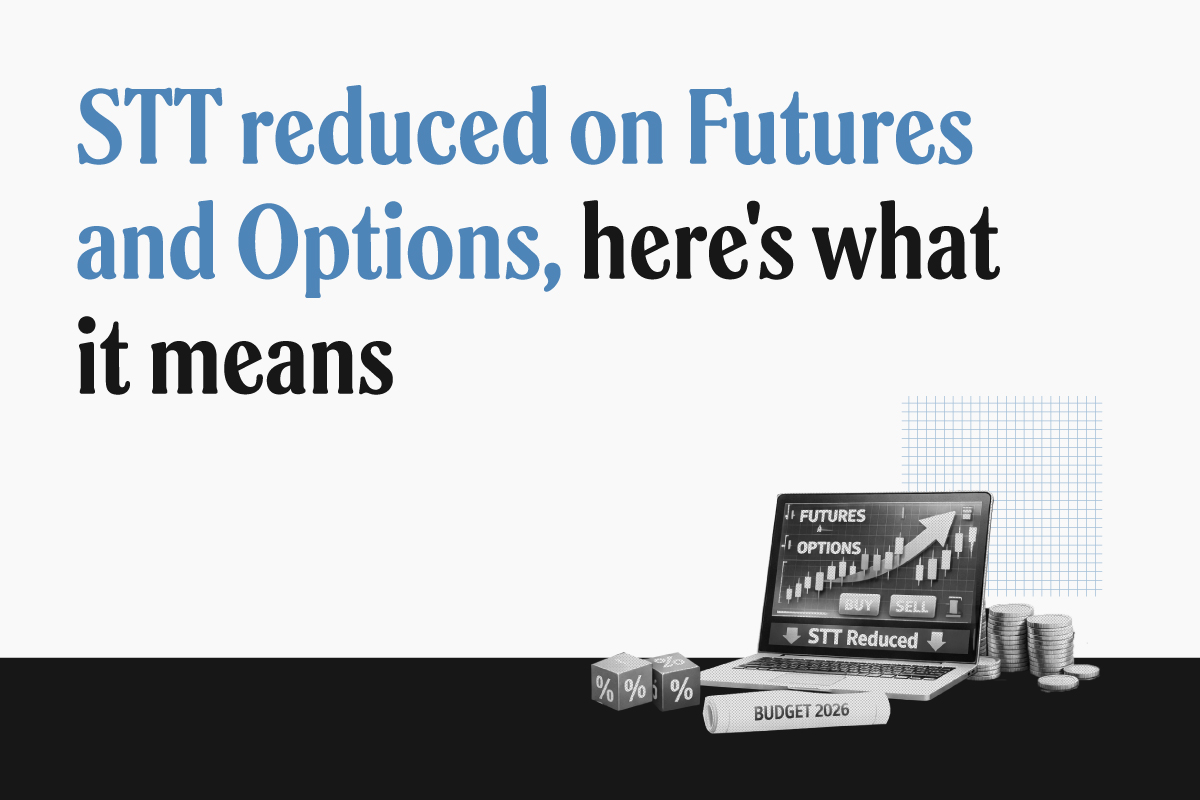





To tighten speculative trading in the derivatives market, Finance Minister Nirmala Sitharaman announced a significant hike in Securities Transaction Tax (STT) on futures and options trading in Budget 2026, presented on February 1, 2026. The move caught many in markets by surprise—and triggered sharp selloffs in broking stocks. Read on to find out how it will impact investors.
What is Securities Transaction Tax (STT)?
Securities Transaction Tax (STT) is a direct tax charged by the Government on buying or selling securities (stocks, derivatives, mutual funds) on recognised stock exchanges like NSE and BSE.
In simple terms STT is a transaction fee/tax you pay to the government every time you trade stocks or derivatives—even if you make a loss.
Hike in STT on futures in Budget 2026
Budget 2026 increased the futures STT from 0.02% to 0.05%. To understand its real-world impact, consider this calculation:
Example: A ₹10 lakh futures contract
- Old STT cost (0.02%): ₹200
- New STT cost (0.05%): ₹500
- Additional cost per contract: ₹300 (150% increase)
A trader executing 10 contracts per day would now pay an additional ₹3,000 in STT daily—or roughly ₹75,000 per month (assuming 25 trading days).
Hike in STT on options in Budget 2026
Options traders face a smaller but still significant increase
STT on options premium increased from 0.10% to 0.15%.
STT on options exercise hiked from 0.125% to 0.15%.
Example: An option premium of ₹10 lakh
- Old STT cost (0.1%): ₹1,000
- New STT cost (0.15%): ₹1,500
- Additional cost per transaction: ₹500 (50% increase)
If you exercise the option too:
Exercise value: ₹10,00,000
Old exercise STT: ₹1,250 (0.125%)
New exercise STT: ₹1,500 (0.15%)
Extra cost: ₹250
While the percentage increase is lower than futures, it still represents meaningful additional friction.
In just 16 months, futures STT has increased four times (from 0.0125% to 0.05%), while options STT has doubled and a half (from 0.0625% to 0.15%).
A table to understand STT hike in Budget 2026
| Derivative Type | Previous Rate | New Rate (Feb 1, 2026) | Increase |
| Equity Futures | 0.02% | 0.05% | +150% |
| Equity Options | 0.1% | 0.15% | +50% |
| Equity Delivery | 0.1% | 0.1% | No change |
| Intraday Equity | 0.025% | 0.025% | No change |
No alterations were made to STT rates on equity delivery or intraday trades, preserving incentives for long-term investing.
Why Budget 2026 hiked STT of futures and options?
Explaining the rationale behind a hike in STT, CA Parag Jain, Tax Head, 1 Finance explained, ”Recently government observed F&O hype & surge in trading volumes in this segment despite over 90% of retail traders incurring losses, as a risk to financial stability of retail individuals. Officials aim to channelise retail investors toward the cash market. Rising the STT could shrink volumes and revenue, but the measure proceeds to promote prudent trading.”
Officials aim to channelise retail investors toward the cash market
– CA Parag Jain, Tax Head
Who will be affected by STT hike for futures and options?
1. Retail options traders
Retail traders executing short-term options strategies—straddles, spreads, iron condors—will have to pay 50% more tax on every trade. Options are already expensive (due to time decay and premiums), and the 50% STT increase will reduce their profits further.
Impact: Options traders will likely reduce frequency and position sizes.
2. High-frequency traders (HFTs)
Algorithmic and high-frequency traders, who generate profits through tight spreads and high turnover, face a lot of pressure. Their business model depends on very low marginal costs per trade. A 150% increase in STT makes many previously profitable strategies unprofitable.
Impact: HFT firms will reduce activity significantly or exit the Indian market.
3. Brokers and market infrastructure firms
For brokers, higher STT means:
- Lower trading volumes (fewer transactions = lower fees)
- Compressed commission margins (if they pass some cost to clients)
- Reduced options/futures revenue (their highest-margin business)
Impact: Broking firms will may see earnings pressure, as evidenced by the stock price decline announced today.
This move is aimed at keeping investors away from F&O trading and eventually losing their hard-earned money. Deepak Shenoy, CEO, Capitalmind Asset Management said, “The biggest players in futures are arbitrage funds. Your arbitrage fund returns will fall by about 0.5% next year due to this increased STT.”
Passive long-term investors in equities are barely affected. Since they rarely trade, STT is negligible. A buy-and-hold investor incurs STT only twice (at purchase and eventual sale), minimizing cumulative impact.
How did the market react after the STT hike?
The announcement immediately triggered a selloff in capital market infrastructure stocks. Stock exchanges and broking firms saw a sharp fall.
Broking firms derive revenue directly from trading volumes and transaction fees. Higher transaction taxes reduce retail participation and dampen short-term trading activity—the highest-margin business for brokers.
STT hike on futures and options in budget 2026: When will it come into effect?
Jain added, “Since the Budget was presented on February 1 2026, and there’s no separate retrospective clause reported, the STT hike is expected to be effective from April 1, 2026.”
Conclusion
The Budget 2026 tax increase—futures from 0.02% to 0.05% and options from 0.1% to 0.15%—is the biggest jump in 20 years on these trades.
Why did they do it? STT is a “behavior tax” meant to stop too much gambling and day trading. The government’s message is clear. They don’t want small investors to gamble their money on futures and options trading and lose their investments.
This matches SEBI’s worries about regular people trading risky derivatives with borrowed money, which could cause big problems if many lose at once.