

Comprehensive Guide to Exchange-Traded Funds (ETFs): What You Need to Know
Mutual Fund
Sep 20, 2024
Plan Your Retirement with Our Qualified Financial Advisors

Your first financial plan is free
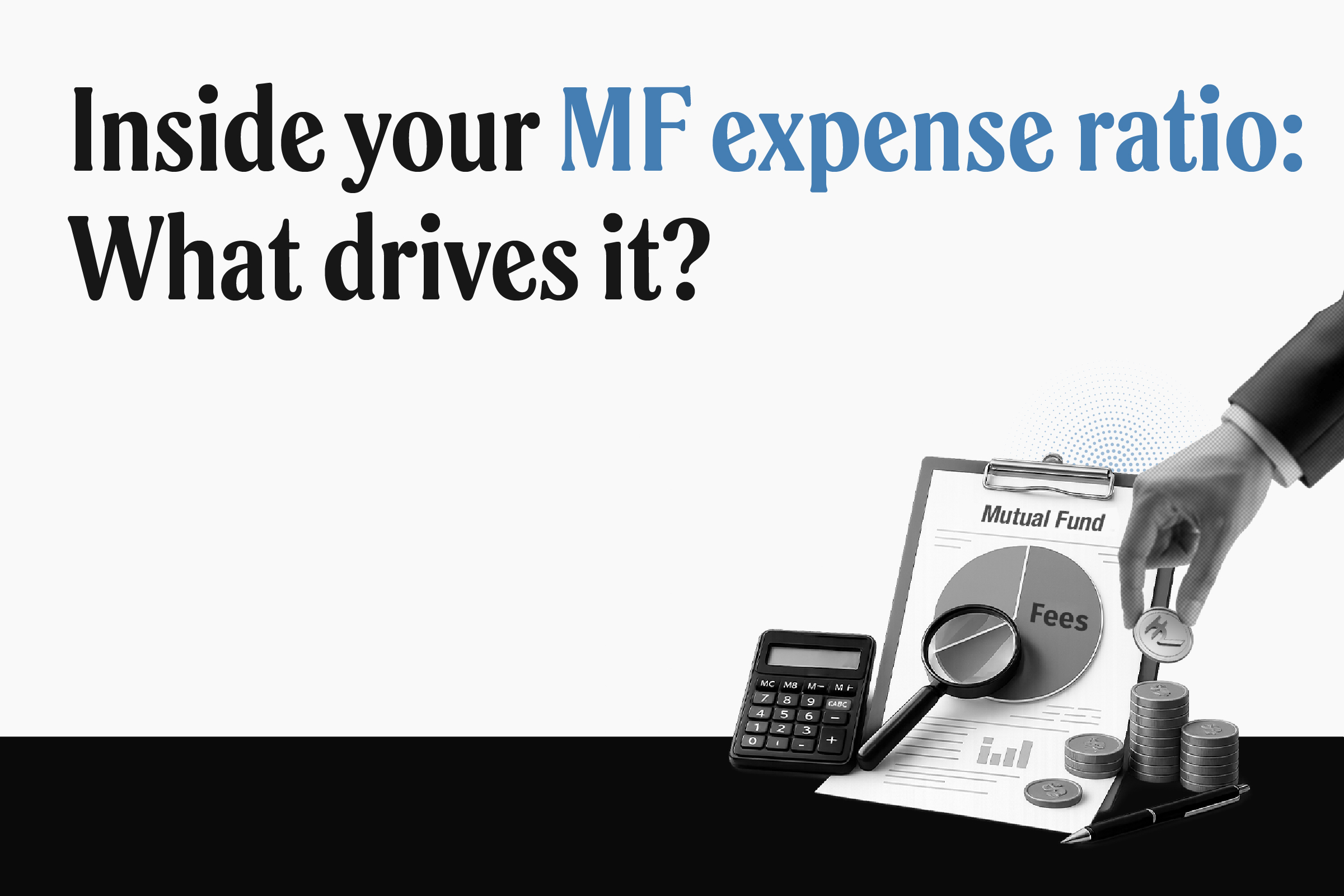
The mutual fund expense ratio is the easiest number on a fund’s page to read past. It sits as a modest decimal between 0.05% and 2%, far less eye-catching than the returns chart printed right above it. Most investors notice it, judge it too small to argue with, and move on. Over the years, this unexamined number impacts your final corpus more than you can imagine.
The mutual fund expense ratio is simply the annual fee a fund house charges to manage your money, set as a percentage of the assets it holds for you. That much most investors already know, except how this figure is calculated and what components it contains. Particularly, what SEBI’s 2026 unbundling rules entails now.
A fund house deducts the charge before the figures ever reach your screen, which is part of why it stays so easy to forget. The fund divides its annual percentage across the 365 days of the year and deducts a tiny portion from the scheme’s assets on every trading day. For a fund charging 1.5%, that portion works out to roughly 0.004% of the assets.
The fund values its portfolio at market prices, subtracts expenses and other liabilities, and divides what remains by the number of outstanding units. Hence, the scheme’s NAV you see is therefore measured after considering all costs.
No fund house sets the mutual fund expense ratio in open air. SEBI caps how much a scheme can charge for managing your money, termed as a total expense ratio (TER).
Until April 2026, every fund reported a single Total Expense Ratio (TER), which bundled the fund house’s management charge, along with brokerage, taxes, and statutory levies. SEBI’s (Mutual Funds) Regulations, 2026, in force from 1 April 2026, unbundled that figure.
The fund house’s own charge was pulled apart from the trading costs and levies once reported alongside it, and that charge now carries its own name, Base Expense Ratio (BER).
The BER captures everything it spends to manage, administer, and distribute the fund. SEBI caps the BER, and the ceiling it sets depends on the type of scheme.
Maximum Base Expense Ratio (BER) permitted
| Scheme type | Scheme category | Maximum Base Expense ratio (as % of the daily net assets) |
|---|---|---|
| Close-ended schemes | Equity-oriented funds | 1% |
| Close-ended schemes | Other than equity-oriented schemes | 0.8% |
| Open-ended schemes | Index funds or ETFs | 0.9% |
| Open-ended schemes | Fund of Funds (investing in liquid schemes, index fund scheme and exchange traded funds) | 0.9% |
| Open-ended schemes | Fund of Funds (investing at least 65% in equity-oriented funds) | 2.1% |
| Open-ended schemes | Fund of Funds (investing in schemes other than the ones mentioned above) | 1.85% |
Scroll right to view full table →
Now, why did SEBI reform this rule? The old total expense ratio in mutual funds made it impossible to separate ‘what the fund charged for skill’ from ‘what it simply paid in brokerage and government taxes’.
Take two equity funds with identical management costs of 0.95%. One holds its positions for years, while the other churns its portfolio aggressively, with each trade triggering brokerage fees and the Securities Transaction Tax (STT) at 0.1% on both the buy and the sell side of every equity transaction. Under the bundled TER, the second fund reported a noticeably higher expense ratio purely because of its trading style, unable to tell investors whether they were paying for management skill or for the manager’s restlessness. These unbundling rules change how you should compare mutual funds now.
SEBI drew the boundary in its 2026 circular, stating that fund houses can no longer route miscellaneous costs, other than BER, brokerage cost, and statutory levies into the mutual fund expense ratio you pay.
The BER and these separate items, added together, make up the total expense ratio you pay now.
The total expense ratio in mutual funds: New 3-part structure
| Component | What it includes |
|---|---|
| Base expense ratio (BER) | Management fees, operating costs, distribution commission (in regular plans) |
| Brokerage and transaction costs | Pure brokerage commission paid to brokers on the fund’s trades |
| Statutory and regulatory levies | STT, CTT, stamp duty, GST on management fee, GST on brokerage, SEBI fees, exchange charges, clearing corporation fees |
Scroll right to view full table →
The first is the management fee. It pays the fund manager and the analysts behind them for the actual work of investing, choosing securities, and rebalancing the portfolio as per market conditions. This is the part of the fee that buys you an expert judgement, which is why it sits at the top of the list.
Next are the administrative and operational expenses, which keeps a fund running. A custodian safekeeps the securities, a registrar maintains the record of who owns what, and auditors, lawyers, technology, and compliance staff each take their share. No single item here is large, but together they are large enough to matter.
The third component is distribution, and it’s the one you can most directly avoid. Buy a fund through an intermediary, and the fund house pays that intermediary a commission folded into the regular plan’s expense ratio. The direct plan of the same scheme pays no such commission, which is the entire reason its TER reads lower.
Compounding turns this difference into a massive drag on your final corpus over the long run. Let’s see how.
Picture two investors, each one putting ₹20,000 into a monthly SIP for 20 years, ₹48 lakh of their own money committed in even instalments, with the money growing at an assumed gross return of 10%.
The only thing separating these two investors is the expense ratio of the fund each one picked: 0.5% for a direct plan; 1.5% for a regular plan.
Monthly SIP of ₹20,000 for 20 years at 10% gross return (₹48 lakh invested)
| Expense ratio | Net annual return | Corpus after 20 years |
|---|---|---|
| None before any fee | 10% | ~₹1.53 crore |
| 0.5% | 9.5% | ~₹1.44 crore |
| 1.5% | 8.5% | ~₹1.26 crore |
Scroll right to view full table →
Both investors committed the identical ₹48 lakh and earned 10% gross return, with a final corpus difference of about ~₹18.98 lakh. In the language of goals, the same sum is several years of your retirement spending, or a sizable share of your child’s education, surrendered to a mutual fund expense ratio that looked too small to examine.
Check out: Run your SIP corpus through our SIP calculator
An active fund is built to outperform its benchmark. That ambition needs people, a research desk reading companies continuously, and a manager adjusting the portfolio as their reading changes. The cost of running this team, along with the brokerage and STT that come from higher portfolio turnover, surfaces as a higher expense ratio.
Passive investing operates differently. An index fund tracks a benchmark like the Nifty 50, holding the same stocks in the same proportions and giving up any attempt to outguess the market. An exchange-traded fund (ETF) is a similar passive instrument, which trades on the stock exchange in real time, rather than being bought from the AMC at end-of-day NAV. Both need far less research, that’s why they cost a fraction of what active funds charge.
In India, direct-plan index funds and ETFs typically run between 0.05% and 0.3%, while actively managed equity funds in their direct plans usually sit between 0.5% and 1%. Even the small difference in TER reflects what active management actually consumes, the salaries of analysts and managers, the cost of continuous research, and the trading expenses that come with rebalancing the portfolio through the year.
The fixed costs of running a scheme don’t scale with assets. The custodian, the registrar, the auditors, the technology stack, and the compliance team cost roughly the same to maintain whether the fund manages ₹500 crore or ₹50,000 crore.
When that same set of bills is spread across a much larger asset base, the share resting on each rupee you have invested shrinks. SEBI’s 2026 slabs codify this logic into mandatory caps, with the maximum BER stepping lower each time a scheme crosses an AUM threshold.
Maximum TER permitted by SEBI, by scheme size
| Assets under management (% of the daily net assets) | BER limits for equity-oriented schemes | BER limits for non-equity oriented schemes |
|---|---|---|
| First ₹500 crore | 2.10% | 1.85% |
| Next ₹250 crore | 1.90% | 1.65% |
| Next ₹1,250 crore | 1.60% | 1.40% |
| Next ₹3,000 crore | 1.50% | 1.25% |
| Next ₹5,000 crore | 1.40% | 1.15% |
| Next ₹40,000 crore | Drops 0.05% for every ₹5,000 crore addition | Drops 0.05% for every ₹5,000 crore addition |
| On balance of the assets | 0.95% | 0.70% |
Scroll right to view full table →
Set against returns, mutual fund expense ratios can look like the dull part of a fund decision. But it’s the only settled fact, the only certainty applied for as long as you hold the fund. That’s why it deserves your attention.
A higher expense ratio isn’t, on its own, evidence of a worse fund. In certain corners of the market, a genuinely skilled active manager earns the larger fee back through returns that beat the benchmark after costs. But whether that extra performance, measured over a fair stretch of time, justifies that cost, is the honest question you should be thinking about.
So weigh mutual fund expense ratios in a wider judgement along with other factors, like long-term returns, the manager’s performance, and the portfolio evaluation. Before you invest in any scheme, weigh its expense ratio against category peers, and ensure the fee is justified by consistent performance. Our Mutual Fund Scoring and Ranking model simplifies this check by evaluating funds holistically.
If this still feels overwhelming, consult a Qualified Financial Advisor (QFA) for help. They handle the calculations, spot hidden fees, and ensure you only pay for funds that deliver real value. That too at zero commission, providing you with a personalised financial plan.

The views in the article /blog are personal and that of the author. The idea is to create awareness and not intended to provide any product recommendations.


Plan Your Retirement with Our Qualified Financial Advisors
Your first financial plan is free