

ITR in FY 2025-26: When will your ITR be picked for compulsory scrutiny? Check the Income Tax Department’s new guidelines
By Anulekha Ray
ITR Filing
Jul 3, 2025
Plan Your Retirement with Our Qualified Financial Advisors

Your first financial plan is free
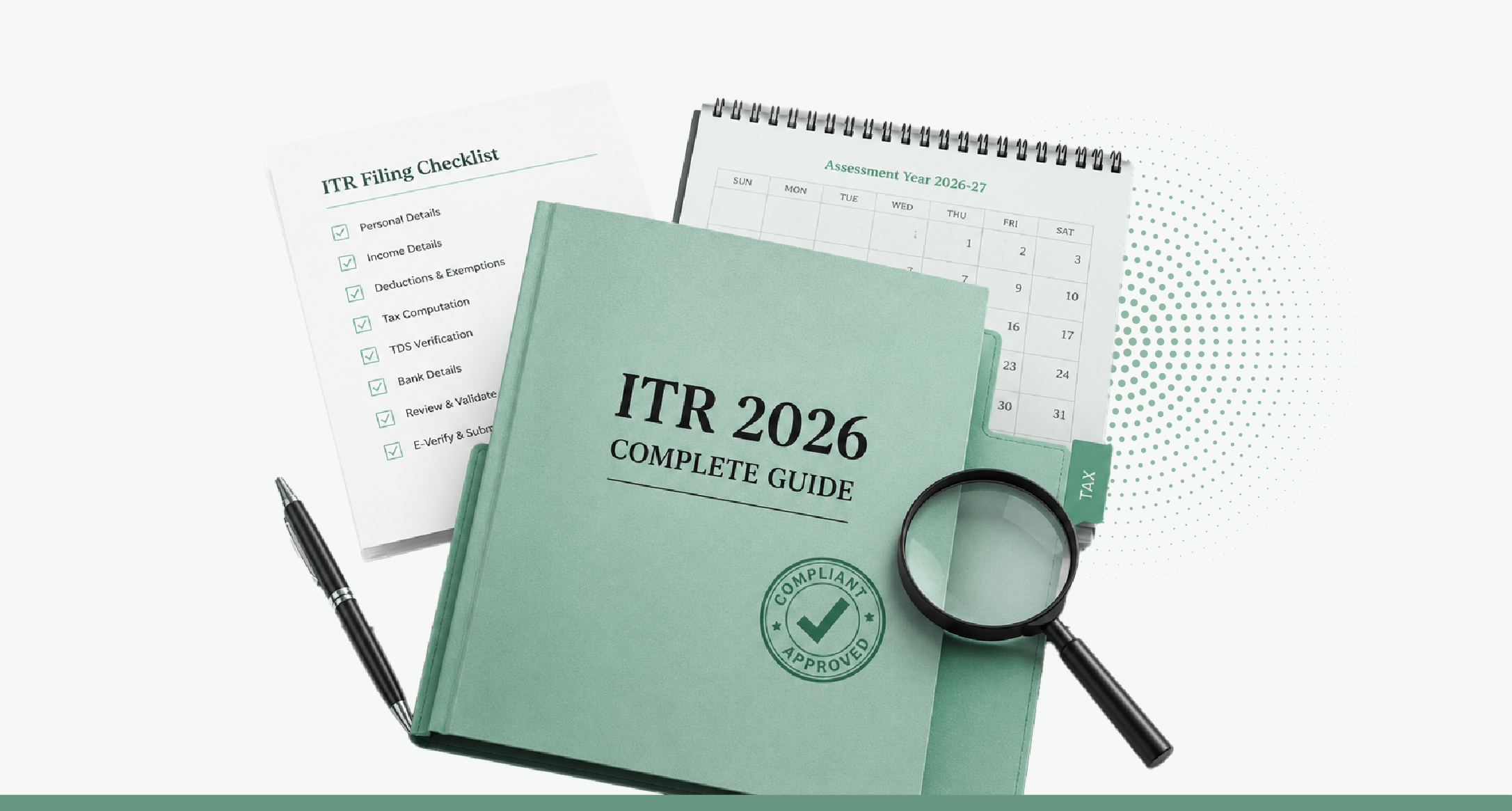
Tax season is back, and 2026 brings real changes: filing deadlines that now depend on your form, a rebate that makes income up to ₹12 lakh tax-free, and a new Income Tax Act on the horizon. This guide explains it all in plain language — who needs to file, which form and regime to pick, and how to file your return for FY 2025-26 (AY 2026-27), step by step.
An Income Tax Return is the form you submit to the Income Tax Department declaring how much you earned in the year, what deductions you are claiming, how much tax was already paid on your behalf (through TDS, advance tax, or self-assessment tax), and whether you still owe tax or are owed a refund.
You are generally required to file if any of these apply:
→ Your gross total income (before deductions) crosses the basic exemption limit, ₹4 lakh under the new regime, or ₹2.5 lakh under the old regime (₹3 lakh for those aged 60–80, ₹5 lakh for those above 80).
→ You want a refund of excess TDS deducted (for example, by your bank or employer), even if your income is below the limit, you must file to get the money back.
→ You meet certain high-value transaction triggers, such as depositing large sums in bank accounts, spending heavily on foreign travel, paying high electricity bills, or holding foreign assets or income.
→ You have capital gains, business or professional income, or income from more than one source.
Even when filing is not strictly mandatory, doing it has real upside: it builds a documented financial history that helps with loan and visa applications, lets you carry forward losses to offset future gains, and keeps you on the right side of the law.
Before anything else, you choose between two ways of being taxed. This single choice usually has a bigger effect on your taxes than any other decision you make while filing, so it is worth understanding properly.
The new tax regime is now the default. If you do nothing, you are taxed under it. It offers lower slab rates but strips away most popular deductions and exemptions, no Section 80C, no 80D, no HRA, no home-loan interest under Section 24(b). The old regime keeps all those deductions but charges higher rates.
| Income slab | Tax rate |
| Up to ₹4,00,000 | Nil |
| ₹4,00,001 – ₹8,00,000 | 5% |
| ₹8,00,001 – ₹12,00,000 | 10% |
| ₹12,00,001 – ₹16,00,000 | 15% |
| ₹16,00,001 – ₹20,00,000 | 20% |
| ₹20,00,001 – ₹24,00,000 | 25% |
| Above ₹24,00,000 | 30% |
The headline benefit, introduced in Budget 2025 and continued in Budget 2026, is the enhanced Section 87A rebate: a rebate of up to ₹60,000, which fully wipes out the tax for resident individuals with taxable income up to ₹12 lakh. In other words, if your taxable income is ₹12 lakh or below under the new regime, your tax works out to zero.
For salaried taxpayers and pensioners, there is a standard deduction of ₹75,000 on top. That pushes the effective tax-free salary up to ₹12.75 lakh under the new regime.
One important thing that many people miss: the ₹12 lakh rebate applies only to normal income. Special-rate income such as capital gains (for example, profits from selling shares or mutual funds) is taxed separately at its own rates and is not covered by the rebate. So if part of your income is capital gains, you can still owe tax on that slice even if your total is around ₹12 lakh.
| Income slab | Tax rate |
| Up to ₹2,50,000 | Nil |
| ₹2,50,001 – ₹5,00,000 | 5% |
| ₹5,00,001 – ₹10,00,000 | 20% |
| Above ₹10,00,000 | 30% |
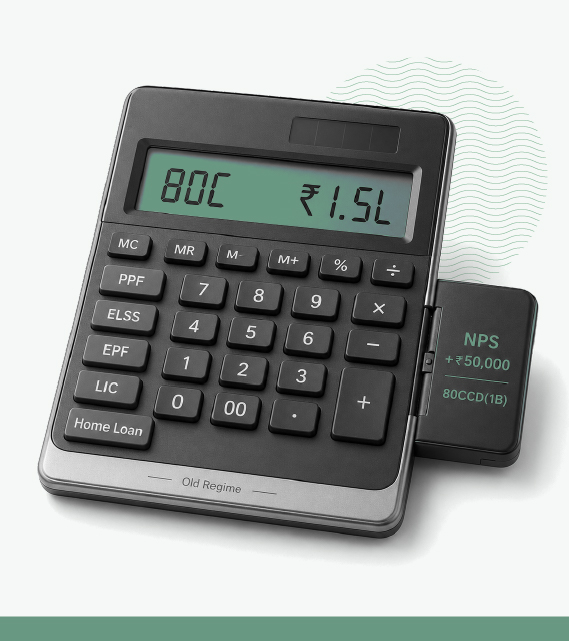
Under the old regime, the Section 87A rebate is smaller, up to ₹12,500, covering taxable income up to ₹5 lakh, and the standard deduction for the salaried is ₹50,000. But this regime lets you claim the full range of deductions: 80C investments, 80D health insurance, HRA, home-loan interest, NPS, and more.
On top of the tax computed under either regime, everyone pays a 4% Health and Education Cess, and high earners pay an additional surcharge once income crosses certain thresholds.
The answer depends entirely on how many deductions you actually claim. As a rough rule of thumb, the more you genuinely invest and spend on deduction-eligible items (rent, home loan, insurance, 80C instruments), the more the old regime can work in your favour; if you claim few deductions, the new regime’s lower rates usually win. Run both calculations before deciding. You can use 1 Finance old vs. new tax calculator which will help you decide the suitable regime.
A practical warning: if you want the old regime, you generally must say so by filing your return on time. If you miss the deadline and file a belated return, you can be locked into the new regime by default, losing access to those deductions. That alone is a good reason not to file late.
The Income Tax Department released all ITR forms (ITR-1 to ITR-7) on 30 March 2026, which means the filing window for AY 2026-27 is now open.
Choosing the correct ITR form is important. If you file using the wrong form, your return may be treated as defective and you may have to correct and re-submit it.
Here’s a quick guide to help you choose:
→ ITR-1 (Sahaj): For resident individuals with total income of up to ₹50 lakh from salary or pension, one or more house properties, and other sources such as interest income. A major change this year is that you can now report income from up to two house properties in ITR-1. Earlier, owning more than one house meant you had to file ITR-2.
→ ITR-2: For individuals and Hindu Undivided Families (HUFs) who have capital gains, more than two house properties, foreign income or assets, or total income above ₹50 lakh, but no business or professional income.
→ ITR-3: For individuals and HUFs earning income from a business or profession where maintaining books of accounts is required.
→ ITR-4 (Sugam): For small businesses and professionals who opt for the presumptive taxation scheme under Sections 44AD, 44ADA, or 44AE. Under this scheme, income is calculated as a fixed percentage of turnover, reducing the need for detailed accounting records.
→ ITR-5, ITR-6, and ITR-7: These forms are meant for firms, LLPs, companies, and trusts, depending on their type and tax status.
Having these documents ready beforehand will help you file your return accurately and avoid last-minute hassles.
The complete process is explained in our detailed filing guide, but here’s a simple overview of the steps:
You can e-verify your return instantly through any of the following methods:
If you are unable to e-verify online, you can send a signed ITR-V form by post to the Centralised Processing Centre (CPC) in Bengaluru. However, online verification is quicker, easier, and generally recommended.
This year brings an important change to the ITR filing process. Instead of a single deadline for most taxpayers, due dates are now based on the type of return being filed. Make sure you know which deadline applies to you.
| Taxpayer category | Due date |
| Salaried individuals, pensioners, and investors filing ITR-1 or ITR-2 (non-audit cases) | 31 July 2026 |
| Businesses and professionals filing ITR-3 or ITR-4 (non-audit cases) | 31 August 2026 |
| Taxpayers whose accounts require a tax audit | 31 October 2026 |
| Taxpayers with transfer pricing requirements (international or specified domestic transactions) | 30 November 2026 |
| Belated return (filed after the original due date) | 31 December 2026 |
| Revised return (to correct mistakes in a filed return) | 31 March 2027 |
| Updated return (ITR-U) for reporting missed income | 31 March 2031 |
The biggest change for individual taxpayers is that salaried individuals filing ITR-1 or ITR-2 continue to have the familiar 31 July 2026 deadline. However, businesses and professionals filing ITR-3 or ITR-4 now get an additional month and can file their returns until 31 August 2026. This extra time is intended to help with closing books of accounts and completing reconciliations.
The time limit for filing a revised return has also been extended. If you discover an error after filing your return, you can now submit a revised return up to 31 March 2027, instead of the earlier deadline of 31 December.
If you have missed reporting income from a previous year, you can use the updated return (ITR-U) facility. For income relating to FY 2025–26, an updated return can be filed up to 31 March 2031, giving taxpayers up to four years from the end of the assessment year to correct omissions.
These are the currently announced deadlines. Since the Income Tax Department has extended filing deadlines in some previous years due to system or form-related delays, it is advisable to check the e-filing portal for any updates as the due dates approach.
Missing the ITR filing deadline is not the end of the road, but it can lead to additional costs and other consequences. Here’s what you need to know:
If you miss the original deadline, you should still file a belated return before 31 December 2026. Filing late is usually far better than not filing at all.
If you have paid more tax than required, the excess amount will be refunded directly to your pre-validated bank account after your return is processed and verified. Refunds are often issued within a few weeks, although processing times can vary.
You can track your refund status through the income tax portal. If there is a delay, common reasons include bank account validation issues, mismatches in tax records, or pending verification.
If you discover an error after filing your return, you can submit a revised return to correct the mistake. For AY 2026–27, a revised return can be filed up to 31 March 2027. The revised return replaces the original return and becomes the valid version on record.
Many taxpayers focus on reducing their tax bill at the last minute by purchasing tax-saving products or making hurried investments. However, effective tax planning is about making sound financial decisions first and enjoying the tax benefits that come with them.
A tax deduction is valuable when the underlying financial decision makes sense for your goals. For example, buying adequate term insurance, contributing to your provident fund, or taking a home loan for a property you genuinely want can provide both financial benefits and tax savings.
On the other hand, investing in products you do not need simply to claim a deduction can lead to poor returns, unnecessary expenses, or money being locked away for years. The tax saved may not justify the cost.
Instead of chasing deductions, focus on choosing the tax regime, investments, and financial products that align with your long-term goals. Tax efficiency should be the outcome of good financial planning—not the sole objective. That approach will serve you much better not just during tax season, but throughout your financial life.
You may have heard that the Income Tax Act, 2025 has replaced the old income tax law. While that is true, it does not affect the return you are filing this year.
The return you are filing now relates to income earned during FY 2025–26 (1 April 2025 to 31 March 2026). This income is governed entirely by the Income Tax Act, 1961, and all the rules, tax provisions, and filing requirements in this guide are based on that law.
The Income Tax Act, 2025 comes into effect from 1 April 2026 and will apply to income earned from that date onward, that is, income from FY 2026–27. Returns for that financial year will be filed in 2027 under the new law.
In simple terms:
This means that concepts introduced under the new law, including the new “Tax Year” terminology and any new forms or procedures, are relevant only from next year onward.
It is a point that often confuses taxpayers, so remember this simple rule: the return you are filing now follows the old Income Tax Act, 1961; the new Income Tax Act, 2025 applies from next year.
What is ITR filing?
ITR filing is the process of submitting your Income Tax Return to the Income Tax Department — declaring your income for the financial year, the deductions you are claiming, and the tax already paid on your behalf. It tells the government whether you still owe tax or are due a refund. For income earned in FY 2025-26, you file in AY 2026-27.
What is ITR-1, ITR-2, ITR-3, or ITR-4?
These are different return forms for different taxpayers. ITR-1 (Sahaj) is for salaried individuals with income up to ₹50 lakh and up to two house properties; ITR-2 is for those with capital gains, more than two properties, or foreign income but no business income; ITR-3 is for business and professional income; and ITR-4 (Sugam) is for small businesses and professionals under the presumptive taxation scheme.
Who can file ITR-1?
Resident individuals with total income up to ₹50 lakh from salary or pension, income from up to two house properties, and other sources such as interest. You cannot use ITR-1 if you have business income, more than two house properties, foreign income or assets, or are a company director.
How do I file ITR myself online?
You can file it yourself, for free, on incometax.gov.in — no agent needed. Log in with your PAN, select AY 2026-27 and your ITR form, check the pre-filled income and TDS details against your Form 16 and AIS, choose your tax regime, pay any balance tax, submit, and e-verify within 30 days. Our step-by-step filing guide walks through every screen.
What is the last date for ITR filing 2026?
For AY 2026-27, the due dates are 31 July 2026 for salaried filers (ITR-1/ITR-2), 31 August 2026 for non-audit business and professional filers (ITR-3/ITR-4), 31 October 2026 for audit cases, and 30 November 2026 for transfer pricing cases.
Is the ITR filing date extended for AY 2026-27?
As things stand, the due dates are 31 July 2026 for salaried filers (ITR-1/ITR-2) and 31 August 2026 for non-audit business and professional filers (ITR-3/ITR-4). The department has granted extensions in some past years when forms or the portal were delayed, so check incometax.gov.in close to the deadline for any official extension before assuming you have extra time.
Is it mandatory to file ITR?
It is mandatory if your gross total income exceeds the basic exemption limit (₹4 lakh under the new regime, ₹2.5 lakh under the old). It is also mandatory regardless of income if you meet certain triggers — such as large bank deposits, high foreign-travel spends, high electricity bills, or holding foreign assets or income. Even when not mandatory, you should file to claim a refund of any TDS deducted.
Can we change the tax regime while filing ITR?
If you are salaried with no business income, yes — you can choose your regime afresh each year while filing the return. If you have income from a business or profession, the choice is restricted: once you opt out of the new regime you generally cannot keep switching back and forth freely.
Can I file ITR for the last 3 years now?
Yes — through an Updated Return (ITR-U). For AY 2026-27 you can file an ITR-U up to four years from the end of the assessment year, that is up to 31 March 2031, to report income you missed in earlier years. Additional tax applies, and an ITR-U cannot be used to claim a refund or to report a loss.
Can I file a revised return after my ITR has been processed?
Yes. As long as you are within the revised-return window — up to 31 March 2027 for AY 2026-27 — you can file a revised return even after your original has been processed, to correct any error or omission. The revised return simply replaces the original.
How do I download my filed ITR?
Log in to incometax.gov.in and go to e-File → Income Tax Returns → View Filed Returns. From there you can download your filed return and its acknowledgement (ITR-V) for any year as a PDF.
What happens if I don’t file ITR?
You may face a late-filing fee under Section 234F (₹1,000 if your income is up to ₹5 lakh, ₹5,000 above that) and 1% monthly interest under Section 234A on any unpaid tax. You also lose the right to carry forward losses and can be locked into the new regime. Persistent non-filing despite having taxable income can lead to notices and, in serious cases, prosecution.
How do I check my ITR filing status?
Log in to incometax.gov.in and go to e-File → Income Tax Returns → View Filed Returns. You will see whether your return is submitted, verified, under processing, or completed. Refund status appears in the same place once processing begin

The views in the article /blog are personal and that of the author. The idea is to create awareness and not intended to provide any product recommendations.


Plan Your Retirement with Our Qualified Financial Advisors
Your first financial plan is free