


Mis-selling by banks: Is the bank trying to scam you? How to protect yourself
By Tejashree Satpute
Personal Finance
Oct 15, 2025
Plan Your Retirement with Our Qualified Financial Advisors

Your first financial plan is free
In India, higher education has always been seen as a reliable path to financial stability. Families save for years, take loans, and make significant sacrifices to put their children through engineering, MBA, or professional programmes. The assumption is straightforward: a good degree leads to a good job, and the investment pays for itself.
Research published as part of the Global Economic Outlook 2026 by 1 Finance suggests that for a growing number of graduates, the answer is no. Rising education costs, an oversupply of graduates, and a widening gap between what colleges teach and what the market needs are quietly eroding the financial returns of some of India’s most popular degrees.
Here’s what the data reveals and what it means for families making these decisions today.
Let’s start with engineering, one of the most common degree choices in the country.
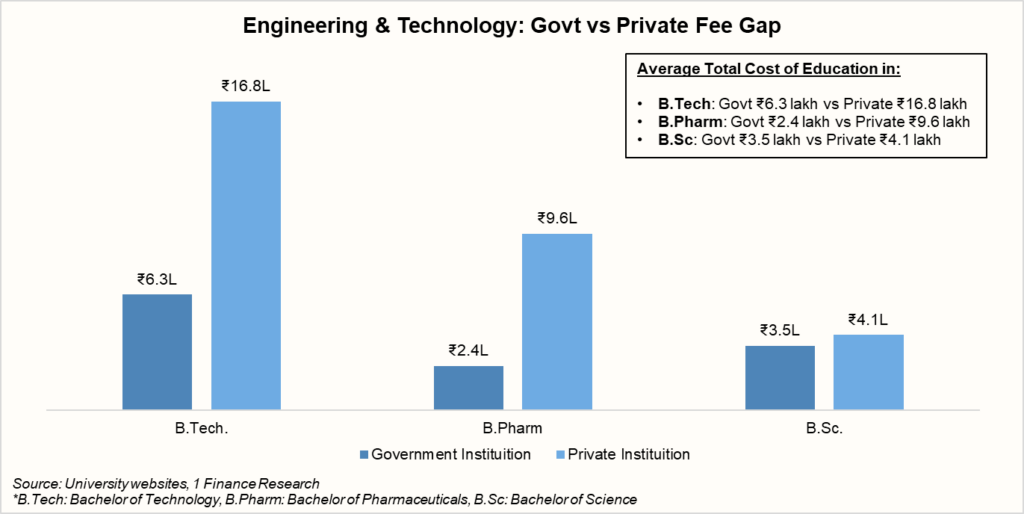
For families aspiring to careers in engineering and technology, the cost of education shows striking contrasts. A 4-year B.Tech in a government college averages ₹6.3 lakh, while the same degree from a private institution can cost nearly ₹16.8 lakh, almost three times higher.
Now, let’s assume a child aims to become a software developer:
| The total costs of schooling for 13 years at a mid-range Mumbai school | ₹17.3 lakh |
| A 4-year B.Tech from a private college (+) | ₹16.8 lakh |
| Together, total education spending reaches | ₹34.1 lakh |
The average starting salary for the same graduate? ₹4.74 lakh per year.
Even if you assume a steady 10% annual increment, which is optimistic, it would take over 20 years just to recover the cost of education. Not to earn a return on the investment, but simply to break even.
For families that stretch their budgets or take on education loans to fund this degree, the financial recovery timeline is a serious concern.
That said, the ROI problem does not apply equally to all engineering graduates. There is a clear and growing divide within the tech sector based on what you specialise in.
An analysis of 950 job postings across Mumbai, Pune, Delhi-NCR, Hyderabad, and Bangalore, published in the Global Economic Outlook 2026, shows a significant salary gap between AI-related and traditional IT roles.
The table below compares the roles and their relative salaries in India across various experience levels.
| Experience | AI-Related Roles (Salary Per Annum) | Traditional IT Roles (Salary Per Annum) | ||||||
| Average | Max | Min | Median | Average | Max | Min | Median | |
| 0-3 years | ₹6L | ₹23L | ₹2L | ₹5L | ₹5L | ₹18L | ₹2L | ₹5L |
| 3-5 years | ₹12L | ₹38L | ₹3L | ₹12L | ₹9L | ₹29L | ₹3L | ₹8L |
| 5-10 years | ₹22L | ₹65L | ₹5L | ₹20L | ₹17L | ₹75L | ₹1L | ₹15L |
| 10+ years | ₹36L | ₹70L | ₹13L | ₹35L | ₹26L | ₹58L | ₹9L | ₹23L |
Source: Job Postings, 1 Finance Research
At the entry level (0–3 years of experience), the difference is modest. AI roles average about ₹6 lakh per year, while traditional IT roles average around ₹5 lakh. But the gap widens quickly with experience.
At 3–5 years, AI professionals earn an average of ₹12 lakh compared to ₹9 lakh for traditional IT. At the 5–10 year mark, AI roles average ₹22 lakh versus ₹17 lakh for IT. And beyond 10 years, AI professionals earn around ₹36 lakh on average, while many traditional IT professionals settle between ₹23–58 lakh.
The pattern is consistent: AI and data-focused roles pay 20–40% more than traditional IT roles at similar experience levels. What this tells us is that the degree on your resume matters less than the specialisation it enables. A B.Tech with an AI or data science focus and a B.Tech in a general IT stream are now two very different financial outcomes.
If engineering has a cost problem, the MBA space has a supply problem.
India now has over 5,000 institutions offering MBA or PGDM programmes. That includes 21 IIMs. The number of AICTE-approved MBA institutes grew from 3,095 in 2021–22 to 3,465 in 2025–26. MBA enrollments rose 25% between 2017–18 and 2021–22.
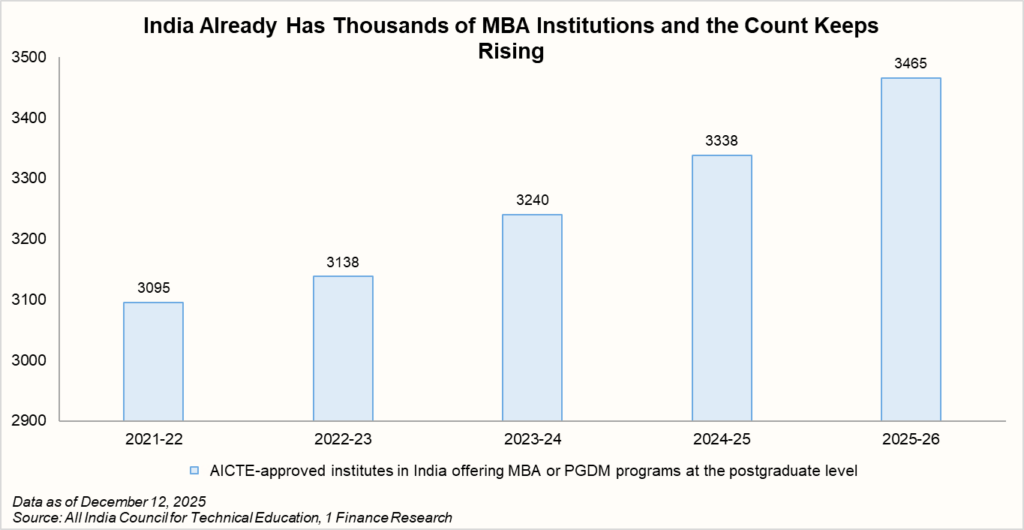
More seats are being created every year. But the number of quality jobs has not kept pace.
Placement data from top B-schools highlights this stress clearly. In 2024, IIM Indore’s average placement salary dropped nearly 15% from 2023 levels. In fact, similar pressure is visible across multiple management institutes. This reflects a demand-supply mismatch. The number of institutions is rising. Quality job creation is not.
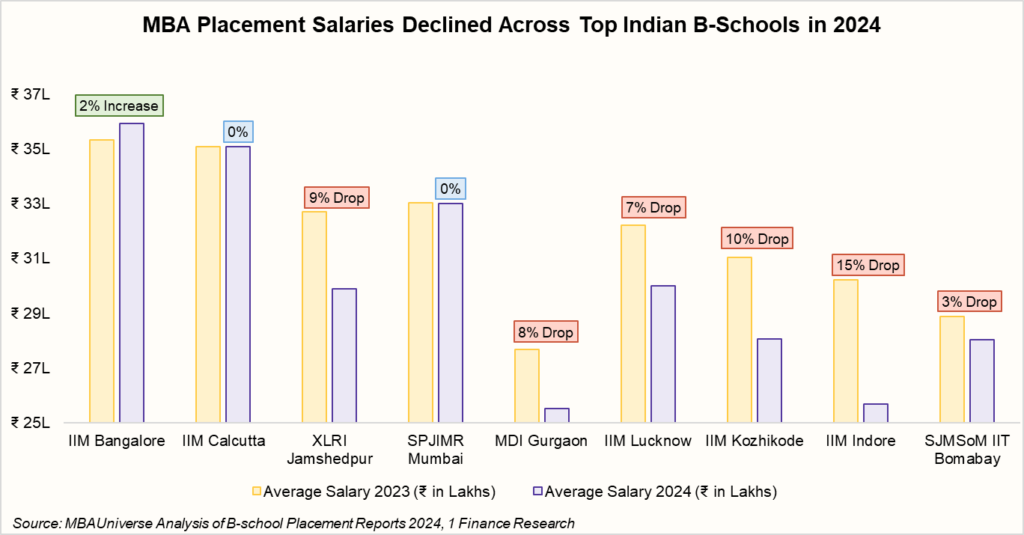
These are not mid-tier colleges. These are institutions that charge ₹20–25 lakh in programme fees. If the returns are slipping at the top, the situation further down the ranking is likely to be more challenging.
The Unstop Talent Report 2025, which surveyed over 30,000 respondents across engineering and management institutes, puts a number on the employment gap.
Among 2025 B-school graduates, 46% entered the job market without a job or internship. In engineering, the figure was 83%. Even among graduates of the Top 30 B-schools in the country, one in four students remained unplaced.
This is not a one-time dip. It reflects a structural issue: the education system has scaled enrolment significantly, but curriculum relevance, industry partnerships, and placement infrastructure have not scaled at the same rate.
The same pattern extends to professional qualifications.
Total CA exam appearances jumped from 6 lakh in 2019 to 12 lakh in 2025, a doubling of supply in six years. But entry-level compensation has not moved in line. Semi-qualified CA candidates often find themselves in fallback roles paying ₹3–5 lakh per year.
However, many CA aspirants and semi-qualified candidates face modest starting pay. Fallback roles like Account Executive typically offer ₹3-5 lakh annually. This remains true even after several years of experience.
| Experience | Account Executive (Salary Per Annum) | ||
| Average | Min | Median | |
| 0-3 years | ₹3L | ₹1L | ₹3L |
| 3-5 years | ₹4L | ₹2L | ₹4L |
| 5-10 years | ₹5L | ₹3L | ₹4L |
| 10+ years | ₹7L | ₹4L | ₹5L |
Source: Job Postings, 1 Finance Research
In other words, the opportunity exists, but the path to it is longer and narrower than most aspirants expect.
Three factors are driving this situation simultaneously.
This is not an argument against higher education. A well-chosen degree from a strong institution still holds value. But the definition of “well-chosen” has changed, and it requires more thought than it did a decade ago.
India’s education ROI problem is not temporary. It is structural, and it is expanding into the country’s most popular and aspirational educational segments.
The degrees that Indian families have long considered safe investments are now delivering uncertain returns. Education costs are outpacing salary growth, graduate supply is far exceeding demand, and a significant portion of what is being taught does not align with what the market values today.
This does not mean education has lost its value. It means the decision of which degree to pursue, where, and with what specialisation needs to be treated like the major financial decision it is — backed by real data, realistic expectations, and an honest assessment of the skills the market is actually willing to pay for.

The views in the article /blog are personal and that of the author. The idea is to create awareness and not intended to provide any product recommendations.


Plan Your Retirement with Our Qualified Financial Advisors
Your first financial plan is free