
 Book a free consultation
Why We Believe There Are 3 Generations of Wealth Creators
Personal Finance
Nov 17, 2022

Plan Your Retirement with Our Qualified Financial Advisors

Your first financial plan is free
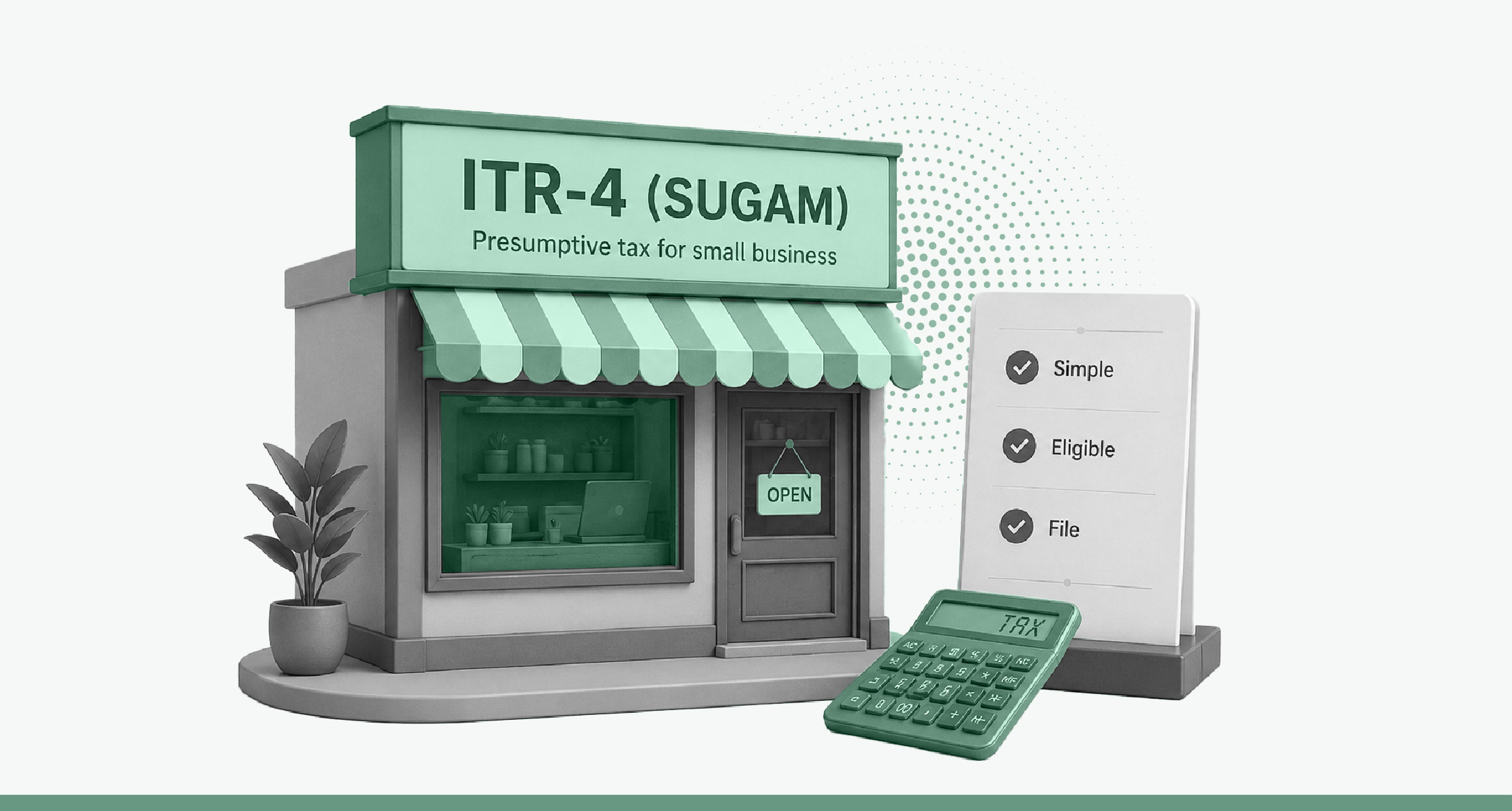
ITR-4, called Sugam, is the income tax return form for small businesses and professionals who use the presumptive taxation scheme. It is the simplest way for shop owners, freelancers, consultants, and small transport operators to file, because presumptive taxation lets you declare a fixed percentage of your turnover as income without maintaining detailed books of accounts.
This guide explains who can file ITR-4, how the presumptive scheme works under Sections 44AD, 44ADA, and 44AE, what changed for AY 2026-27, and how to file it online. For the wider context, see our complete ITR filing guide for FY 2025-26 and our guide on choosing the right ITR form.
You can file ITR-4 only if you meet all of these conditions.
You must be a:
→ Resident individual, HUF, or partnership firm. LLPs cannot use ITR-4, and non-residents (NRIs) and RNORs are not eligible.
→ Taxpayer with total income up to ₹50 lakh for the year.
Your income must come only from these sources:
→ Business or professional income computed on a presumptive basis under Section 44AD, 44ADA, or 44AE.
→ Salary or pension.
→ One house property.
→ Other sources such as interest income (but not winnings from lottery or race horses).
→ Long-term capital gains under Section 112A (listed shares or equity mutual funds) up to ₹1.25 lakh, with no losses to carry forward.
→ Agricultural income up to ₹5,000.
Presumptive taxation is a simple tax method for small taxpayers. Instead of keeping detailed books and calculating exact profit, you can show a fixed part of your turnover or receipts as income. ITR-4 can be used for all three presumptive tax sections.
Section 44AD – Small businesses
Under Section 44AD, income is presumed to be 8% of turnover for cash receipts and 6% of turnover for digital receipts. This scheme is available to eligible businesses with an annual turnover of up to ₹2 crore. The threshold increases to ₹3 crore if cash receipts do not exceed 5% of total receipts.
Section 44ADA – Professionals
Section 44ADA applies to specified professionals such as doctors, lawyers, architects, engineers, and consultants. Under this scheme, income is presumed to be 50% of gross receipts. It can be availed if gross receipts are up to ₹50 lakh, with the limit increasing to ₹75 lakh where cash receipts do not exceed 5% of total receipts.
Section 44AE – Goods transport business
Section 44AE applies to taxpayers engaged in the business of plying, hiring, or leasing goods carriages. For operators owning up to 10 goods vehicles, income is computed on a prescribed fixed amount per vehicle per month, irrespective of actual earnings.
Let an expert handle it

We will get back to you shortly.
You must use ITR-3 (or ITR-2 if you have no business income) if any of these apply:
→ Your total income is above ₹50 lakh.
→ You have short-term capital gains, long-term gains above ₹1.25 lakh, or gains from property, gold, or other assets.
→ You have crypto or virtual digital asset income.
→ You have more than one house property.
→ You have foreign income or foreign assets, or signing authority in an account outside India.
→ You are an NRI or RNOR, a company director, or hold unlisted equity shares.
→ You have losses to carry forward, or income from commission, agency business, lottery, or race horses.
→ You are an LLP, or you are required to maintain books of accounts or get a tax audit.
F&O and intraday traders cannot use ITR-4 either, because that income is treated as a regular business and is reported in ITR-3.
Both forms are for business and professional income. ITR-4 is only for presumptive taxation with total income up to ₹50 lakh and no detailed books. ITR-3 is for everyone else with business income — those who keep regular books, earn above ₹50 lakh, report a loss, trade in F&O, or fall outside the presumptive rules.
Both forms are for business and professional income. ITR-4 is only for presumptive taxation with total income up to ₹50 lakh and no detailed books. ITR-3 is for everyone else with business income — those who keep regular books, earn above ₹50 lakh, report a loss, trade in F&O, or fall outside the presumptive rules.
If you opt for presumptive taxation under Section 44AD and later declare profit below the presumptive rate while still being eligible, Section 44AD(4) applies. You are then barred from using the presumptive scheme for the next five years, and you must maintain regular books of accounts and get a tax audit if your income crosses the basic exemption limit. The takeaway: once you choose 44AD, plan to stay in it, because moving out has a five-year cost.
Let an expert handle it
We will get back to you shortly.
Presumptive taxpayers get a simpler advance tax rule. Instead of paying in four instalments through the year, you pay your entire advance tax in a single instalment by 15 March. If you miss it, you pay self-assessment tax later with interest under Section 234C.
You can also file using the offline Excel utility, which generates a JSON file to upload on the portal.
Filing ITR-4 after the due date attracts a late fee under Section 234F (₹1,000 if total income is up to ₹5 lakh, ₹5,000 above that) and 1% monthly interest under Section 234A on any unpaid tax. You can file a belated return up to 31 December 2026. Filing on time also keeps your option to choose the old regime, which needs Form 10-IEA before the due date.
Let an expert handle it
We will get back to you shortly.
What is the ITR-4 (Sugam) form?
ITR-4 is a simplified income tax return for resident individuals, HUFs, and partnership firms (not LLPs) with total income up to ₹50 lakh who use the presumptive taxation scheme under Section 44AD, 44ADA, or 44AE. It also covers salary, one house property, and other income.
Who can file ITR-4?
A resident individual, HUF, or partnership firm (not an LLP) with total income up to ₹50 lakh and presumptive business or professional income, along with salary, one house property, interest, and LTCG under Section 112A up to ₹1.25 lakh.
What is presumptive taxation?
Presumptive taxation lets small taxpayers declare income as a fixed percentage of turnover or receipts instead of maintaining detailed books. The rate is 6% or 8% of turnover under Section 44AD, 50% of receipts under Section 44ADA, and a per-vehicle amount under Section 44AE.
Can I file ITR-4 if I have capital gains?
Only limited gains. You can report long-term capital gains under Section 112A (listed shares or equity mutual funds) up to ₹1.25 lakh with no carried-forward losses. Short-term gains, larger long-term gains, or gains from property and other assets require ITR-2 or ITR-3.
What is the difference between ITR-3 and ITR-4?
ITR-4 is for presumptive taxation with total income up to ₹50 lakh and no detailed books. ITR-3 is for those who keep regular books, earn above ₹50 lakh, report a loss, trade in F&O, or fall outside the presumptive rules.
What is the last date to file ITR-4 for AY 2026-27?
31 August 2026 for non-audit cases. A belated return can be filed up to 31 December 2026 with a late fee and interest.
Can a freelancer file ITR-4?
Yes. A freelancer or professional can use ITR-4 under Section 44ADA if gross receipts are within ₹50 lakh (₹75 lakh if cash receipts are 5% or less) and total income is up to ₹50 lakh, declaring 50% of receipts as income.
How do I file ITR-4 online?
Log in to incometax.gov.in, go to e-File → Income Tax Returns, select AY 2026-27 and ITR-4, confirm your turnover and presumptive income in Schedule BP, add other income, choose your regime, pay any tax due, submit, and e-verify within 30 days.
Sources and references
Disclaimer
This guide is for general informational purposes and is accurate to the best of our knowledge as of June 2026. It is not a substitute for personalised tax advice. Tax laws, rates, and deadlines can change, and individual circumstances vary. Please verify current details on incometax.gov.in and consult a qualified Chartered Accountant or tax advisor before acting on any information here.
Published on 25 Jun 2026, 2:14 pm IST

The views in the article /blog are personal and that of the author. The idea is to create awareness and not intended to provide any product recommendations.


Plan Your Retirement with Our Qualified Financial Advisors
Your first financial plan is free