


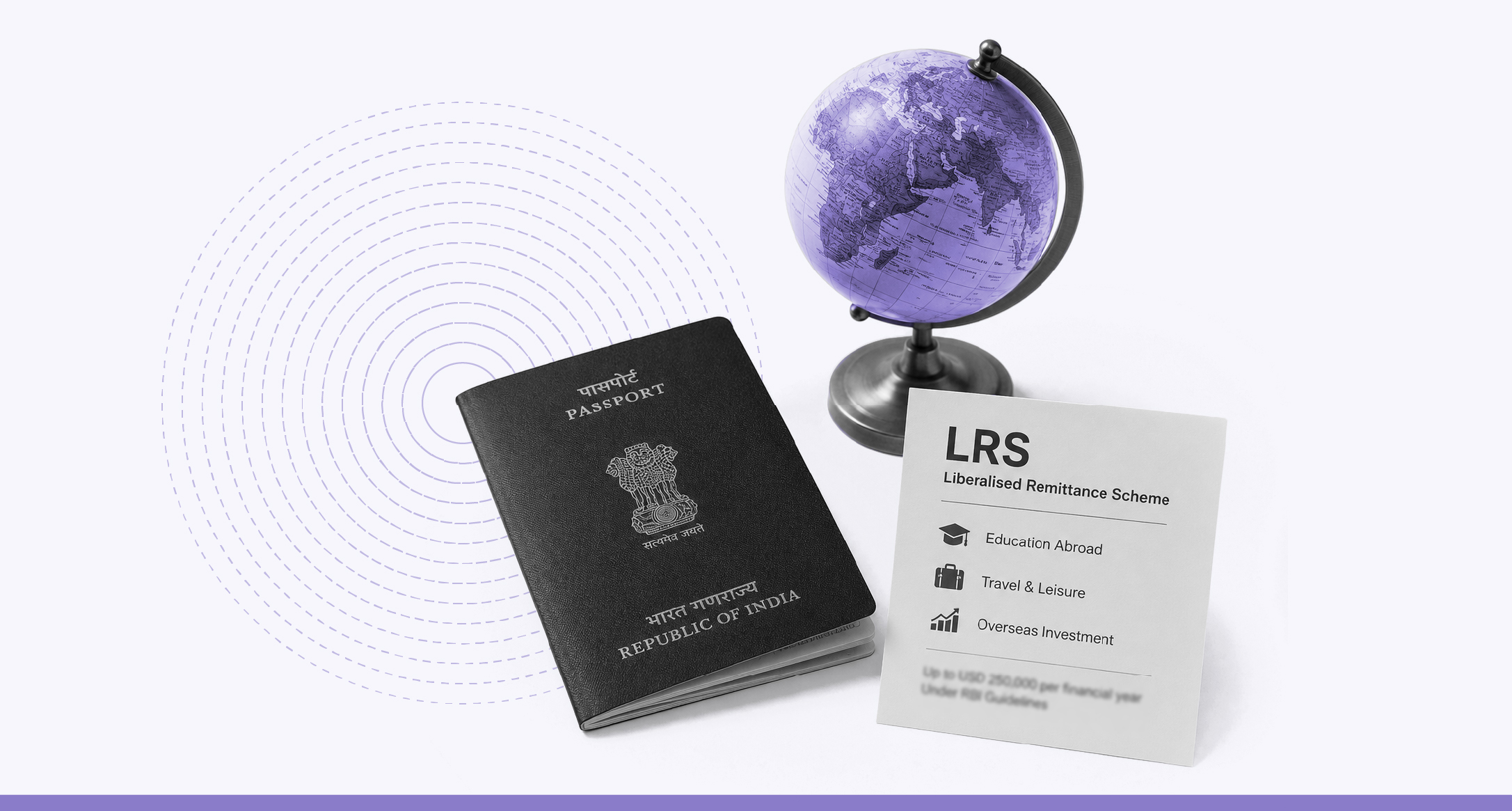

Every time a parent wires tuition to a university in Boston, an investor buys shares of a US-listed company, or a family sends a wedding gift to a cousin in Toronto, the transfer is typically made under the Liberalised Remittance Scheme (LRS). Many people do not encounter the scheme by name until a bank asks them to sign Form A2 or deducts tax from an outward remittance.
The Liberalised Remittance Scheme is the Reserve Bank of India’s framework for outward remittances by resident individuals. It sets the rules for how much money eligible individuals can send abroad each financial year and the purposes for which those remittances are allowed. Banks use the scheme to process transactions such as overseas education payments, foreign investments, gifts, travel expenses, and maintenance of relatives abroad.
This guide explains how the scheme works, who can use it, which transactions are permitted, which are prohibited, and the tax collected at source (TCS) rules that apply to outward remittances, including the changes that took effect on 1 April 2026.
What LRS is
The Liberalised Remittance Scheme (LRS) allows each resident individual in India to remit up to USD 250,000 abroad in a financial year (April to March) for permitted current and capital account transactions without prior approval from the Reserve Bank of India. The RBI introduced the scheme in 2004 under the Foreign Exchange Management Act, 1999 (FEMA), and administers it through its Master Direction on the Liberalised Remittance Scheme. Before the scheme was introduced, many outward remittances for personal purposes required case-by-case approval. The LRS replaced that process with a single annual limit and a defined list of permitted transactions.
A short history: From USD 25,000 to USD 250,000
The Reserve Bank of India introduced the Liberalised Remittance Scheme in 2004 with an annual limit of USD 25,000 per resident individual. The RBI increased the limit in stages as India’s foreign exchange reserves grew, reaching USD 200,000. In August 2013, the RBI reduced the limit to USD 75,000 during a period of pressure on the rupee. It restored the limit to USD 125,000 in June 2014, increased it to USD 250,000 in May 2015, and has kept it at that level since then.
The remittance limit has remained unchanged since 2015. The rules on tax collected at source (TCS) on certain outward remittances have changed several times during that period.
The USD 250,000 limit
The Liberalised Remittance Scheme allows each resident individual to remit up to USD 250,000 in a financial year (April to March). The limit applies to the individual, not the household. Two eligible spouses each have a separate USD 250,000 limit. A resident minor also has a separate USD 250,000 limit, and the required declarations are signed by a natural guardian on the minor’s behalf.
The USD 250,000 is a single annual limit that covers all eligible remittances under the scheme. Payments for overseas education, foreign investments, travel expenses, gifts, maintenance of relatives abroad, and other permitted transactions all count toward the same limit.
The limit applies across all Authorised Dealer (AD) banks. Using multiple banks does not create separate allowances. Banks verify remittances against the applicant’s Permanent Account Number (PAN) and report LRS transactions under the RBI’s reporting framework. Remittances that exceed the annual limit without the required approval are not permitted under the Foreign Exchange Management Act (FEMA).
A resident individual who needs to remit more than USD 250,000 in a financial year must obtain specific approval from the Reserve Bank of India before making the excess remittance.
Who can, and cannot, use LRS
The Liberalised Remittance Scheme is available only to resident individuals as defined under the Foreign Exchange Management Act (FEMA). Resident adults and resident minors are eligible. A natural guardian signs the required declarations for a minor.
The scheme does not apply to companies, partnership firms, Hindu Undivided Families (HUFs), trusts, limited liability partnerships, or other non-individual entities. Those entities are governed by separate provisions under FEMA.
Non-Resident Indians (NRIs) are not eligible to remit under the LRS because the scheme is limited to resident individuals. NRIs use other FEMA provisions that govern NRE, NRO, and FCNR accounts. A resident individual may remit money under the LRS to an NRI, including as a gift, subject to the scheme’s rules. That remittance counts toward the resident sender’s annual LRS limit.
Permitted uses under LRS
The RBI classifies permitted remittances under the LRS as current account transactions and capital account transactions.
Current account transactions include:
- Private travel abroad.
- Business travel abroad.
- Overseas education, including tuition and living expenses.
- Medical treatment abroad.
- Maintenance of close relatives living abroad.
- Gifts and donations.
- Expenses related to emigration.
Capital account transactions include:
- Opening and maintaining a foreign currency account with a bank outside India.
- Purchasing immovable property outside India.
- Investing in foreign shares, debt securities, mutual funds, and exchange-traded funds.
- Making overseas direct investments, including setting up a wholly owned subsidiary or joint venture abroad, subject to the applicable regulations.
- Extending loans to eligible NRI relatives, subject to the conditions prescribed under FEMA and RBI regulations.
Prohibited transactions
The Reserve Bank of India prohibits certain transactions under the Liberalised Remittance Scheme. These include:
- Remittances for the purchase of lottery tickets, sweepstakes, or prohibited magazines.
- Margin trading or trading in foreign exchange abroad.
- Capital account remittances to jurisdictions identified by the Financial Action Task Force (FATF) as high-risk or subject to countermeasures, and to persons or entities identified as posing terrorism financing risks.
- Remittances connected with activities prohibited or restricted under applicable law.
- Purchases in the secondary market of foreign currency convertible bonds issued abroad by Indian companies.
The RBI has not issued a general approval for using the LRS to purchase cryptocurrencies or other virtual digital assets abroad. Banks may decline such transactions based on their compliance policies, and other regulatory requirements may apply. Anyone considering such a remittance should confirm whether the transaction is permitted with their Authorised Dealer bank and obtain professional advice where necessary.
Tax Collected at Source (TCS) on LRS remittances
For many remittances under the LRS, the bank or tour operator collects Tax Collected at Source (TCS) when the transaction is made. The amount is deposited against the remitter’s Permanent Account Number (PAN) and appears in Form 26AS and the Annual Information Statement (AIS). The remitter can claim credit for the TCS when filing an income tax return. If the TCS exceeds the final tax liability, the excess is refundable.
The Finance Act, 2026 replaced Section 206C(1G) of the Income-tax Act, 1961 with Section 394 of the Income-tax Act, 2025 from 1 April 2026. The TCS rates for Financial Year 2026-27 are:
| Purpose of remittance | TCS rate (FY 2026-27) |
| Education funded through a loan from a specified financial institution | Nil |
| Education or medical treatment (self-funded) | Nil up to Rs. 10 lakh, 2% on the amount above Rs. 10 lakh |
| Overseas tour packages | 2% from the first rupee |
| All other purposes, including investments, gifts, purchase of property, and maintenance of relatives | Nil up to Rs. 10 lakh, 20% on the amount above Rs. 10 lakh |
The Rs. 10 lakh threshold applies per PAN for each financial year. It covers eligible remittances that are subject to the threshold and is not applied separately to each transaction. The threshold increased from Rs. 7 lakh to Rs. 10 lakh with effect from 1 April 2025.
From 1 April 2026, the TCS rate on self-funded remittances for education and medical treatment above the threshold is 2%. Remittances funded through an education loan from a specified financial institution remain subject to a nil rate.
Overseas tour packages are subject to 2% TCS from the first rupee. The Rs. 10 lakh threshold does not apply to these packages.
For remittances that do not fall within the education, medical treatment, or overseas tour package categories, TCS applies at 20% on the amount above Rs. 10 lakh.
The Central Board of Direct Taxes clarified in 2023 that spending on an international credit card while a person is abroad is outside the scope of the LRS and does not attract TCS under the LRS provisions. Loading a forex card and remitting foreign currency under the LRS remain subject to the applicable TCS rules.
If a person’s PAN is inoperative because it is has not been linked with Aadhaar, the higher TCS rates prescribed under the Income-tax Act apply.
Examples
A parent remits Rs. 25 lakh for a child’s overseas education and pays from personal funds. The first Rs. 10 lakh is not subject to TCS. TCS applies at 2% on the remaining Rs. 15 lakh. The bank collects Rs. 30,000.
A parent remits Rs. 25 lakh for overseas education funded through a loan from a specified financial institution. The applicable TCS rate is nil. The bank does not collect TCS.
An investor remits Rs. 40 lakh to invest in foreign securities. The first Rs. 10 lakh is not subject to TCS. The remaining Rs. 30 lakh attracts TCS at 20%. The bank collects Rs. 6,00,000. The remitter can claim credit for that amount when filing an income tax return.
A traveller buys an overseas tour package costing Rs. 6 lakh. Overseas tour packages attract TCS at 2% from the first rupee. The bank or tour operator collects Rs. 12,000.
How an LRS remittance works
An outward remittance under the Liberalised Remittance Scheme is made through an Authorised Dealer (AD) Category-I bank. The remitter must provide a Permanent Account Number (PAN), complete Form A2, and declare the purpose of the remittance. The bank may ask for documents that match the stated purpose, such as a university admission letter and fee demand for education or a hospital estimate for medical treatment.
The bank records the transaction under the applicable purpose code. The purpose code determines how the remittance is reported and may affect the TCS rate. The remitter should confirm that the bank has selected the correct code before the transaction is processed.
If TCS applies, the bank collects it when processing the remittance. The remitter must also pay any applicable bank charges and correspondent bank fees.
Common mistakes
The USD 250,000 remittance limit and the Rs. 10 lakh TCS threshold are calculated across the financial year. Earlier remittances affect the treatment of later ones.
Loading a forex card counts as an LRS remittance. It uses part of the annual remittance limit and is included when calculating the applicable TCS threshold.
A remittance funded through an eligible education loan is subject to a nil TCS rate. A self-funded education remittance is subject to the rates that apply to that category.
For remittances that fall under the “other purposes” category, the timing of transfers across financial years changes how much of a remittance falls above the Rs. 10 lakh threshold in a given year.
LRS and overseas investment
The Liberalised Remittance Scheme is the main route through which resident individuals invest abroad under FEMA. Subject to the annual USD 250,000 limit and the applicable regulations, a resident individual may invest in foreign shares, mutual funds, exchange-traded funds, debt securities, and immovable property outside India. A married couple who are both eligible residents each have a separate annual limit.
Remittances for most overseas investments fall within the “other purposes” category for TCS. Amounts above the Rs. 10 lakh annual threshold attract TCS at 20%. The remitter can claim credit for the TCS when filing an income tax return.
Frequently asked questions
Can I use LRS to buy property abroad?
Yes. Purchasing immovable property outside India is a permitted capital account transaction under the Liberalised Remittance Scheme, subject to the USD 250,000 annual limit and the applicable FEMA and RBI regulations.
Can NRIs use the LRS?
No. The LRS is available only to resident individuals. Non-Resident Indians use the FEMA rules that govern NRE, NRO, and FCNR accounts. A resident individual may remit money to an NRI under the LRS, subject to the scheme’s conditions.
Is TCS an additional tax?
No. TCS is collected in advance and credited against the remitter’s PAN. It can be claimed as a credit when the income tax return is filed. If the TCS exceeds the final tax liability, the excess is refunded.
Does spending on an international credit card abroad count under the LRS?
No. The Central Board of Direct Taxes clarified in 2023 that spending on an international credit card while a person is outside India is outside the scope of the LRS and does not attract TCS under the LRS provisions. Loading a forex card and remitting foreign currency under the LRS remain subject to the applicable rules.
What happens if I exceed the USD 250,000 annual limit?
An Authorised Dealer bank may refuse to process the remittance. Remitting more than the annual limit without the Reserve Bank of India’s approval is not permitted under the Foreign Exchange Management Act (FEMA) and may result in regulatory action and penalties.