


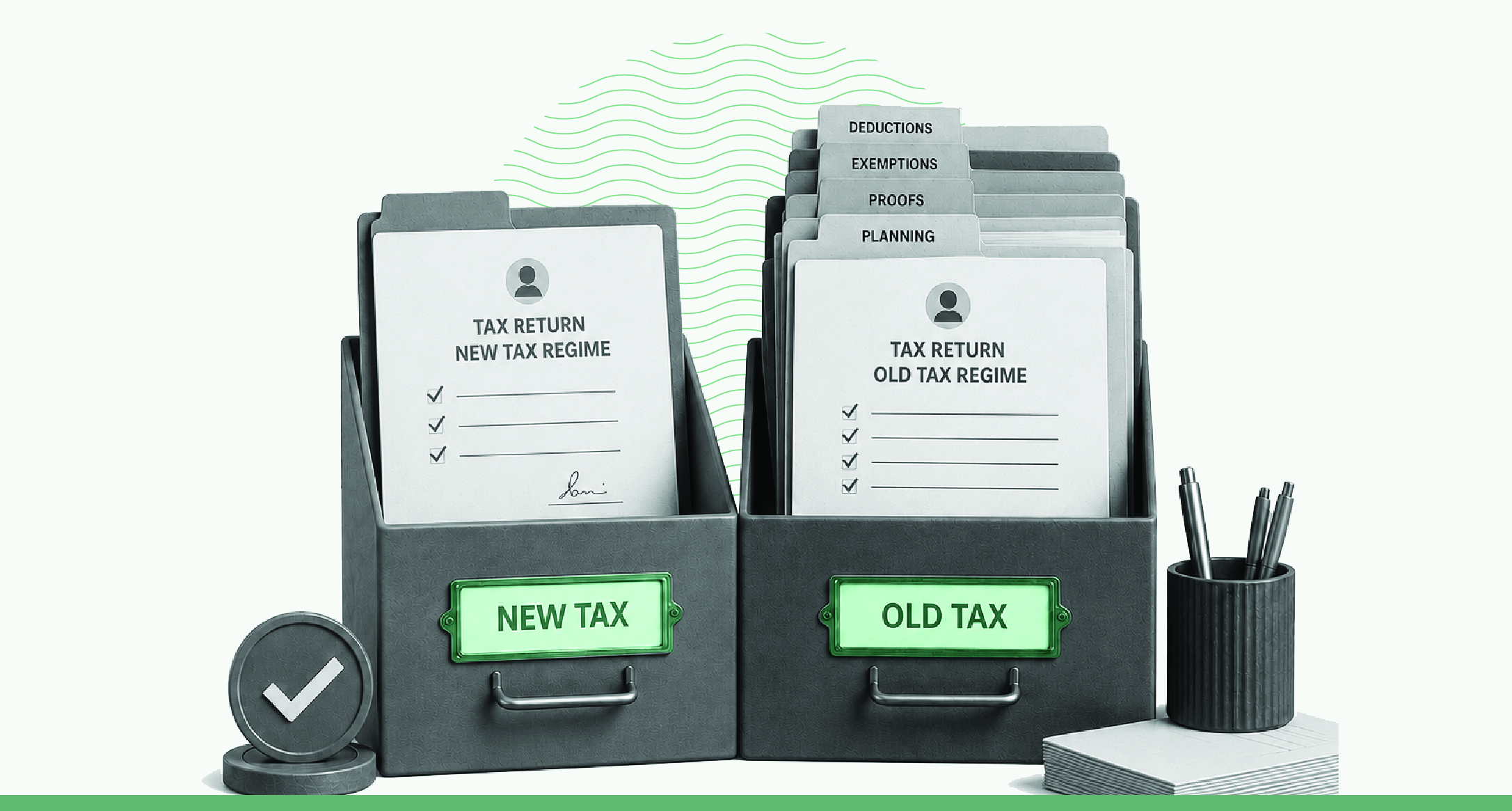

Choosing between the old and new tax regime is the single biggest decision you make while filing your return, and it usually affects your tax liability more than anything else. For FY 2025-26 (AY 2026-27), the new regime is the default and offers lower slab rates, while the old regime keeps the familiar deductions like 80C, HRA, and home loan interest. This article shows you exactly which one saves you more, with the actual numbers, a break-even analysis, and a decision framework based on your stage of life.
For the wider filing process, see our complete ITR filing guide for FY 2025-26.
Key takeaways
- The new regime has lower rates and a standard deduction of ₹75,000, but removes most deductions. Income up to ₹12 lakh is tax-free because of the Section 87A rebate (up to ₹12.75 lakh for the salaried).
- The old regime has higher rates but lets you claim 80C, 80D, HRA, home loan interest, NPS, and more.
- For most salaried people with typical deductions, the new regime wins.
- The old regime usually wins only if your total deductions are large — roughly ₹5.9 lakh or more at ₹15 lakh income, rising with income.
The difference between new regime and old regime
The new regime gives you lower tax rates but takes away almost all deductions and exemptions. There is no Section 80C, no 80D, no HRA, and no home loan interest deduction under Section 24(b). You get a standard deduction of ₹75,000 and not much else.
The old regime charges higher rates but lets you reduce your taxable income through deductions. If you invest in 80C instruments, pay health insurance premiums, claim HRA, or pay home loan interest, the old regime lets all of that lower your tax.
So the choice comes down to one question: do your deductions save you more than the new regime’s lower rates do?
New tax regime: Slabs and rebate (FY 2025-26)
| Income slab | Tax rate |
| Up to ₹4,00,000 | Nil |
| ₹4,00,001 – ₹8,00,000 | 5% |
| ₹8,00,001 – ₹12,00,000 | 10% |
| ₹12,00,001 – ₹16,00,000 | 15% |
| ₹16,00,001 – ₹20,00,000 | 20% |
| ₹20,00,001 – ₹24,00,000 | 25% |
| Above ₹24,00,000 | 30% |
The Section 87A rebate of up to ₹60,000 makes income up to ₹12 lakh completely tax-free. With the ₹75,000 standard deduction, a salaried person earning up to ₹12.75 lakh pays no tax.
One limit to note: the rebate applies to normal income only, not to special-rate income like capital gains.
Old tax regime: Slabs and deductions (FY 2025-26)
| Income slab | Tax rate |
| Up to ₹2,50,000 | Nil |
| ₹2,50,001 – ₹5,00,000 | 5% |
| ₹5,00,001 – ₹10,00,000 | 20% |
| Above ₹10,00,000 | 30% |
The old regime’s Section 87A rebate covers income up to ₹5 lakh, and the standard deduction for the salaried is ₹50,000. Its value lies in deductions: Section 80C up to ₹1.5 lakh, Section 80D for health insurance, HRA, home loan interest up to ₹2 lakh under Section 24(b), and the extra ₹50,000 NPS deduction under Section 80CCD(1B). The basic exemption is higher for older taxpayers, ₹3 lakh for those aged 60 to 80, and ₹5 lakh for those above 80.
A 4% Health and Education Cess applies on top under both regimes.
Break-even: How many deductions you need for the old regime to win
This is the most useful number to know. It is the total deduction amount (including the ₹50,000 standard deduction) at which the old regime starts beating the new regime. Below it, the new regime wins; above it, the old regime wins.
| Gross salary | New regime tax | Old regime wins if deductions exceed |
| ₹7,00,000 | ₹0 | New regime already gives zero tax |
| ₹10,00,000 | ₹0 | New regime already gives zero tax |
| ₹12,75,000 | ₹0 | New regime already gives zero tax |
| ₹15,00,000 | ₹97,500 | ₹5.9 lakh |
| ₹20,00,000 | ₹1,92,400 | ₹7.6 lakh |
| ₹25,00,000 | ₹3,19,800 | ₹8.5 lakh |
| ₹30,00,000 | ₹4,75,800 | ₹8.5 lakh |
First, if your salary is up to about ₹12.75 lakh, the new regime makes it tax-free with no deductions at all, so it almost always wins. The old regime can only match it, and only if you have very large deductions.
Second, above that level, the old regime wins only with substantial deductions — around ₹5.9 lakh at ₹15 lakh income, and ₹7.6 to ₹8.5 lakh higher up. To reach those figures you generally need a combination of full 80C (₹1.5 lakh), home loan interest (up to ₹2 lakh), significant HRA, health insurance under 80D, and the NPS deduction. Most salaried people claim ₹2 to ₹4 lakh in total, which keeps them in new-regime territory.
Which regime suits your life stage
The right choice depends first on your income, then on how many deductions you genuinely have.
Early career, renting, few investments
Your deductions are usually small, and your income is often within the tax-free band. The new regime almost always wins, and it saves you the effort of locking money into tax-saving products you may not need.
Mid-career with a home loan and a family
This is the one stage where the old regime can win. If you pay home loan interest, claim HRA in a metro city, max out 80C, pay health insurance premiums, and contribute to NPS, your deductions can cross the break-even. Add them up honestly and compare. If they fall short of roughly ₹5.9 to ₹7.6 lakh, the new regime still wins.
High earners without large deductions.
If your income is high but you don’t have a home loan or heavy 80C investments, the new regime’s lower rates win clearly. If you do have large, genuine deductions, run the comparison — the old regime can still come out ahead.
Senior citizens and pensioners
The old regime gives a higher basic exemption (₹3 lakh or ₹5 lakh) and extras like the ₹50,000 interest deduction under 80TTB. But the new regime’s ₹12 lakh rebate is powerful: a pensioner with income up to ₹12.75 lakh pays no tax under it, often beating the old regime even after deductions. Above that level, seniors with large deductions and high interest income may prefer the old regime. Compare both.
How to choose and switch your regime
The new regime is the default. If you do nothing, you are taxed under it.
If you are salaried with no business income, you can choose your regime afresh each year while filing your return. You simply select the old regime in the ITR if it suits you.
If you have business or professional income, the rules are stricter. To opt for the old regime, you must file Form 10-IEA before the due date. Once you switch out of the old regime back to the new one, you generally cannot return to the old regime again.
One practical point: file on time. A belated return can lock you into the new regime by default, so missing the deadline can quietly cost you the old regime’s deductions.
A note on choosing well, not just choosing low
The regime that saves the most tax is not always the one that serves you best over time. The old regime rewards deductions, which can tempt people into buying insurance policies or investments they don’t need, just to claim the benefit. A deduction is only worth it when the underlying decision is sound on its own — a home loan for a home you want, health cover you actually need, or retirement savings you would make anyway.
Pick the regime that fits your real financial life. If you already have a home loan and genuine investments, the old regime may reward them. If you don’t, the new regime’s lower rates let you keep your money flexible instead of locking it away. Either way, let the tax saving follow your decisions, not drive them.
Frequently asked questions
Which tax regime is better, old or new?
It depends on your deductions. For most salaried people with ordinary deductions, the new regime saves more because of its lower rates and the rebate that makes income up to ₹12 lakh tax-free. The old regime wins only when your total deductions are large — roughly ₹5.9 lakh or more at ₹15 lakh income.
Is income up to ₹12 lakh tax-free under the new regime?
Yes. The Section 87A rebate makes income up to ₹12 lakh tax-free under the new regime, and up to ₹12.75 lakh for salaried individuals after the ₹75,000 standard deduction. This does not cover special-rate income like capital gains.
Can I switch between the old and new regime every year?
If you are salaried with no business income, yes — you choose each year while filing. If you have business income, you must file Form 10-IEA to opt for the old regime, and once you switch back to the new regime you generally cannot return to the old one.
How do I decide which regime to choose?
Add up your real deductions, including the standard deduction, 80C, 80D, HRA, home loan interest, and NPS. Compare that total against the break-even for your income. If your deductions are below it, choose the new regime; if above, choose the old. The portal’s tax calculator can do this for you.
Which regime is the default for AY 2026-27?
The new regime. You are taxed under it unless you actively choose the old regime, which for business income requires Form 10-IEA before the due date.
Does the old regime still exist in 2026?
Yes. The old regime continues for AY 2026-27 with the same slabs and deductions. It is no longer the default, but you can still choose it.
Sources and references
- Income Tax Department, e-filing portal — incometax.gov.in
- Income Tax Act, 1961 — Sections 87A, 80C, 80D, 80CCD(1B), 24(b), 10(13A), 80TTB
- Tax rates and rebate as provided through the Finance Acts of 2025 and 2026
Disclaimer
This guide is for general informational purposes and is accurate to the best of our knowledge as of June 2026. The tax figures are illustrative and assume the stated income and deduction levels; your actual tax depends on your full income, deductions, surcharge, and other factors. Tax laws can change, and individual circumstances vary. Please verify current details on incometax.gov.in and consult a qualified Chartered Accountant or tax advisor before acting on any information here.