

New NPS withdrawal rules: 80% lumpsum withdrawal allowed but only 60% tax-free, how is the rest taxed?
By Muzammil Bagdadi
NPS
Dec 20, 2025

Plan Your Retirement with Our Qualified Financial Advisors

Your first financial plan is free
Your daily expenses and long-term goals run on the monthly salary, which stops at retirement. Your accumulated savings must then deliver that monthly income to fund your non-earning years. The National Pension Scheme (NPS) has long helped subscribers on the accumulation side, building a retirement corpus over decades. The challenge, however, lies in converting that corpus into a steady post-retirement income. PFRDA’s new Retirement Income Scheme (RIS) and drawdown options are introduced to give NPS subscribers more control over how their NPS corpus becomes monthly income.
Whether you are an NPS subscriber or considering one, these new withdrawal rules give you a fresh choice over your monthly income. The earlier you understand them, the better that choice serves you.
Retirement Income Scheme (RIS) is a dedicated investment scheme built for the years after you retire. PFRDA, the pension regulator, introduced RIS, through a circular dated May 15, 2026. The drawdown options arrived alongside it, and together they govern your post-retirement days.
This happens through RIS Steady, a lifecycle fund that holds your corpus and rebalances it on your birthday each year. The asset allocation tilts from equity towards corporate debt and government securities as you age, so the corpus stays invested and keeps earning even as you draw from it.
RIS steady glide path
| Your age | Asset class E (Equity) | Asset class C (Corporate Debt) | Asset class G (Government Securities) |
|---|---|---|---|
| At retirement (age 60) | 35% | 10% | 55% |
| 65 | 25% | 15% | 60% |
| 70 | 15% | 20% | 65% |
| 75 | 10% | 20% | 70% |
| Beyond 80 | Asset distribution is held constant till 85 | ||
Scroll right to view full table →
PFRDA built the framework for both government and non-government NPS subscribers to serve two purposes. One, to bring predictability to your cash flow during retirement; and second, in PFRDA’s own statement, ‘to promote corpus longevity through continued support with corpus appreciation’. This combined effort, thus, can minimise the risk of corpus depletion before the end of the drawdown period.
The old way of spending the NPS corpus was rigid. At the exit age, the arrangement left you with little room to choose. A set portion of the corpus had to buy an annuity that pays a lifelong pension monthly income. The rest arrived as a single lump sum, and both halves of that split carried some limitations.
An annuity buys certainty, yet its payouts stay modest, and the capital locks away with little room to grow. An annuity bought with ₹40 lakh can produce around ₹18,000-₹22,000 a month, considering the average rate ranges between 5.5%-6.5%. However, it’s a sum that can get impacted due to inflation.
Also read: What is annuity rate in NPS?
NPS lump sum looks like freedom, though it often hardens into a burden of its own. Managing a large sum across a retirement of uncertain length is genuinely hard due to the judgement it loads on you. For instance, the right withdrawal amount, and whether you have saved enough for as many years as you live.
In such a situation, a retiree most often makes one of two errors: withdrawing the money too fast or holding it too cautiously out of fear, and both can end badly. Before these 2026 NPS withdrawal rules arrived, the spending years had no structure at all, and left the whole judgement to you. Now, you can customise withdrawals according to your needs.
Retirement Income Scheme answers that difficulty through two drawdown options. You have full liberty to choose either of them for the phased withdrawals.
The first option, Systematic Payout Rate (SPR), runs as the default within RIS. It sets each year’s payout based on your current age and the years left until 85, the maximum end-age of your drawdown period. On every birthday, the rate is recalculated against the current market value of your corpus.
SPR formula = 1 / (85 − current age) %
How the default payout rate rises with your age
| Your age | Years remaining to 85 | Payout rate for that year |
|---|---|---|
| 60 | 25 | 4% (1/85-60) |
| 65 | 20 | 5% (1/85-65) |
| 70 | 15 | 6.67% (1/85-70) |
| 75 | 10 | 10% (1/85-75) |
| 80 | 5 | 20% (1/85-80) |
| 84 | 1 | 100% (1/85-84) |
Scroll right to view full table →
The formula is built to pay your drawdown corpus out across the years to 85, so the rate must rise as fewer years remain. Each year it applies afresh to your corpus’s market value on your birthday, which lets a strong market lift the next payout and a weak one trim it.
The second, Systematic Unit Redemption (SUR), fixes the number of units instead. You divide your total units by the count of payouts across your drawdown period, and that same number leaves your account each time.
SUR formula = Total no. of units at start / (Drawdown period x payout frequency)
Picture a corpus of 5 lakh units drawn monthly across 25 years. That works out to about 1,667 units a month, and their rupee value rises or falls with the NAV. You can be paid monthly, quarterly, or yearly, and the schedule runs until you turn 85.
Two drawdown options in NPS: SPR & SUR
| Drawdown option | How monthly income payout is calculated | What changes from year to year |
|---|---|---|
| Systematic Payout Rate (SPR), the default option | A payout rate set from your age and the years remaining in your drawdown period | The rate is reset each birthday to match the market value of your corpus |
| Systematic Unit Redemption (SUR) | A fixed number of units, redeemed every payout period | The unit count stays constant; the rupee value moves with the NAV |
Scroll right to view full table →
Whichever route you pick, any corpus left when the drawdown period closes can be used to buy an annuity. As a result, nothing simply lapses.
The drawdown options apply only to the NPS lump sum, while the mandatory annuity rule stays intact. You still route the prescribed minimum, 20% or 40% by NPS subsciber category, into an annuity that pays you for life.
That annuity is your guaranteed floor, the monthly income arrives whatever the markets do. It matters most after 85, when the drawdown corpus is spent and the annuity alone keeps paying. RIS adds a flexible, market-linked layer above that floor, and the floor itself stays put.
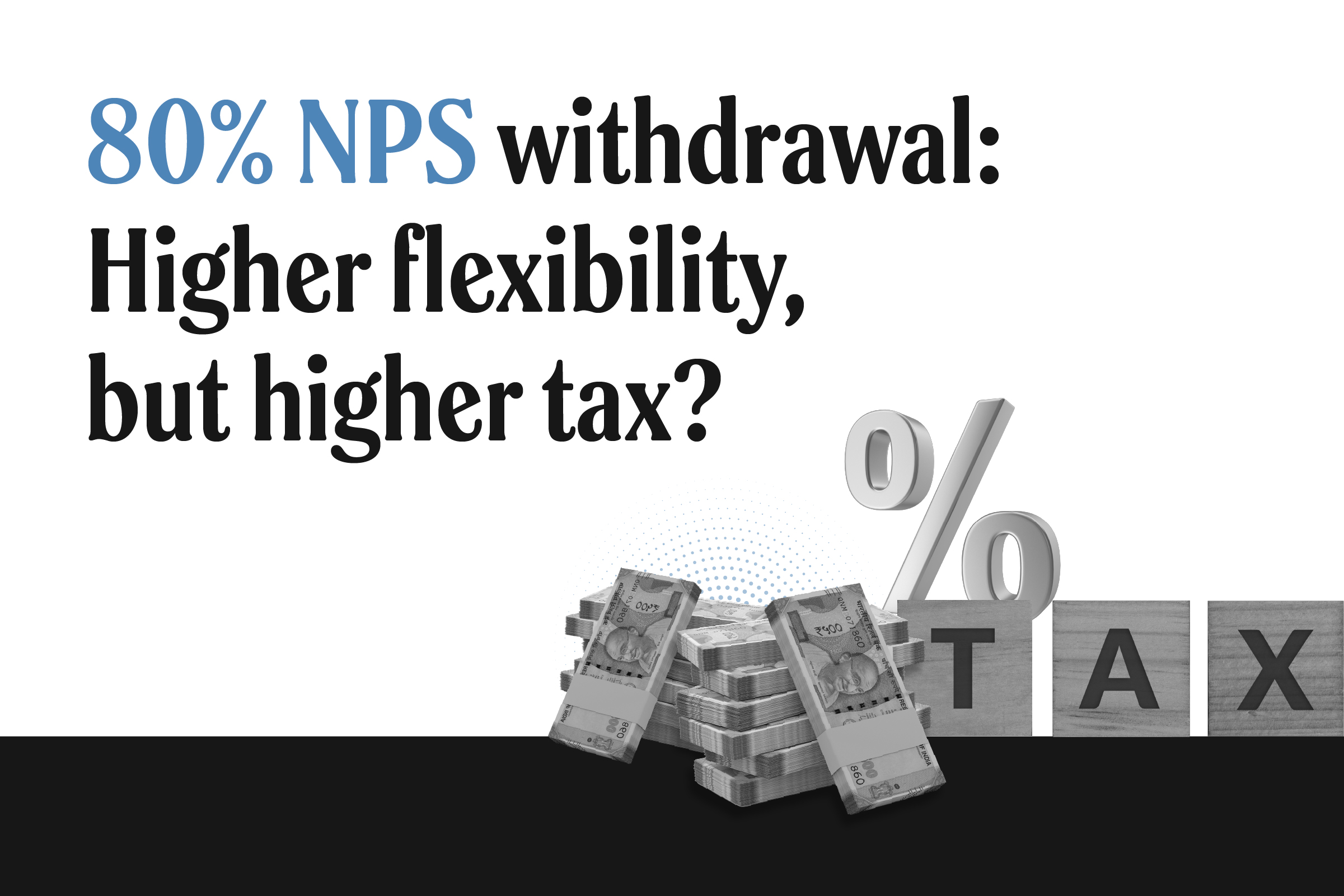
Income tax laws haven’t moved in step with PFRDA’s rules yet. Under Section 10(12A), only 60% of your national pension scheme corpus is tax exempted at retirement. Non-government NPS subscribers may now withdraw up to 80%, yet the 20%, of the total 80% portion, stays taxable at your slab rate. Annuity income is taxable in full.
Drawing your corpus through RIS doesn’t change the taxable portion, though taking it in instalments spreads the tax across the years, instead of concentrating it in one. Before you decide on it, know how much of each payout the tax rules will leave in your hands.
This latest framework carries no live date yet, since PFRDA will notify it once the systems stand ready. So take this time to study the choice. A new withdrawal option, read alone, is merely a feature for your overall retirement plan. Set against your full financial picture, it becomes a planning decision.
The annuity covers your essential expenses with a guaranteed base, and the RIS drawdown sits above it as the part that grows and flexes with your needs. How much weight you place on each depends on your other income, your monthly expenses, your health costs, and the certainty you need to rest easy.
That flexibility carries a cost worth naming. Payouts under the drawdown options move with the market, and PFRDA obliges pension funds to say so plainly, with no guarantee attached. A poor market run early in retirement cuts your income just when you can least absorb it, an exposure the annuity spares you.
While you study the choice, you can run the numbers yourself. The 1 Finance NPS calculator lets you estimate your post-tax corpus and projected payouts under the new framework, and the 1 Finance NPS scoring and ranking model helps you assess the pension fund managing it on cost, returns, and risk-adjusted performance.
A Qualified Financial Advisor can model your numbers directly, weighing the corpus needed to secure a lifelong pension. Retirement income is one pillar of an overall financial planning, and sized alongside the rest, it settles into place far more easily. An advisor who earns nothing from the products you choose can read this framework and recommends a drawdown plan built to last decades, giving you a completely personalised financial plan.
Published on 05 Jun 2026, 1:39 pm IST

The views in the article /blog are personal and that of the author. The idea is to create awareness and not intended to provide any product recommendations.


Plan Your Retirement with Our Qualified Financial Advisors
Your first financial plan is free