

HDFC Infinia Metal vs. HDFC Regalia Gold Credit Card: Rewards, other benefits compared
By Arman Qureshi
Credit cards blogs
Jul 11, 2025
Plan Your Retirement with Our Qualified Financial Advisors

Your first financial plan is free
For years, the SBI Cashback credit card was the undisputed king of online cashback in India. A flat 5% on virtually every online merchant, with a single ₹5,000 monthly cap and almost no category nonsense. Cardholders affectionately called it the “manufactured spend” card — because routing routine bills, rent rotations, and online purchases through it almost always beat the alternatives.
That era ended on April 1, 2026.
SBI Card announced a substantial devaluation that took effect this April: tighter caps, new sub-limits, fresh category exclusions, and new redemption restrictions. The card is still around, the headline 5% rate still exists, but the value math has changed meaningfully.
In this article, we’ll break down exactly what was devalued, what remains, the actual cashback math you can expect in 2026, and how the card now stacks up against alternatives like the Axis Cashback Card, Amazon Pay ICICI, and HDFC Millennia. The goal: a clear answer to whether it still earns its place in your wallet.
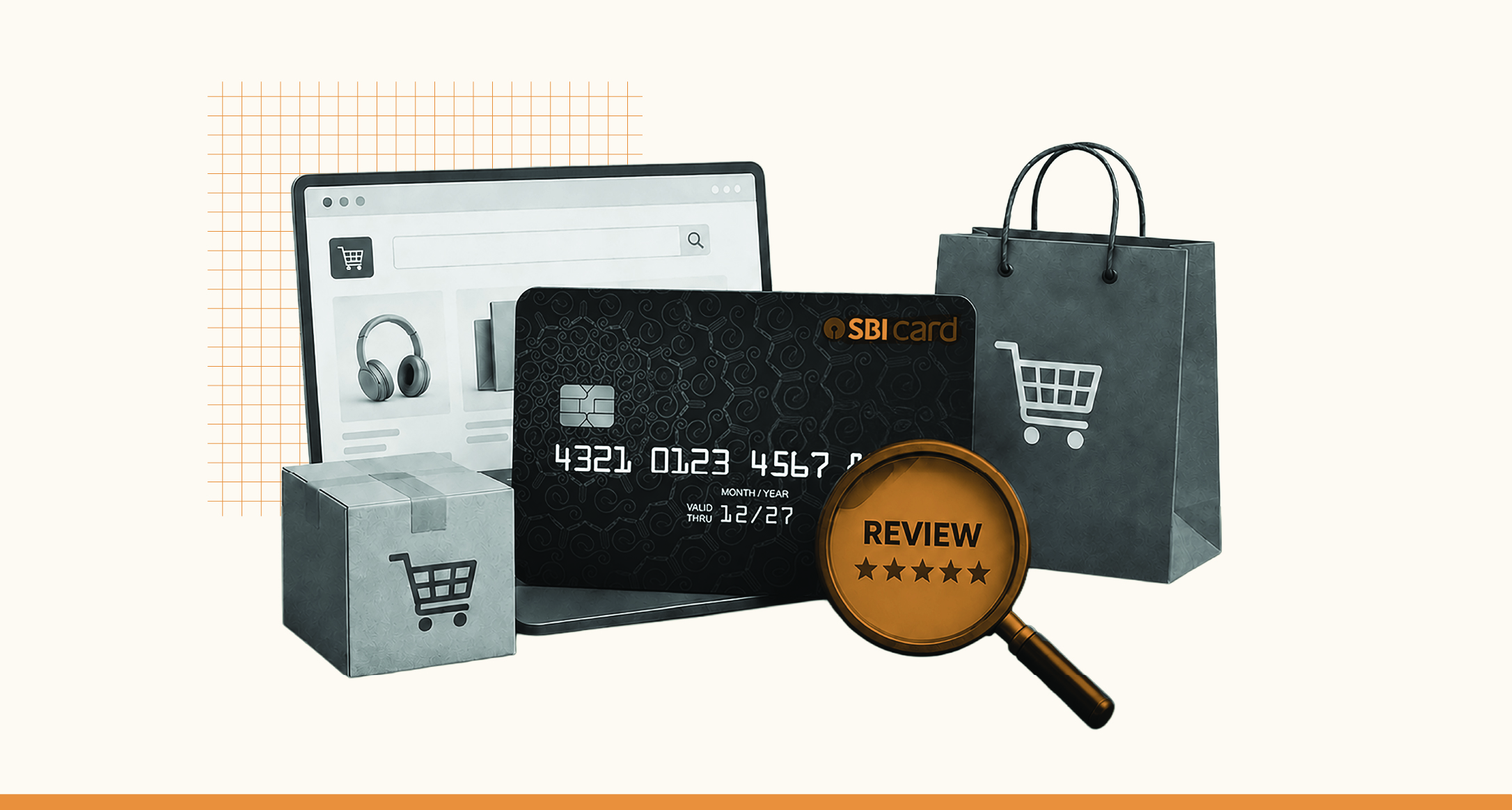
The SBI Cashback credit card (officially the CASHBACK SBI Card) is a cashback-focused credit card built primarily for online shoppers. Unlike co-branded cards tied to specific merchants, this card historically offered a flat 5% on all online spends without merchant restrictions, a feature that made it uniquely powerful for diverse digital spenders.
Positioned as a mid-tier cashback card with a ₹999 annual fee, it falls between entry-level cards like SimplyCLICK and premium offerings like SBI ELITE. The post-April 2026 version remains a flat 5% online card, but with significant caps and exclusions that change how it should be used.
This review focuses on the post-devaluation reality.
| Fee / Charge | Details |
| Joining Fee | ₹999 + GST |
| Renewal / Annual Fee | ₹999 + GST |
| Fee Waiver | Annual fee waived on spending ₹2,00,000 or more in a membership year |
| Finance Charges | Up to 3.50% per month (~42% per annum) |
| Cash Advance Fee | 2.5% of the amount withdrawn or ₹500, whichever is higher |
| Cash Payment Fee | ₹250 + applicable taxes (for paying card bills in cash at SBI branches) |
| Foreign Currency Markup | Approximately 3.5% on international transactions (verify current rate) |
| Late Payment Fee | Tiered structure based on outstanding balance |
| Fuel Surcharge Waiver | 1% waiver on fuel transactions between ₹500 and ₹3,000, capped at ₹100 per statement cycle |
The SBI Cashback card has no welcome offer. Also there are no quarterly or annual milestone vouchers.
4. Eligibility criteria
This is where the most significant changes have occurred. Here’s the current structure effective April 1, 2026:
| Spend category | Cashback rate | Monthly cap |
| Online spends (across all eligible merchants) | 5% | ₹2,000 per statement cycle |
| Offline spends (POS transactions) | 1% | ₹2,000 per statement cycle |
| Total cashback cap | — | ₹4,000 per statement cycle |
The combined cap is ₹4,000 per cycle, down from ₹5,000 previously. That’s a 20% reduction in maximum monthly earning capacity.
Pre-existing exclusions that continue:
The government-related exclusion is particularly significant. Many users routed large tax payments through this card to maximize cashback, and that strategy is now blocked.
This is the most important section in this review. The SBI Cashback card has gone through two notable devaluation phases — one earlier, and the major one effective April 1, 2026.
The card previously offered complimentary domestic airport lounge access. That was removed quietly, and the card has been a pure cashback play ever since. This wasn’t catastrophic because lounge access was always a secondary benefit, but it set the precedent that benefits could be pared back.
Change 1 — cashback cap reduced from ₹5,000 to ₹4,000 per cycle Previously, cardholders could earn up to ₹5,000 cashback per statement cycle without any split between online and offline. The total cap is now ₹4,000.
Change 2 — split caps introduced The single ₹5,000 cap was replaced with two separate ₹2,000 caps:
This is more restrictive than it sounds. Even if you spend zero offline, your online cashback now stops at ₹2,000. You cannot use the full ₹4,000 limit purely on online shopping. To hit the full ₹4,000 cap, you would need ₹40,000 of online spend and ₹2,00,000 of offline spend — practically impossible for most users.
Change 3 — three new exclusions added Digital gaming, toll payments, and government-related transactions (taxes, etc.) no longer earn cashback. The government-related exclusion is particularly impactful — it ends a popular strategy of using this card for income tax and GST payments.
Change 4 — statement credit redemption restrictions (SBI-wide) For SBI cards that earn reward points (not the auto-credit cashback on this specific card), statement credit redemption is now capped at 60,000 points/month and must be in multiples of 4,000 points.
The lifestyle benefits are deliberately sparse. This is a pure cashback utility card, not a lifestyle product.
| Category | SBI Cashback (post-April 2026) | Axis Cashback | Amazon Pay ICICI | HDFC Millennia |
| Joining/annual fee | ₹999 + GST | ₹1,000 + GST | Lifetime free | ₹1,000 + GST |
| Fee waiver | ₹2L annual spend | ₹4L annual spend | Not applicable | ₹1L annual spend |
| Online cashback | 5% (capped ₹2,000/cycle) | Tier-based: 2% up to ₹5K, 5% ₹5K–₹40K, 7% above ₹40K | 5% Amazon (Prime), 3% (non-Prime), 2% partners | 5% on 10 brands only |
| Offline cashback | 1% (capped ₹2,000/cycle) | 0.75% (uncapped on offline/travel) | 1% on all spends | 1% on other spends |
| Total monthly cap | ₹4,000 | ₹4,000 (online only) | No hard total cap | ~₹2,000 |
| Welcome benefits | None | 5,000 EDGE Reward Points | EazyDiner + activation vouchers | 1,000 CashPoints |
| Lounge access | None | None | None | Only via ₹1L quarterly milestone |
| Redemption | Auto-credit to statement | Auto-credit | Auto-credit to Amazon Pay | CashPoints (1:1 statement) with ₹50 fee |
The post-devaluation SBI Cashback occupies a different competitive position than the pre-April 2026 version. Here’s how it compares against each major alternative:
This is the most important comparison. The Axis Cashback card is now the strongest alternative for high online spenders. Its tier structure (2%/5%/7% with the highest rate kicking in above ₹40,000 monthly online spend) means heavy users actually earn more total cashback than they would on SBI Cashback post-devaluation. Both cards cap online cashback at ₹4,000, but Axis lets you reach that cap purely through online spending. The catch: Axis requires ₹4 lakh annual spend for fee waiver (vs. SBI’s ₹2 lakh), and the tier structure is more complex to track.
Amazon Pay ICICI wins on cost (lifetime free) and on Amazon-specific cashback (5% for Prime members), but loses on merchant breadth — SBI Cashback works at any online merchant, while Amazon Pay ICICI’s top rate is locked to Amazon’s ecosystem. If most of your online spending is on Amazon, Amazon Pay ICICI is better. If it’s spread across Flipkart, Myntra, Swiggy, and dozens of others, SBI Cashback still has an edge.
HDFC Millennia gives 5% only on its ten partner brands, with a roughly ₹2,000 monthly cashback cap. SBI Cashback (post-devaluation) also caps at ₹2,000 on the 5% tier but works at any online merchant. For users whose spending doesn’t align neatly with Millennia’s ten brands, SBI Cashback remains the better choice. For users who shop heavily on Amazon, Flipkart, Swiggy, and Zomato, the cards are roughly equivalent — pick based on banking relationship.
The SBI Cashback card has slipped from being the clear best online cashback card in India to one of several roughly equivalent options. Its uniqueness is gone, but its core value proposition — flat 5% on any online merchant — still has no exact equivalent in the market.
You can apply for the Cashback SBI card through SBI Card’s website, mobile app, or partner platforms:
Aggregator platforms like Paisabazaar and BankBazaar may also accept applications, but final approval rests with SBI Card.
The strategy for this card has changed meaningfully. Here’s how to extract maximum value in 2026:
Short answer: Yes for moderate online shoppers with diverse merchant usage. No for heavy users, tax-payers, utility-routers, and anyone whose strategy depended on the pre-April 2026 structure.
Strengths summary: Flat 5% on any online merchant (still rare in the market), automatic statement credit redemption (still best-in-class), no welcome benefit gimmicks, achievable ₹2 lakh fee waiver, and SBI’s broad acceptance.
Weaknesses summary: Devalued caps (₹4,000 total, ₹2,000 per category), three new high-impact exclusions (gaming, tolls, government), no lounge access, no welcome benefits, and a structure that no longer accommodates the high-volume strategies that made this card legendary.
Realistic annual value: For a typical user spending ₹25,000–₹30,000 online per month on eligible merchants, expect roughly ₹15,000–₹20,000 in annual cashback. That still comfortably beats the ₹999 fee and makes the card worthwhile. For users who can’t consistently hit ₹15,000 monthly in eligible online spending, the math gets tighter.
The honest verdict: The SBI Cashback card is no longer the obvious best choice it once was. It’s now one of three or four roughly comparable cashback cards, distinguished mainly by its unrestricted merchant acceptance for the 5% rate. If you already hold it, there’s no urgent reason to cancel — but if you’re applying fresh, compare carefully with Axis Cashback (better for heavy users) and Amazon Pay ICICI (better for Amazon-focused users) before deciding.
Card features, fees, cashback rates, caps, and exclusions can change over time — as this very review demonstrates. The April 1, 2026 revisions discussed here are based on SBI Card’s official communications and may be further updated. Several figures (finance charges, foreign currency markup, late payment fees) should be verified directly against the latest Most Important Terms and Conditions (MITC) on the official SBI Card website. The comparison with competitor cards reflects publicly available information at the time of writing and is subject to change as those cards may also be revised. Always read the current T&Cs before applying or making large spending decisions.
Published on 05 Jun 2026, 8:54 pm IST

The views in the article /blog are personal and that of the author. The idea is to create awareness and not intended to provide any product recommendations.


Plan Your Retirement with Our Qualified Financial Advisors
Your first financial plan is free