


One on One with a Wedding Emcee
Personal Finance
Jan 10, 2024

Plan Your Retirement with Our Qualified Financial Advisors

Your first financial plan is free
Advice cannot be truly objective if its economics depend on what gets sold.
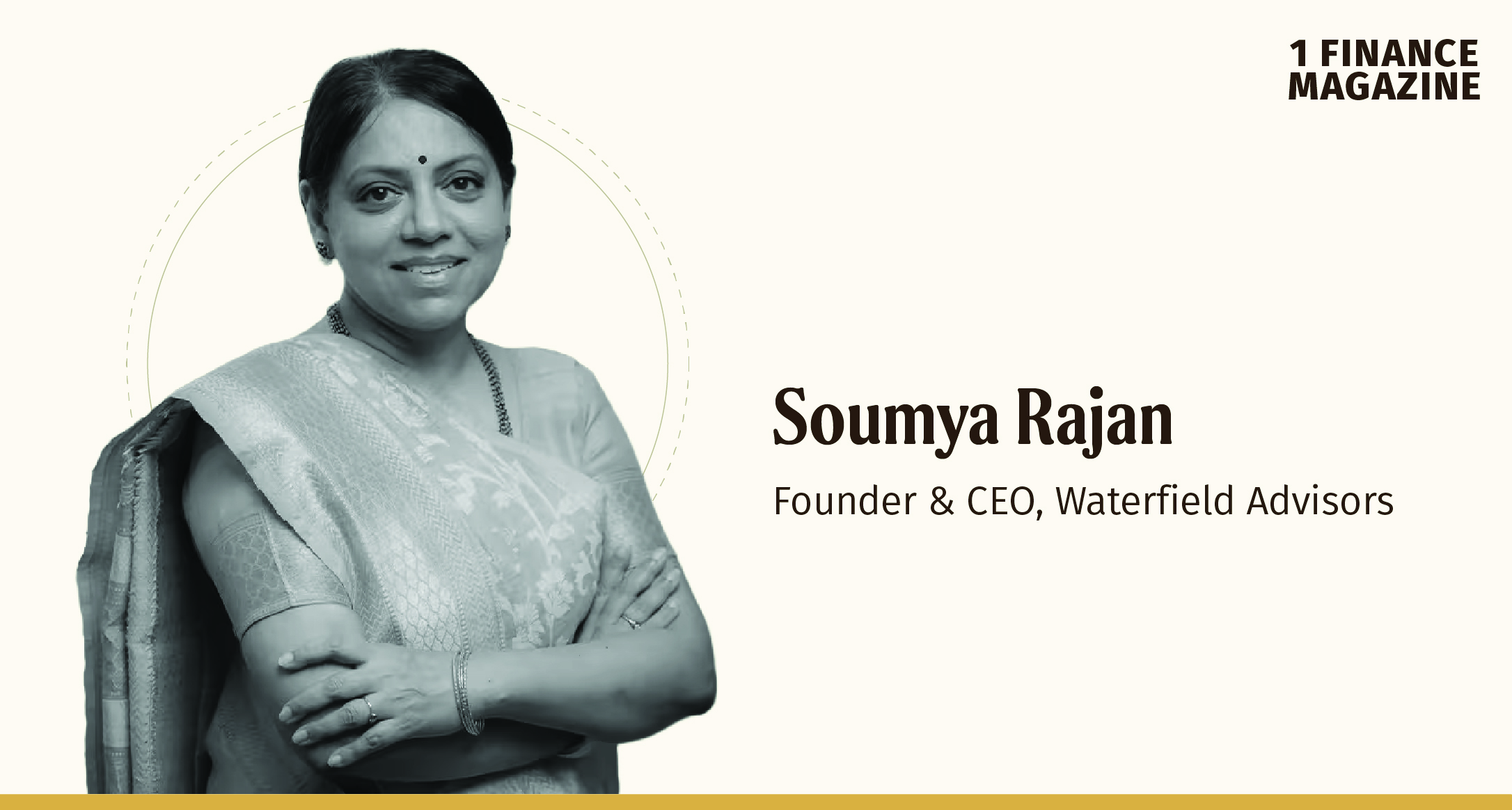
These are the words of Soumya Rajan, and they explain a decision that cost her the easier version of her career. In 2010 she left Standard Chartered, where she ran the private banking business in India, and the following year she founded Waterfield Advisors, now one of India’s largest multi-family offices, on a premise that sounded almost reckless at the time: charge clients directly for advice, and take nothing from the manufacturers whose products that advice might recommend. She has called turning down distribution income the hardest business decision she has ever made.
The conviction came from something she could not stop seeing. In the aftermath of the global financial crisis, clients were beginning to question why what large institutions advised did not always match what those same institutions held on their own books. ‘Once you see that divergence clearly,’ Rajan says, ‘it becomes difficult to rationalise it away.’ Fee-based advice asked the client to pay openly for judgement. The distributor model let the client believe advice was free while the cost sat embedded inside the product. One was far harder to sell. She built her firm on it anyway.
It was a lonely position in 2011. In the early years, clients would protest that paying an advisory fee meant incurring a ‘double layer of fees’, as though judgement were an indulgence stacked on top of the real cost. Only when SEBI introduced its Investment Advisers regulations in 2013, creating a formal category of registered investment adviser, did the distinction between an embedded cost and an explicit fee become clear enough to defend. The framework gave a name to what Waterfield had already been doing for two years.
Fourteen years on, the case for what Rajan built has only sharpened, because the gap she set out to fill has widened in plain sight.
India does not have a participation problem. By August 2025 the country had crossed 20 crore demat accounts. AMFI counted 27.06 crore mutual fund folios in February 2026, more than two and a half times the number five years earlier. Money has moved into markets at a pace few economies have ever matched. Yet as of late March 2026, SEBI’s list of recognised investment advisers held just 993 names. Even allowing for the fact that one investor often holds several accounts and folios, the ratio tells its own story. Access to markets has scaled at extraordinary speed. Access to independent advice has barely moved.
The consequence is not abstract. A market that widens access without widening judgement produces exactly the inefficiencies Rajan spends her days unwinding: portfolios assembled one product at a time, with nobody accountable for the whole; risk nobody has measured; costs that compound in silence. Most investors receive a statement every quarter. The harder question, whether the whole structure could survive what life will eventually throw at it, tends to go unasked.
Rajan calls this ‘the imbalance between participation and judgement’, and she is precise about why it happened. Distribution is easier to scale, easier to explain, and easier to monetise. Advisory asks more: documented suitability, signed client agreements, ongoing review, and the willingness to charge up front for an opinion. ‘Product-linked models offer faster revenue visibility and lower barriers to entry,’ she says. Those advisory disciplines are virtues. They are also friction, and friction does not scale on its own.
The contrast with mature markets is stark. In developed wealth markets, by Rajan’s estimate, advice accounts for close to 60 per cent of the business. In India it is a small fraction of that. What still surprises her is how many wealthy Indian families do not know the alternative exists. Many discover only late, often when something has already gone wrong, that genuinely conflict-free advice was ever on offer. They were never shown it, because almost no one in the chain had a reason to show them.
Some of the friction is regulatory plumbing. One of the largest barriers, Rajan says, is that moving a client from a distributor code to a direct, advisory structure can still be treated almost like a fresh transaction, with the tax bill and paperwork that implies. ‘If India wants advisory to scale,’ she adds, ‘transitions must become simpler and less punitive.’ The job of closing the gap, in her view, is shared three ways: the regulator sets the plumbing, the adviser explains the value, and the client learns to ask sharper questions.
The harder question is what that independent judgement actually buys, because its worth rarely appears on a statement. Making it visible is the work Rajan has spent 14 years on.
She reaches for an analogy she has used for years: a good adviser is closer to a doctor or a lawyer than to a salesperson. ‘Their value is not exhausted by a single visible output,’ she says. ‘It lies in diagnosis, prevention, sequencing and judgement.’ You do not measure a doctor by the prescription alone. The worth is in knowing what to look for, what to head off, and in what order to act. Waterfield was built on that wider lens from the start, taking in legacy and succession planning, ownership structuring, philanthropy and family governance rather than portfolios alone. That, Rajan says, was the original thesis, and it remains the heart of the model.
For most clients, Rajan says, the realisation is rarely a single event. It arrives gradually, as they begin to see their financial life ‘as a system rather than as a bag of products’. It tends to surface during the first proper diagnostic, the moment every asset is finally mapped in one place. That is usually when the inefficiencies become impossible to miss: duplicated PMS exposures, overlapping strategies, liquidity buckets nobody had defined, and fee leakage running into lakhs or crores a year, with no one accountable for the portfolio as a whole.
One case makes the abstraction concrete. A large listed-company promoter family was paying ₹4–5 crore a year in fees on a portfolio that was largely fixed income, with no single point of accountability for how it was built or how its risk was managed. The issue was structural. Nobody owned the whole picture, so nobody was answerable for how the parts fit together or what risk they carried. ‘Once clients see that,’ Rajan says, ‘the conversation changes from “why should I pay a fee?” to “why was nobody looking at this holistically before?”
For clients who have not yet had that moment, she says, the only honest way to show value is evidence. Map the overlap, measure the fees, identify the concentration, test the liquidity assumptions, and ask one hard question: could this structure survive an inflection point? Once a family sees the answer in its own numbers, the fee stops being the argument.
If diagnosis is where advice begins, behaviour is where it earns its keep. Wealth, Rajan has found, does not protect people from their own instincts. ‘Wealth does not immunise people against behavioural error,’ she says, ‘but it certainly increases the cost of being wrong.’
The patterns repeat at every level of the market: overconfidence when prices rise, panic in a drawdown, liquidity decisions taken with no reference to long-term obligations. At the ultra-high-net-worth end they do not soften. They grow more dangerous, because the sums are larger and the decisions harder to reverse. Confidence, the very trait that often built the wealth, becomes the thing that quietly puts it at risk.
She points to an entrepreneur whose company was listed on Nasdaq, suddenly holding 80 to 90 per cent of their net worth in a single stock. Sell too quickly and you destroy value; wait too long and the concentration becomes existential. ‘That is a behavioural and strategic problem, not a product-selection one,’ Rajan says. The goal, in her words, is ‘not to react theatrically’ but to sequence the decision: how much to sell, when, in which jurisdiction, with what tax consequence, inside what estate structure. Coaching at this level, she says, is as much about putting enough structure around the wealth that decisions are not taken ‘under the influence of excitement, grief, fatigue or ego’.
That structure matters because the biggest decisions are so often made at the worst moments, under urgency, grief, optimism or outside pressure, when nobody is thinking clearly. The cost of getting them wrong, Rajan notes, is not always recoverable. That is where a trusted adviser earns the fee.
Rajan is most insistent on a point that sounds dry until its consequences arrive. The value of advice compounds quietly for years, then comes due all at once, at the moments that decide a family’s future. A business exit. An inheritance. A health event. ‘When a business exit, inheritance or health event arrives, time compresses,’ she says. Families are forced to make decisions in weeks that should have been prepared over years.
What is missing at those moments is rarely intelligence. ‘What is usually missing is not intelligence, but architecture,’ Rajan says: no formal investment policy, no separation of family pools from individual capital, no ownership map, no agreed liquidity framework, no estate structure strong enough to survive stress. For most of her clients, the first task has simply been to build an integrated view of the balance sheet, because none existed.
This is why Waterfield moved early beyond portfolios into succession, structuring, governance and philanthropy.
Rajan’s reading of why wealthy families come apart is unsentimental: ‘The most consequential failures in wealthy families begin as design failures.’ Repair is possible, she says, but prevention is far cheaper. Structure the wealth only after the windfall, raise governance only after the disagreement, address the estate only after the illness, and value drains away through timing, tax and fractured decisions. By the time a family arrives without that groundwork, the bill is usually paid in three currencies at once: tax that better sequencing would have softened, assets sold in a hurry at the wrong price, and trust strained by decisions taken without a shared map. Some of it can be rebuilt. The value lost on the way rarely is.
The interventions she rates highest often never show up in a portfolio at all: a conversation that stops a business being sold on timing instead of readiness, or a family arrangement being signed without clarity on what it means financially. In each case, she says, the adviser’s first job is to reframe the question: what is the real objective here, what are the second-order effects, and what happens if the decision turns out to be irreversible? ‘A truly personalised adviser operates across time, not transactions,’ she says. The value sits in the continuity, in holding enough context to spot when a decision is being driven by circumstance rather than intent, and in having the standing to challenge it.
Over a long enough relationship, what changes most is not the portfolio. It is how a family relates to its own wealth. ‘Conversations move from products to purpose, from reaction to agency, from individual preference to family governance,’ Rajan says. Wealth becomes less mysterious, less destabilising. ‘That,’ she adds, ‘is when wealth starts behaving like capital rather than like an accumulation of disconnected bets.’
Part of that shift is about who is in the room. Rajan has argued for years that advisers must bring women into investment and family-business conversations far earlier than they tend to. The reasons are practical as much as principled. Many women inherit control without having been included early enough to exercise it well, and women often outlive men, which leaves them carrying a disproportionate share of long-term stewardship. Waterfield has put its own house in order on this count: by 2022, women made up more than half of its staff and leadership, and a dedicated proposition for women clients, HERitage, grew out of the same conviction.
The outcome she describes is modest in language and large in effect. Wealth stops being a source of anxiety and becomes something a family can discuss, govern and pass on with some maturity. For a country minting new wealth faster than it is building the institutions to steward it, that is no small claim.
The families Rajan describes sit at the very top of the market. The gap she is pointing to runs all the way down it. The same pattern, products bought one at a time with nobody watching the whole, shows up in a salaried professional with a dozen overlapping SIPs, two insurance policies sold as investments, and no one to say whether any of it adds up to a plan. India now counts its investors in tens of crores and, on SEBI’s list, fewer than a thousand advisers formally bound to act in their interest.
Rajan has thought hard about scale, because the segment that needs this most, India’s fast-growing mass affluent, is the one the advisory industry serves least. In her newsletter, CuriouSR, she set out eight changes she believes would let advice grow into the gap.
A few stand out. The first is awareness: a campaign for fiduciary advice on the scale of ‘Mutual Fund Sahi Hai’, so the option becomes visible to people who do not know it exists. The second is what she calls the single biggest hurdle in the industry today, allowing an investor to move from a distributor code to a direct, advisory structure without it being treated as a redemption and a taxable event. Until that switch is painless, inertia will keep money exactly where it sits.
The rest concern the economics of being an adviser. Rajan wants the cap on fixed advisory fees, currently ₹1.5 lakh per client a year, raised so that genuinely complex planning can be priced for what it takes to deliver. She wants lighter, proportionate compliance for small RIAs, to encourage solo practitioners and niche firms instead of pricing them out. And she wants serious investment in the profession itself: structured training that runs past product knowledge into financial planning, behavioural finance and estate structuring, apprenticeship routes that carry a junior planner through to lead adviser, and shared, regulator-aligned digital tools for risk profiling, suitability and record-keeping, so advisers spend their hours on judgement instead of paperwork. No single fix will do it, she says; the system has to move as a whole.
That belief returns Rajan to the number she keeps coming back to. India has built access to markets that would have looked impossible a generation ago. The judgement to use it well has not been built at anything close to the same pace. ‘We have created extraordinary access to financial markets in India,’ she says. ‘What we have not yet created, at the same scale, is access to independent, fiduciary judgement.’ Closing that gap, in her words, is ‘not just an industry opportunity, but an economic necessity’.
The wave of mass-affluent wealth now forming in India will need that judgement whether or not the industry is ready to supply it. Rajan built Waterfield more than a decade early on a bet that the country would eventually want advice it could trust. The open question is whether the rest of the system can be built fast enough to reach the people already waiting for it.
Published on 08 Jun 2026, 6:05 pm IST

The views in the article /blog are personal and that of the author. The idea is to create awareness and not intended to provide any product recommendations.


Plan Your Retirement with Our Qualified Financial Advisors
Your first financial plan is free