
Looking to invest in high growth property? Here are four key factors that you should know about
By Arman Qureshi
Investing
Jan 10, 2026

Plan Your Retirement with Our Qualified Financial Advisors

Your first financial plan is free
I often tell advisors that the best portfolio is a boring one. In an industry that rewards complexity, that tends to raise eyebrows.
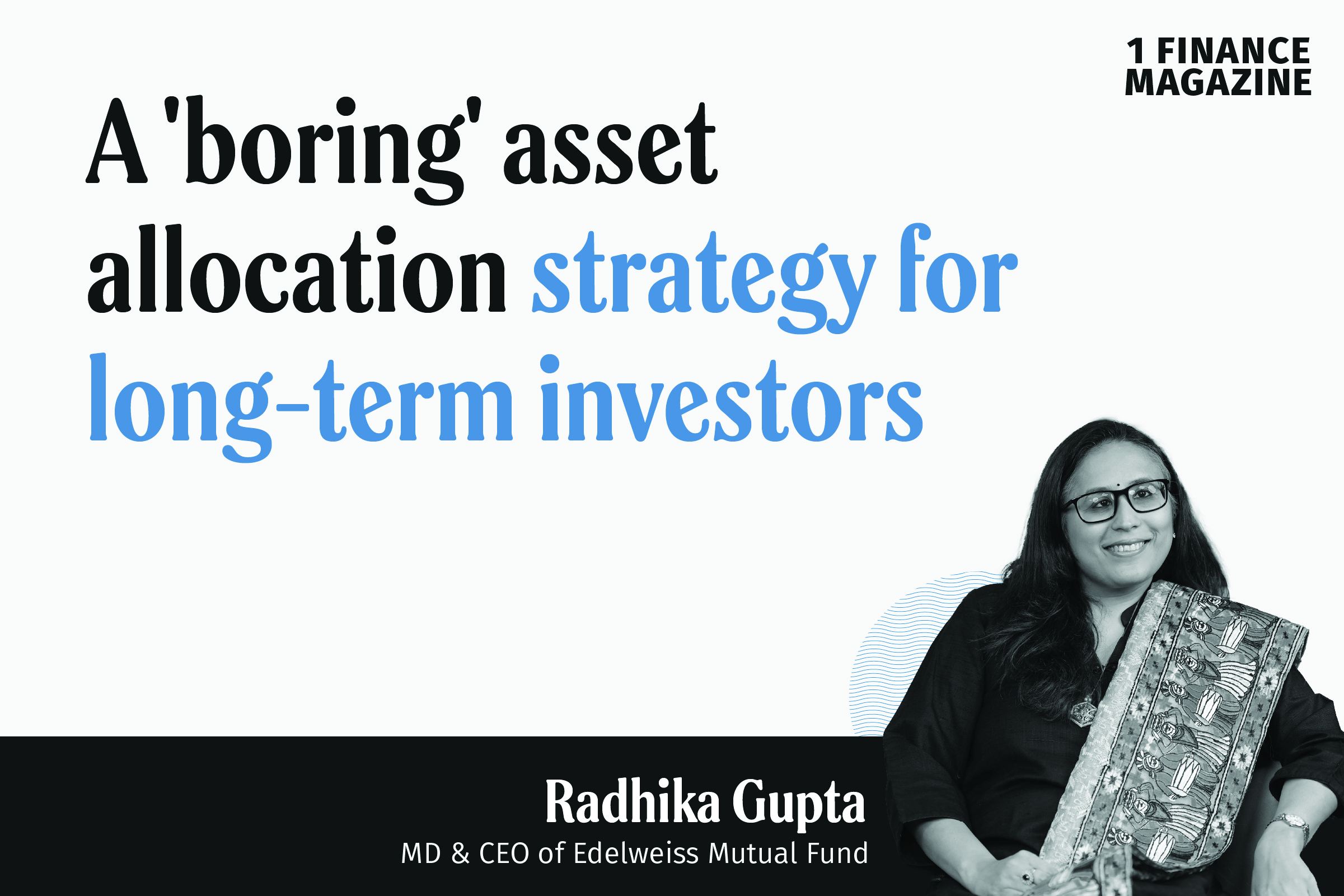
These are the words of Radhika Gupta, the MD and CEO of Edelweiss Mutual Fund, and they arrive with the weight of conviction earned through two decades in finance. She is not being dismissive of sophistication. Rather, she is making a case that in an industry drowning in products, frameworks, and performance chasing, the radical act is simplicity. A portfolio that does not try to be everything. A portfolio that looks, in her memorable phrase, like a thali—the traditional Indian meal of balanced, complementary components arranged around a central grain.
This is not contrarian positioning. It is a hard-won philosophy. Over years of studying how investors behave, how markets cycle, and how funds perform in real time, Gupta has arrived at a principle that sounds almost quaint: consistency beats flash. Measured exposure beats over-allocation. Diversification built on core principles beats thematic chasing. And the portfolio that achieves this is, by design, rather unexciting to look at, which is precisely why it works.
The journey to this philosophy began with observation. Edelweiss Mutual Fund, under Gupta’s leadership, manages over 1.4 lakh crore in assets across a sprawling menu of offerings, like passive funds, active funds, ETFs, structured products, offshore strategies, and more. The expansion has been deliberate, even aggressive. Yet the more products the firm introduced, the more Gupta observed a troubling pattern: investors were unhappy.
Not because the funds underperformed. But because the very breadth of choice paralysed decision-making. Advisors found themselves explaining the differences between seventeen variants of an equity strategy. Investors chased rankings, mistaking one year’s top performer for a structural advantage. Flows shifted with sentiment. And the moment a fund dipped in a single year, even if it had outperformed over three or five years, clients threatened to exit.
The irony was stark: the industry had solved the technical problem of investment management. The real problem was human. How do you help investors stick with a strategy? How do you defend their portfolios not just against market volatility, but against their own short-termism? How do you build something that works across an entire market cycle, not just the years when that particular strategy is in favour?
This question led Gupta to the thali framework. Not as a marketing metaphor, but as a genuine guide to portfolio construction. Just as a thali works across regions—the south Indian version differs from the north Indian version, yet both follow the same logic of balance—a portfolio built on core principles should perform consistently across market cycles, regardless of which sector or style is in favour that year.
The thali philosophy crystallises into a specific asset allocation: 65 per cent domestic equity, 10 per cent gold, 10 per cent silver, and 15 per cent debt. This is not a one-size-fits-all prescription. Rather, it is an argument for why this particular balance works as a foundational strategy.
The 65 per cent equity allocation provides the growth engine. But it is not pure domestic exposure—within that equity component, Gupta advocates for a blend of active and passive strategies, large-cap consistency with mid-cap dynamism, and increasingly global diversification. The reasoning is pragmatic: India offers compelling valuations and growth, but relying entirely on domestic assets carries concentration risk. The offshore investment limit of USD 7 billion across the entire industry remains a constraint that the sector has consistently advocated to regulators to revisit, given that individual investors can now access up to USD 250,000 annually through GIFT City and the Liberalised Remittance Scheme.
The 10 per cent gold allocation serves as the portfolio’s large-cap insurance. It is stable, globally recognised, and performs when other assets stumble. But gold alone does not capture the full defensive case. This is why the framework includes 10 per cent silver—Gupta’s new small cap. Silver has different volatility characteristics than gold. It benefits from both jewellery demand and industrial applications (solar panels, electronics, medical devices). Over the past three years, as the industry launched Edelweiss’s first Gold & Silver Fund of Funds with a 50:50 split, silver AUM across the sector grew from virtually nothing to over 20,000 crore. Yet it remains misunderstood and under-owned by most investors—precisely the kind of contrarian long-term holding that distinguishes a true thali from a conventional portfolio.
The final 15 per cent is debt—not as a market timing tool, but as a steady ballast. In a portfolio, debt serves multiple functions: it reduces overall volatility, it provides dry powder during corrections, and it stabilises returns. Within this allocation, Gupta is increasingly exploring passive fixed-income strategies and newer structures like Structured Investment Funds (SIFs), which allow for customised risk-return profiles without the complexity of direct derivatives.
What makes this framework powerful is its simplicity. There is no need to time markets or second-guess sector rotation. The allocation rebalances naturally—when equities rally and exceed 65 per cent, you trim. When they fall below, you buy. Gold and silver act as natural rebalancers, absorbing flows when equity valuations look stretched. Debt provides steadiness. This is boring, yes. But boringness, in Gupta’s worldview, is a feature, not a bug.
The data supporting this philosophy is compelling. Edelweiss’s mid-cap SIPs—steady, systematic investments in mid-size companies—have delivered 9 to 10 per cent annualised returns over the past decade. That may not sound thrilling. But compound that 10 per cent annually over twenty years, and an initial investment of 10,000 becomes 67,000. More importantly, those returns were achieved without the mental torture of watching quarterly rankings or panicking during 2020 or 2022.
By contrast, investors who chase performance—buying last year’s top-quartile fund—face a statistical inevitability: that same fund often drops to the bottom quartile within two years. Gupta notes this pattern is even more pronounced in sectoral and thematic funds, where concentration amplifies both upside and downside. A fund ranked second or third over five years may dip in a single year. When investors optimise for that annual dip by selling, they crystallise losses. When they hold, they eventually recover, and those who stayed put capture the rebound.
At Edelweiss, funds are evaluated on rolling returns—one year, three years, and longer periods. This removes the noise of any single year’s performance. It also forces conversations about what consistency actually means. A sectoral or thematic fund should not be the core of a portfolio. Instead, Gupta likens it to pickle and chutney in a thali—a complement to the main allocation (the dal and roti), not the meal itself. Investors who build portfolios this way avoid the trap of betting the farm on whichever sector is in favour.
Precious metals illustrate the point particularly well. At the start of 2025, gold prices grew 73 per cent in calendar year 2025. That rally blindsided most forecasters—when Edelweiss launched its gold and silver strategy three years ago, past returns in both metals were so weak that investor interest was minimal. Today, the same strategy attracts significant inflows. But those who bought gold expecting that rally to continue indefinitely will be disappointed. Instead, the case for gold is structural: central banks continue accumulating it as reserve assets become increasingly important in a multipolar world. In an environment marked by higher inflation risks, tariffs, and geopolitical uncertainty, hard assets including precious metals are well positioned. That case remains true even if this year gold underperforms. Holding is the point.
If the thali is the framework, what comes next? Gupta sees three edges for investors willing to think slightly beyond the core allocation.
First, global diversification. India’s growth story is compelling, but it is one story. The world’s two largest economies are the US and China. Edelweiss’s international offerings have been among the oldest in the industry—strategies like US Technology and Greater China have emerged as popular products. Yet domestic regulatory limits on offshore investments have constrained access. GIFT City offers a natural solution. Edelweiss recently launched a Greater China Equity Fund through GIFT City with a minimum investment of USD 5,000, structured as a retail fund to democratise access. The partnership with JP Morgan provides on-ground research capability in a market where that matters enormously. For investors already with a core domestic allocation, adding 10 to 15 per cent global exposure (particularly in outbound strategies for China and the US) provides genuine diversification benefits without diluting the domestic core.
Second, structured products for yield. Structured Investment Funds (SIFs) are not meant for first-time investors. But for those with a minimum five-year horizon and a clear understanding of risk, they offer genuine alternatives to traditional fixed income. SIFs can be designed for steady absolute returns (for investors tired of traditional fixed-income compression), or for higher-risk exposures like selective mid-cap or small-cap opportunities. The key is using SIFs as complements to core holdings, not replacements. An SIF with a clearly defined use case—say, yield generation when bank deposits and arbitrage funds are offering minimal returns—is a powerful tool. An SIF bought because it might outperform is just another complexity to avoid.
Third, and most underrated, process over personalities. When fund managers leave, does performance crater? At Edelweiss, the answer is consistently no. The reason is a rigorous process. Gupta compares asset management to aviation, not healthcare: in healthcare, you trust the doctor; in aviation, you trust the airline’s systems. Even if one pilot is unavailable, processes ensure safe travel. At Edelweiss, every fund follows strict rules—the mid-cap fund will not buy large caps, regardless of the fund manager. Dual fund manager structures and house-level protocols guard consistency. Leadership changes in equity teams have had no impact on portfolios or performance. This is not charisma; it is discipline. And it is far more valuable to investors in the long run.
If you are a financial advisor, Gupta’s advice is simple: hand-hold more during bad times. Advisors often communicate actively when markets are doing well, but clients need guidance and reassurance most when markets are turbulent. Being present and supportive during downturns builds trust and long-term relationships. This is not about predicting markets or offering tactical calls. It is about anchoring clients to the strategy they agreed to, reminding them of the thali they signed up for, and holding the line.
For investors, the advice is equally candid. If you have a demanding career and limited bandwidth for stock research, direct equity investing is probably a losing game. Mutual funds—passive or active—offer professional management without constant involvement. A 30-year-old targeting early retirement (by age 50 or 55) should aim for at least 50 to 60 per cent equity exposure (if risk capacity allows), diversified across domestic and global markets, with meaningful allocation to gold and silver, and prudent debt. More importantly: save aggressively. Investors in their 30s willing to save more than 50 per cent of post-tax income can meaningfully improve outcomes, especially if targeting early retirement. The mathematics of compounding then works in your favour.
Evaluate your portfolio today. Book your first free consultation with a Qualified Financial Advisor
And for the industry itself, Gupta advocates for education over hype. The Mutual Fund Sahi Hai campaign has done important work. But what is needed next is deeper focus: promoting dal-chawal funds (core, diversified holdings), emphasising five-year horizons, and highlighting rolling returns rather than chasing short-term performance. Investors who stay invested long enough will create a more ethical and rewarding ecosystem. And naturally, that expanding investor base will drive the growth the industry seeks.
The best portfolio is a boring one. In an industry where complexity sells and noise fills the airwaves, that statement is almost radical. But Radhika Gupta is betting that investors are hungry for clarity. That advisors are tired of explaining the hundredth variant of a strategy. That markets will continue to reward consistency over cleverness. And that the humble thali—balanced, diversified, steady—will outperform the gourmet seven-course meal that promises the moon and delivers buyer’s remorse.
Over the next five years, Gupta expects a reset in how Indian investors think about asset allocation. Not because products are changing, but because the discipline of process, diversification, and consistency will finally get its due.

The views in the article /blog are personal and that of the author. The idea is to create awareness and not intended to provide any product recommendations.


Plan Your Retirement with Our Qualified Financial Advisors
Your first financial plan is free