Popular searches
Get to know your policy better
Product scoring may vary based on gender, age, policy tenure and sum assured.

Gender
Age Group

The lowest age in the selected range is considered for price evaluation (e.g., 25 - 29)
The lowest age in the selected range is considered for price evaluation (e.g., 25 - 29)
Sum Assured
Mastering Market Signals: Nilesh Shah on Thriving in Active Fund Management
Considering the significant growth in AUM since January 2021, from ₹30.5 lakh crores to around ₹52-54 lakh crores, with net inflows of only ₹5 lakh crores, primarily driven by equity, do you anticipate further growth in inflows? Or do you foresee this growth primarily in AUM rather than inflows?
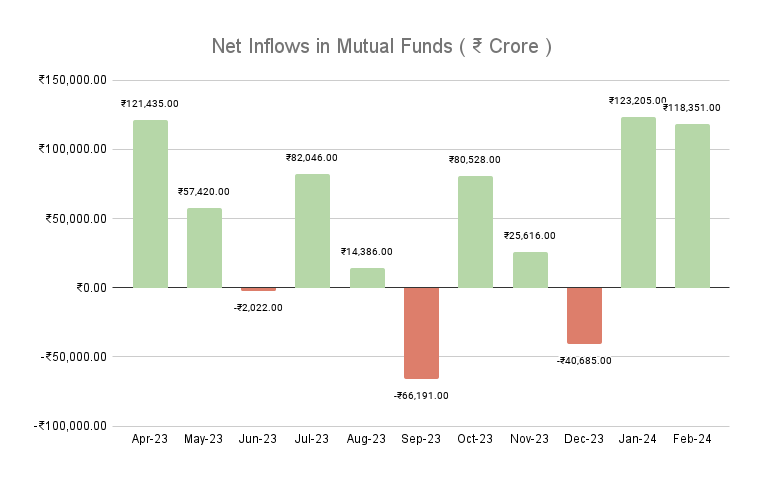
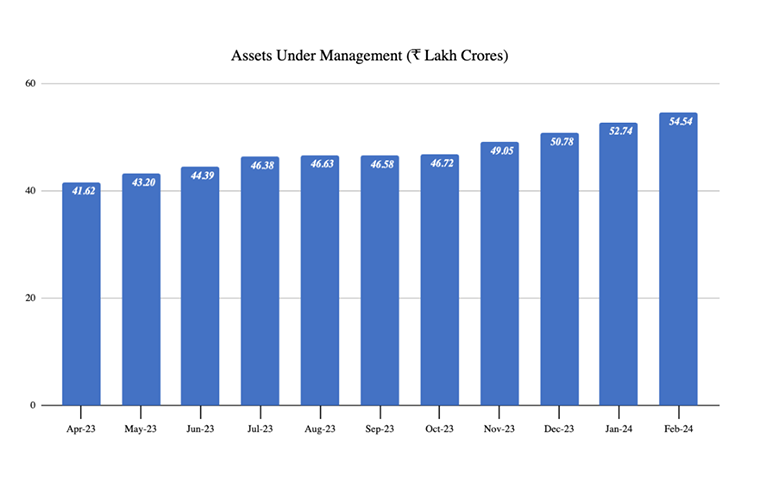
Source: SEBI
Absolutely. If we look at the RBI data on financial household flows from 2021 to 2023, while around ₹4 lakh crores flowed into mutual funds, still a staggering ₹9 lakh crores went into currency. It's like people choosing to stand outside on a scorching day with ice, rather than enjoying the comfort of an air-conditioned room. I may not deliver last year's returns every year,but i'll still outperform currency notes significantly.
Regarding the low number of unique investors compared to the total folios, it's a concern. Considering there are approximately 27 crore vehicles in India, each potential mutual fund customers, and only 4 crore investors currently, there's vast untapped potential. Even among those involved in crypto trading or gaming, there's a sizable audience that could benefit from mutual funds. We've barely scratched the surface, reaching only 15-20% of our potential customer base.
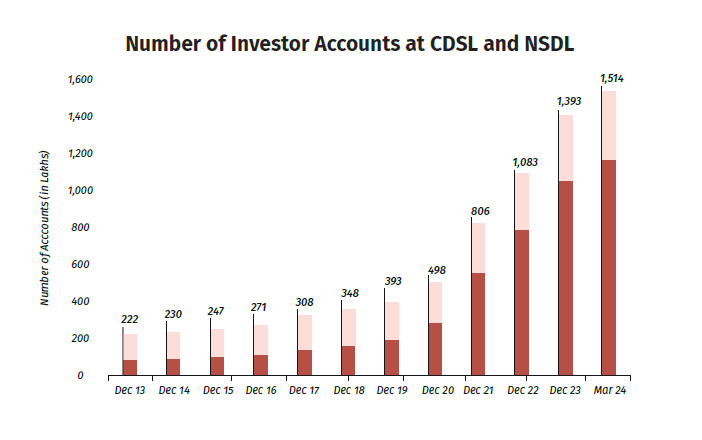
Source: SEBI, 1 Finance Magazine
The journey ahead involves penetrating semi-urban and rural India, expanding our distributor network, and enhancing the ease of investing. Achieving this will determine how soon we reach the target of 25 crore investors, making mutual funds accessible to all.
We still have a long journey. The first is a level playing field. My transparency and my communication are actually working against me.
Today, if you see most competitor products, their advertising is far more direct. Our advertising is far more nuanced.
They are able to say many things, which, as mutual funds, I am not able to say in terms of guaranteed return or potential return and so on and so forth.
Now, to reach out to the common man, I will also require distributors. Insurance has 25 lakh distributors; we are at 2.5 lakh EUIN numbers. The gap is 1:10. How do I develop my distribution reach? And third and the final thing, how do I improve the ease of making investments? Today, if you want to buy gold, you carry cash, walk into a shop, buy the gold and move out. That's not possible in the financial market, including for mutual funds. So how do I keep on improving the ease of doing business through the use of digital technology, or through use of something else? So we believe the path from 4 to 25 is given.
Considering the popularity of gambling, prediction and astrology apps, where people spend significant amounts despite uncertain returns, it seems to reflect a broader literacy issue. Despite high GST rates and diminished returns, people continue to engage. What initiatives, beyond regulatory measures, do you think can address this literacy gap and foster a mindset shift towards more informed financial decisions?
There are several approaches to improving financial literacy. Firstly, leveraging word of mouth can be powerful. If a father tells his son, “Beta SIP chalu kar", that will always have far more weight than us talking about SIPs. Satisfied customers who become brand ambassadors can significantly influence others to invest in mutual funds.
Secondly, effective communication is key. Simplifying complex concepts and communicating in a language accessible to the common man can enhance understanding and encourage long-term investment. However, finding the right medium for communication remains a challenge, as past attempts in regional languages like Punjabi, Marathi, Bengali, Kannada, Tamil, Hindi, English, Udiya, Gujarati, etc. have seen limited success.
Thirdly, product innovation plays a crucial role. What we have to launch is what is needed by my customer. Can I give them a product that is as good as bank fixed deposits but better written than bank FD? Can I give them a product that is better than physical gold? I remember when I was in ICICI Prudential, we had filed for a product that used the gold options to give you a payoff profile of full participation when gold prices went up. But because of the option, when gold prices fall, you will not lose money. In physical gold, you make money based on price movement on both sides. In this fund, you would have made money only if it went up, but no loss if it went down. It was a far superior product. We just couldn't launch it due to regulatory issues and other challenges.
Ultimately, the right product, the right communication and the right channel are required to penetrate semi-urban and rural, middle and lower middle classes.
Do you think that in 15-20 years, states like Maharashtra, Gujarat, and Karnataka could have GDPs equivalent to India's current GDP, potentially leading India to become a $20 trillion economy?
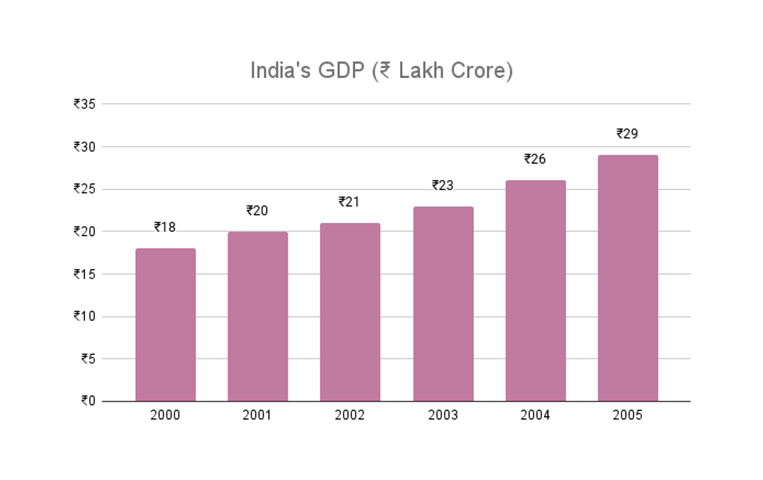
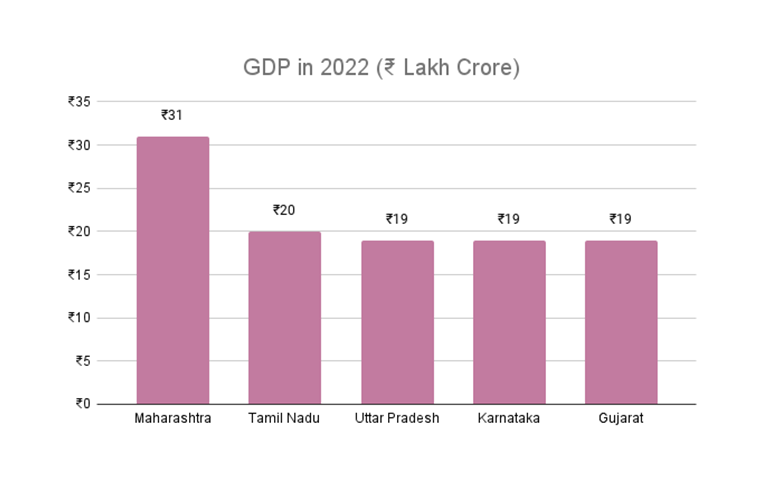
Source: RBI Handbook of Statistics
In the past two decades, states like Maharashtra, Gujarat, Tamil Nadu, Karnataka, and UP have grown their GDPs to where India's was 15-20 years ago. To reach current Indian GDP levels, they'll need to work even harder.
There's a very nice comment by Charlie Munger in his book that Koreans work for 84 hours a week, 7 days a week. Their kids, when they return from school, spend 4 hours doing additional learning. Now, do you feel surprised when you lose to them? And you must be talking to American automobile companies that were taken over by Korean automobiles. When Narayan Murthy talked about a 70 hour work week, there was a protest.
Imagine, we have to compete with Koreans who are working 84 hours a week. If we have to outperform Korea, we should be working 90 hours a week. People will have to work to achieve those numbers. It won't happen because someone else is going to work.
So as of today, certainly we have the leadership that is taking that kind of thing. I was at the RBI's 90th year celebration and the Prime Minister said, I will be busy in the elections for 100 days, but after taking the oath, we have to work hard. In the next 5 years, we will go from 5th to 3rd and then by 2047, we have to become Viksit Bharat, a developed nation with a higher per capita GDP. Those will require some amount of sacrifice and some amount of hard work.
I think it is possible this time because India has a really nice combination of talent, capital and infrastructure. Earlier, smart Indians used to go abroad for opportunities. Now, many of them are staying back. A few of them are going abroad, and then your parents money can become your startup capital. Today, there is private equity venture capital, which can give you money. And earlier, your business suffered because of infrastructure issues. Today, it's possible to ship your product in five hours from your factory in Bangalore to air cargo. Today, ports are no longer as crowded as before, and power is available. So this combination of talent capital infrastructure should deliver along with the political leadership.
Are there any sunrise sectors that you are betting at and what is your estimate behind that?
Certain sectors will experience significant growth driven by technological innovation or regulatory shifts. For instance, transitioning from fossil fuels to electric vehicles reflects regulatory pressure to address global warming. Sectors undergoing such transformations have investment potential. Engineering, especially in infrastructure and capital goods, represents a promising area due to India's proficiency in manufacturing complex engineering products.
Renewable energy, although predominantly in unlisted markets, presents opportunities amidst regulatory dependencies.
Questions
Share:


Share:
