Popular searches
Get to know your policy better
Product scoring may vary based on gender, age, policy tenure and sum assured.

Gender
Age Group

The lowest age in the selected range is considered for price evaluation (e.g., 25 - 29)
The lowest age in the selected range is considered for price evaluation (e.g., 25 - 29)
Sum Assured
Beyond the Horizon: Mr. Utpal Sheth on Terminal Value Theory and Forecasting Market Megatrends
How does your terminal value theory help you pick winning companies and
industries in the equity market?
Sure. This theory has worked for us but I am not saying it is the only theory that should work for everyone else.
In my experience, maybe 90% of the market players have a time horizon of less than 1 year,maybe 5% have a time horizon of 1-3 years, another 2% may have a time horizon of 3-5 years,another 1% may have a time horizon of 5 to 8 years and the balance may be 8 to 10 years plus.
The competitive intensity is notably lower in extended time intervals.
Unlike a classic discounted cash flow method with a fixed formula, terminal value isn't a precise mathematical number. So let's say you are standing at time T0. Today's value at time T0 is what you see, and terminal value in 10 years (T10) is what you estimate today. In 10 years, T10 shifts to T20, making it an ongoing chase rather than a destination. But this theory may not be for those working on shorter timelines. Terminal value is flexible, always changing and evolving. I look for adaptable management to handle challenges until the terminal value time.
Since it is not a mathematical concept, understanding it can be challenging. One has to get comfortable with that high degree of uncertainty because this is a distant value. It is driven by various intangibles; it is not formula-driven.
Terminal Value includes intangibles, megatrends and leadership. This can be further drilled down into factors like culture, brand, distribution, and the execution mindset of the management team. It also involves aspects like frugality and how they handle capital allocation and risk,which are challenging to quantify compared to straightforward metrics like EPS x PE.
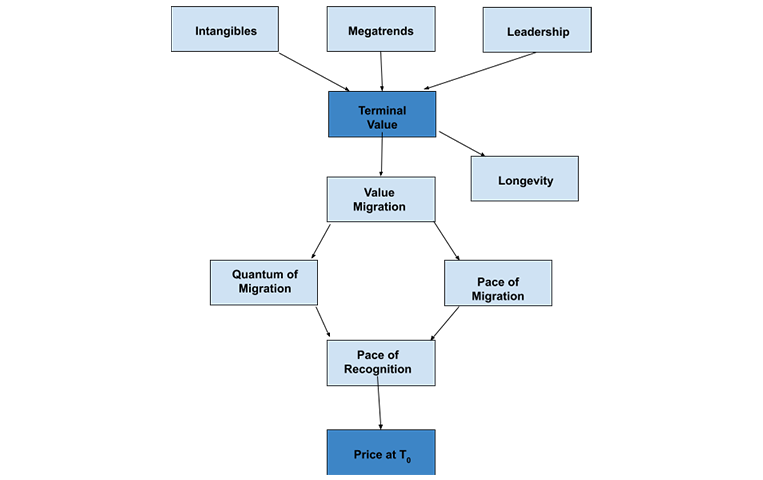
Getting comfortable with these less obvious factors is essential, with megatrends, leadership,and intangibles being the most important aspects for figuring out the terminal value.
Talking about leadership, can you elaborate on specific aspects you analyse?
Traditional views consider market share or profit pool leadership, even the quality and persona of leadership. However, focusing on sustainable leadership for our 10-year period involves institutionalisation, i.e., leadership that transfers seamlessly over time.
We have seen many Indian corporations that have had multiple leadership transitions over time and have still thrived because of institutionalisation. Most people do not realise that the institutionalisation of management itself is something that adds to longevity and, therefore, adds to valuations. In many businesses, you see instinct or gut based decision making and then there are businesses where you see data-based decision making, and there are instances where you see data-driven paralysis.
So it is important to see how a company makes its decisions. Is it thinking strategically or tactically? Is it focused on execution? Is it focused on delivering value to its customers? and so on.
There are many dimensions to leadership. There is no one formula, but you will look for a combination of these leadership characteristics that help you build your conviction in that management team or promoter.
Do you envision India emerging as a significant power in the next 20-25 years?
Clearly! India is an idea whose time has come in multiple ways. Whether it's being the fourth or fifth largest economy, the largest contributor to the global workforce in the next two decades, or the fastest-growing major economy, India is establishing itself as a vital global player. While this holds true absolutely, it's also significant relative to the rest of the world. Despite being an emerging market, India stands out. I believe in the next 10 years, we'll witness India as an independent asset class among emerging markets.
Which are the sectors that you see in India or across the world that can be megatrends in the coming decades?
As I explained to you, each megatrend has multiple dimensions and multiple layers. The ones that are very frequently talked about in the market are China plus one, opportunities in manufacturing, electric vehicles, renewables, the impact of artificial intelligence and so on. But these are very well known. Let me talk about a few that are more subtle.
I think female labour force participation is a huge change waiting to happen.
Second, the acceleration in the pace of urbanisation is another huge change. We have already seen a big change in the last two decades, but we will see far more in the next two decades in terms of urbanisation.
But a lot of that excitement is already reflected in the stock prices.
So unless you have that differentiated insight into the terminal value, you’ll not be able to hold on to it. One has to look for those megatrends in which you can build your conviction, not just to buy but also to hold, which is very important.
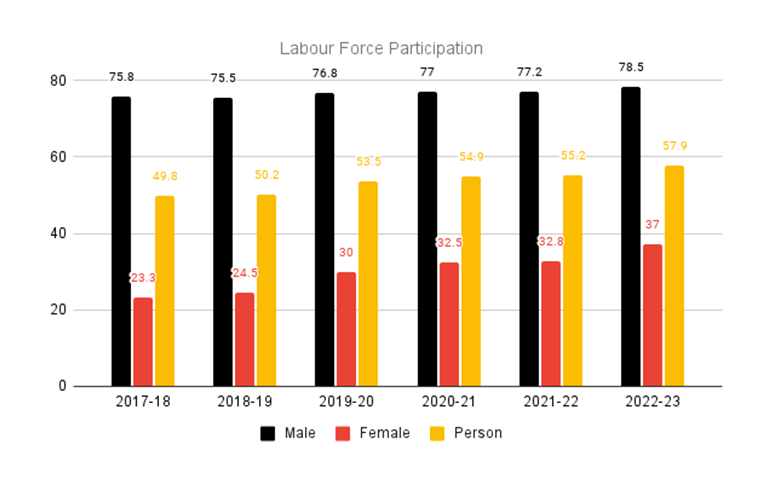
On female labour force participation, do you see a substantial shift taking place?
Absolutely. At the margin, that change is there. If you see the toppers of SSC, ICSE or CBSE, there are girls. It's a big change. If you see the proportion of women working in China, for example, it's massive. China has also become an economic powerhouse because of that and India will have to go in that direction.
Apart from the societal benefits, how will the participation of the female workforce help in the overall growth of the country?
It will double the household’s income. This will increase not just per capita GDP but also discretionary consumption.
Moreover, an empowered, independent, and professional woman ensures better education and opportunities for her children, leading to transformative societal changes. This process goes hand in hand with urbanisation and presents additional opportunities beyond the increase in female labour force participation.
Where do you see headline indices going in the next 15 to 20 years?
15 to 20 years is surely going to be positive and there is no rocket science in these predictions. If you see India, the nominal rupee return on Indian indices has been between 13-15% on along term compound basis. So I think 8x in 20-24 years is doable. We should look at 1,60,000 plus Nifty.
Questions
Share:


Share:
