




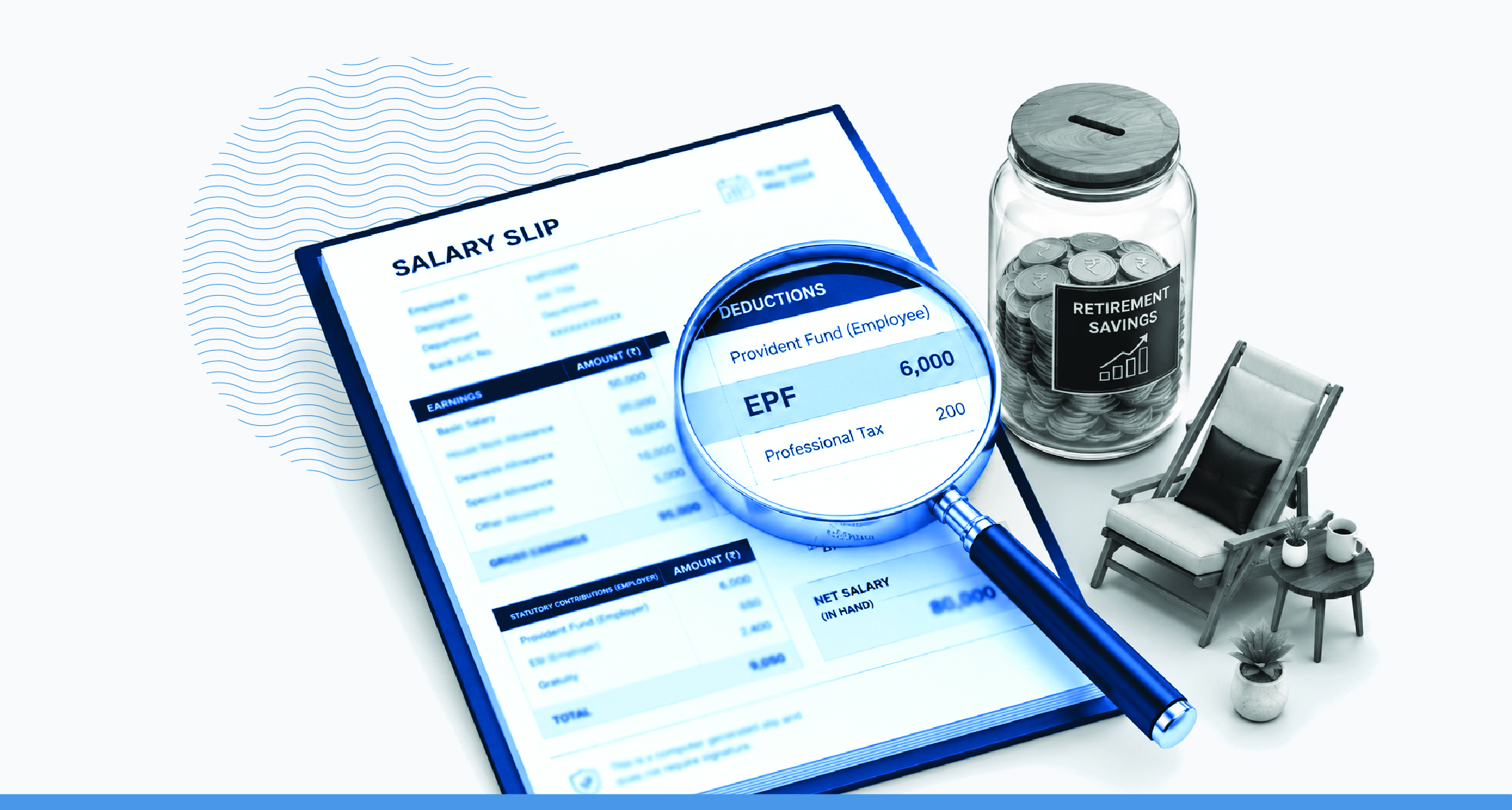
Your employer puts as much toward your retirement each month as you do, matching your Employee Provident Fund (EPF) contribution rupee for rupee. That money never reaches your salary, so the account is easy to forget about entirely.
Over a career, those paired contributions compound at a government-set rate into a corpus most people underestimate. So it is worth knowing how much goes in each month, how the balance grows, and when you can reach it.
What is the Employee Provident Fund?
The Employee Provident Fund is a compulsory retirement savings scheme for salaried employees in India, funded by a monthly contribution from both you and your employer. It is run by the Employees’ Provident Fund Organisation (EPFO), a statutory body set up under the Employees’ Provident Funds and Miscellaneous Provisions Act of 1952.
EPFO actually runs three linked schemes.
- Employee Provident Fund (EPF) is your long-term retirement corpus.
- Employees’ Pension Scheme (EPS) pays you a monthly pension once you retire.
- Employees’ Deposit Linked Insurance (EDLI) gives your family an insurance payout if you pass away while still in service.
Each scheme operates within defined wage ceilings and contribution rules. The sections ahead work through those rules in detail.
Who can join an Employee Provident Fund
To become an EPF member, two things decide: the size of your employer and your basic monthly salary. Any company in a covered industry with 20 or more employees must register under the 1952 Act, and its staff become EPF members from their first day. Smaller employers can choose to register, creating a voluntary employee fund (VPF) that offers the same membership.
Inside a registered company, your pay sets the terms. A basic monthly salary plus dearness allowance of ₹15,000 a month or less makes EPF compulsory, with contributions starting on day one. If your basic pay is above ₹15,000, EPF is optional; you join only if you and your employer submit a joint request.

Plan for your retirement today
Consult our Qualified Financial Advisors to guide you
 Book a free consultation
How much goes into your EPF account monthly
Both you and your employer put in 12% of your basic salary plus dearness allowance, a combined 24%. Your full 12% goes straight into your EPF account. The split happens with the employer’s 12%. For a basic salary at or below ₹15,000, the rule is fixed. This ceiling sets the most that can ever go to the pension side.
1. When your monthly basic salary is ₹15,000 or less
Your full 12% share goes into your EPF account every month. Your employer sends 8.33% of your pay to the pension scheme and the remaining 3.67% to your EPF account.
Consider a basic monthly salary of ₹15,000
| Component | Contribution |
|---|---|
| Your contribution (12% of ₹15,000) | ₹1,800 |
| Employer contribution to EPS (8.33% of ₹15,000) | ₹1,250 |
| Employer contribution to EPF (3.67% of ₹15,000) | ₹550 |
| Total contribution into EPF every month | ₹2,350 (₹1,800 + ₹550) |
2. When your monthly basic salary is more than ₹15,000
Above ₹15,000, the employer’s pension (EPS) contribution is capped at ₹1,250 a month, which is 8.33% of the ₹15,000 ceiling. Any employer contribution above 12% of your actual salary (the portion that exceeds the EPS cap) is put into your EPF account instead.
Whether you get any EPS pension at all depends on your EPS membership: employees whose salary first crossed the ₹15,000 ceiling after September 2014 usually have the entire employer share credited to EPF, so no employer pension contribution goes to EPS.
How ₹30,000 basic monthly salary splits, with and without EPS
| Component | If you are in EPS | If the full share goes to EPF |
|---|---|---|
| Your contribution (12% of ₹30,000) | ₹3,600 | ₹3,600 |
| Employer contribution to EPS (capped at 8.33% of ₹15,000) | ₹1,250 | ₹0 |
| Total employer contribution to EPF | ₹2,350 (₹3,600 − ₹1,250) | ₹3,600 |
| Total contribution into EPF every month | ₹5,950 (₹3,600 + ₹2,350) | ₹7,200 |
The result is that high earners build a far larger EPF balance than pension over their working years. The EPS contribution stays frozen at ₹1,250 a month, regardless of your basic monthly salary.
How your EPF balance grows
Your balance earns interest at a rate the EPFO sets each year from what the fund itself earns. For FY 2025-26 the rate is 8.25%, held there for the second year running. Interest is worked out on your monthly running balance and credited to your account at the close of the financial year.
Over a long career the rate does the heavier lifting, because the interest you earn starts earning interest of its own. A contribution made in your 20s has three decades to compound before you retire. That’s why the employee provident fund scheme rewards an early start and an unbroken record far more than a large contribution made late.
How EPF taxation works at each stage
EPF carries EEE status, which stands for exempt at contribution, exempt on interest, and exempt at withdrawal, but those exemptions come with conditions.
The employee contribution is eligible for deduction under Section 80C (up to ₹1.5 lakh) only if you opt for the old tax regime; the new tax regime gives no equivalent deduction, so the “exempt at contribution” benefit effectively doesn’t apply there. If the employer’s annual contribution (when added to their contributions to NPS and superannuation) exceeds ₹7.5 lakh in a financial year, the excess is treated as a taxable perquisite in your hands.
Interest on EPF is tax‑free, but if your own contributions in a financial year exceed ₹2.5 lakh, the interest attributable to the excess becomes taxable in that year, under ‘Income from Other Sources’.
Withdrawals are tax‑free only after 5 continuous years of service, applicable for both principal and interest accrued; premature withdrawals can be taxable and may attract TDS (10% for PAN-linked and 30% if PAN isn’t provided) above the prescribed threshold of ₹50,000.
In short: Employee provident fund is EEE in principle, but old vs new tax regime choice, contribution size and the 5‑year continuity rule create specific exceptions where tax can apply.
When you can withdraw from EPF, and how much
The employee provident fund is designed as a retirement product, though it isn’t sealed shut until then. You can take the full balance once you retire, which the scheme treats as age 58 for final settlement, with early retirement allowed from 55. From age 54, a year before that early mark, up to 90% of the EPF balance can be drawn.
Certain exceptions are acceptable for early withdrawal. Losing your job opens access sooner. You can withdraw 75% of the balance after one month without work, and the remaining 25% after the second month. The scheme also permits partial withdrawals during your working years for set reasons, such as a medical emergency, higher education, a home purchase or loan repayment, or a wedding in the family, each with its own conditions and limits.
A common worry has a clear answer, what becomes of your EPF when you change jobs. Your Universal Account Number (UAN) stays with you across employers, so the balance carries forward and keeps earning interest without a break. Nothing is paid out or reset when you move.
Benefits of employee provident fund for retirement
Its biggest advantage is the employer match. Every rupee you contribute is met by an equal one from your employer. So, the corpus builds at close to twice the pace your own deduction suggests. That match is part of your earnings, set aside for later rather than paid out now.
Stability comes next. It is government-backed and pays a declared rate, so your balance doesn’t move with the equity market the way a mutual fund does. That steadiness earns it a place in most retirement plans, working alongside market-linked investments rather than replacing them.
The quality people overlook is that the scheme saves without being asked. The money is set aside before you ever see it. It removes the hardest part of saving, the monthly decision to do it at all. The corpus keeps growing year after year while you forget it is there.
The next time you look at your salary slip, give that EPF line a second look. A Qualified Financial Advisor can place EPF within the wider picture of your investments, taxes, insurance, and retirement income, so the corpus building each month is doing the work it should within your full plan.