
 Book a free consultation
From Clay Tablets to Plastic: The Evolutionary Journey of Credit Cards
Credit cards blogs
Jul 7, 2023

Plan Your Retirement with Our Qualified Financial Advisors

Your first financial plan is free
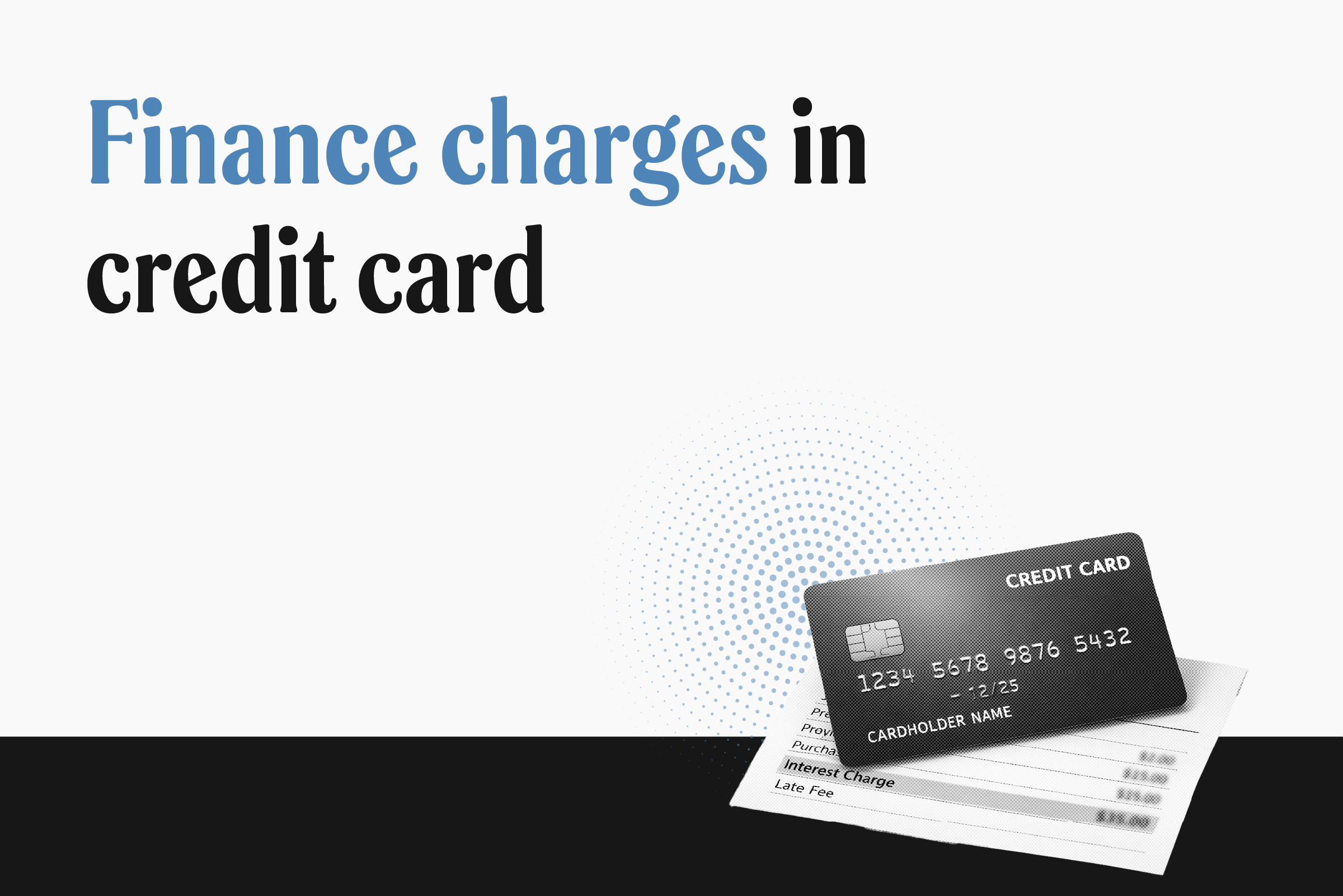
Have you ever seen the term “finance charge” in your credit card statement but you were not able to fully understand it? Credit cards offer us convenience of buying now and paying later, You can earn rewards, and manage your monthly expenses smoothly. But what happens when you are not able to pay back? You face a penalty, also called finance charges.
In this article, we will clearly explain what a finance charge is, when it applies, how it is calculated, and most importantly, how you can avoid paying unnecessary interest. Understanding this will help you use your credit card wisely and stay in control of your money.
Finance charge is often a basket of different costs related to credit usage. Key components of finance charge includes:
Interest on outstanding balance
When you receive your credit card bill, you are expected to pay the full statement amount by the due date. If you pay less than the full amount, even if you pay only the minimum due, the remaining unpaid amount becomes your outstanding balance.
The bank then charges interest on this unpaid amount from the due date until you fully repay it.
The longer you take to clear this balance, the more interest gets added. Since credit card interest rates are usually high, this cost can increase quickly if you keep carrying the balance forward.
Example: Suppose your credit card bill is ₹20,000.
Now, this ₹15,000 becomes your outstanding balance.
If your card charges 3% interest per month, interest will be applied on ₹15,000 until you fully repay it.
So roughly:
If you don’t clear it next month, interest will again be charged — and possibly on a higher amount if new purchases are added.
Interest on cash advances:
When you withdraw cash using your credit card (ATM withdrawal), it is called a cash advance.
Cash advances are more expensive than normal purchases because:
Here, you start paying interest immediately.
Interest/charges on overdue EMIs:
If you convert purchases to EMI and then miss an EMI, interest is charged on the overdue EMI amount. This is also included in finance charges.
Balance transfer interest and fees:
A balance transfer means moving your unpaid credit card balance from one card to another, usually to get a lower interest rate for a limited time. While this can help reduce interest, it is not completely free.
There are usually two types of costs involved:
Both of these are part of your total finance charges.
Late payment fees and related interest:
If you miss or delay payment, the issuer can charge a late fee and may levy a higher “penalty APR”; these costs are part of the overall finance burden of using credit.
Let our Qualified Financial Advisors guide you for free!

We will get back to you shortly.
Most banks calculate credit card interest on a daily basis on your unpaid balance. At the end of the billing cycle, they total this interest and show it as a finance charge in your monthly statement.
Here’s the formula: Finance charge = outstanding balance × daily interest rate × number of days
For example : Outstanding balance = ₹20,000, monthly interest rate = 3%, you carry it for 30 days.
Finance charge: ₹20,000 × 0.1% × 30 days ( 3% divided by 30 days) = 600
So, ₹600 will be added as finance charge for that month.
If you don’t clear it next month, interest will again be charged, possibly on a higher amount.
Things to be mindful of
That is why credit cards are considered one of the most expensive ways to borrow money.
Even a small unpaid amount can grow if you keep carrying it forward.
While exact numbers vary by issuer and product, most Indian cards fall roughly in these ranges:
| Component | Typical level in India (approx.) |
| Monthly interest on purchases | About 2.5%–3.75% per month on revolving balances. |
| Annualised interest (APR) | About 30%–45% per annum when you revolve dues. |
| Cash advance interest | Often 3.4%–3.75% per month, from transaction date, no grace period. |
| Balance transfer fee | Roughly 3%–5% of the amount transferred (plus interest later). |
| Late payment fee | Slab based, depending on statement amount; varies by issuer. |
| GST on interest/fees | 18% GST on interest and eligible fees, further raising effective cost. |
These values are indicative to show how expensive revolving credit card debt can become if not managed carefully.
Finance charges typically apply when:
Ways to minimise or avoid finance charges:
Book a call with our Qualified Financial Advisor for your tax plan
We will get back to you shortly.
Finance charges usually don’t happen because people want to borrow at high interest. They happen because of poor planning, unexpected expenses, cash flow problems, or depending too much on credit cards. This is where proper financial planning makes a big difference.
When you plan your finances well:
A simple monthly budget, regular savings habit, and clear repayment discipline can help you completely avoid unnecessary interest and penalties.
Credit cards are not the problem. Lack of planning is. When your finances are organised, you:
In the end, smart financial planning is the best way to enjoy the benefits of credit cards without falling into the trap of finance charges.
Speak to a Qualified Financial Advisor today and take control of your finances before small dues turn into big debt.
Published on 23 Feb 2026, 4:39 pm IST

The views in the article /blog are personal and that of the author. The idea is to create awareness and not intended to provide any product recommendations.


Plan Your Retirement with Our Qualified Financial Advisors
Your first financial plan is free