



How Imposter Syndrome Sneaks Up on Your Finances
Call it a bias, a pattern or a habit, but at its most basic level, imposter syndrome ...
 Book a free consulation
Get advice on investing, insurance, tax planning, loan management, etc, for free with a Qualifed Financial Advisor
In the late 1800s, an American scientist named Wilbur Atwater locked people in a strange metal room. They ate measured plates of food, rode a stationary bicycle, even slept inside this box while machines tracked every breath they took and every bit of heat their bodies gave off. Out of that odd experiment came something of great utility, something people utter almost every day: the calorie, a simple number that suddenly made our invisible eating habits visible. For the first time, people could see not just what they were eating, but how that behaviour added up over time.
In personal finance, most of us are still in the pre-calorie era. We have portfolio values, CIBIL scores, app dashboards… but almost no way to measure the thing that actually decides our outcomes over decades: our financial behaviour.
Your current financial condition is nothing but the outcome of your financial behaviour.
But what is financial behaviour? It’s the way you act with your money. Not what you intend to do with it, but what you actually do, every day, repeatedly. These patterns, conscious or not, make up your financial behaviour. Good patterns build stability and wealth. Poor patterns lead to financial stress and despair.
If Financial behaviour is so important, how do you know whether it is actually on the right track?
Galileo once said, “Measure what is measurable, and make measurable what is not so.”
Hence, to measure your financial journey, we created the Financial Behaviour Score (FBS).
The Financial Behaviour Score (FBS) is a numerical representation of your financial well-being. It reflects how closely your current financial choices align with the ideal behaviour suited to your personal situation and the broader macroeconomic environment.
The score is calculated by looking at three key areas of your financial life: Expense & Liability Management, Asset Allocation, and Emergency Planning.
Expense & Liability Management looks at how well you control spending, save regularly, and manage debt. Asset Allocation evaluates how your investments are spread across assets like equity, debt, and real estate, and whether they suit your personal profile. Emergency Planning assesses how prepared you are for unexpected situations by reviewing your liquid savings and insurance coverage..
FBS is measured on a scale of 0 to 100. Based on your score, you fall into one of three ranges:
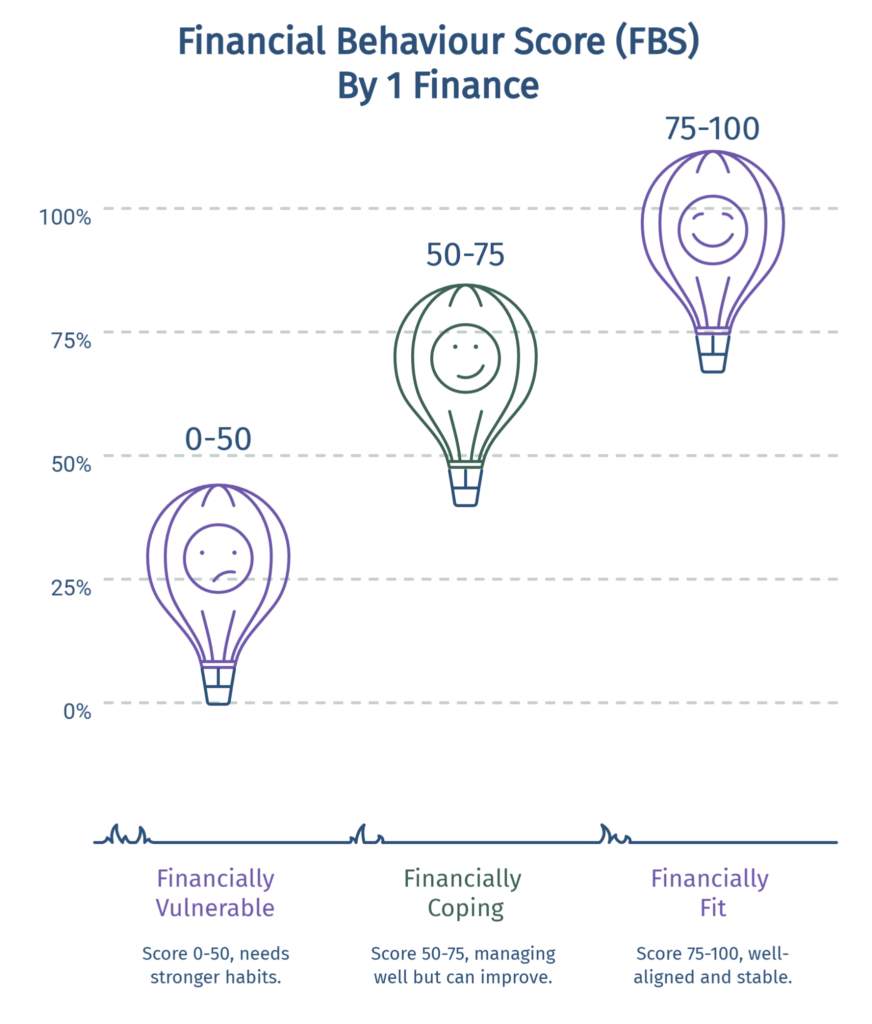
The Financial Behaviour Score aims to do what calories did with people’s food habits.
Most people already know the basics, save regularly, avoid unnecessary debt, build an emergency buffer, protect your risks. But knowing isn’t the same as seeing how well you are actually doing.
Just like calories makes your energy from food intake visible, FBS makes your financial behaviour visible.
Suppose your score comes back as 44, and the biggest factor pulling it down is an underfunded emergency buffer. Now the issue is clear, and so is the next step.
In practice, this is what FBS changes:
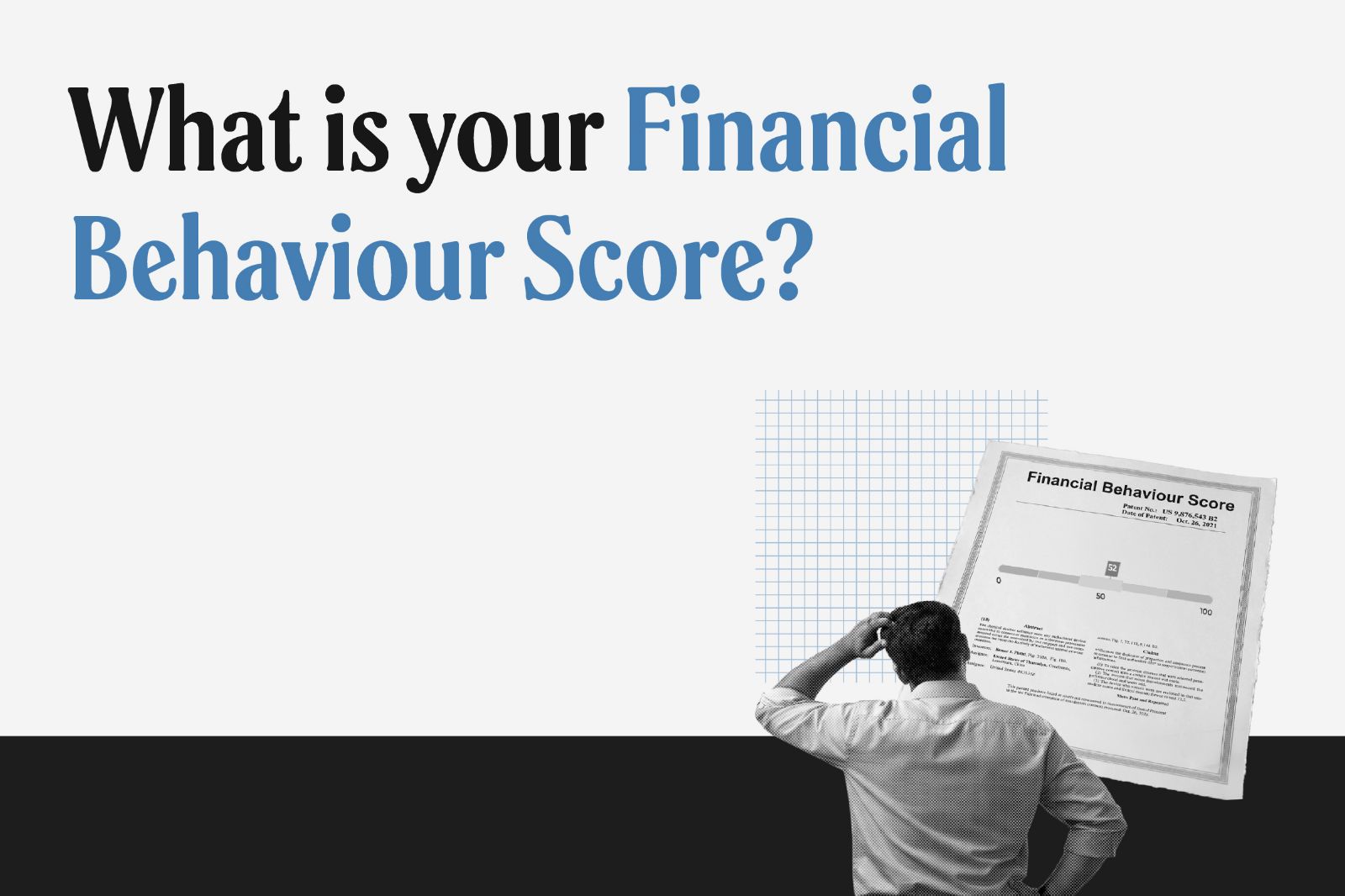
1 Finance has been granted an Indian patent for the Financial Behaviour Score, making it the first company in India, and the first globally, to receive a patent for a framework that systematically quantifies financial behaviour through a structured, dynamic scoring model.
Your Financial Behaviour Score is not something you can calculate with an online calculator. It is determined through a structured advisory conversation that examines your real financial life, your income, savings rate, debt, insurance, assets, and most importantly, your MoneySign®, your innate personality with money.
Once your MoneySign® is established and your financial picture is mapped, your FBS is assessed across five core areas: savings, debt, emergency preparedness, protection, and asset alignment. The score is then benchmarked against your life stage, goals, and circumstances.
To know your Financial Behaviour Score, visit 1finance.co.in or download the 1 Finance app and book a FREE consultation with a Qualified Financial Advisor.
Your Qualified Financial Advisor (QFA) will first create a comprehensive financial plan by analysing your income, expenses, assets, liabilities, savings patterns, insurance coverage, and investment portfolio. The plan also takes into account your MoneySign® (your financial personality with money), life stage, generation, financial goals, and the prevailing macroeconomic environment.
Using this information, your financial behaviour is evaluated through 1 Finance’s patented Financial Behaviour Score (FBS) framework.
In 1726, a 20-year-old printer named Benjamin Franklin began a habit that would change his life. He took a small leather notebook and dedicated it to tracking 13 virtues, principles like frugality and industry. Every night, Franklin sat down to mark where he had slipped. He did it because he believed a simple truth: You cannot fix what you cannot see.
By age 42, Franklin had retired. He was wealthy enough to spend the rest of his life as an inventor and diplomat. Interestingly, he never once tracked his net worth in that notebook. He tracked his behaviour.
“I was surprised to find myself so much more full of faults than I had imagined; but I had the satisfaction of seeing them diminish.” — benjamin franklin
He simply trusted that if the inputs were right, the outcomes would follow.
He was right.
Today, you have a tool he didn’t: a precise, personalised number that tells you exactly where your financial behaviour stands.
The question is no longer “am i doing okay with money?” That question is too vague to ever answer honestly. The real question is: what is your financial behaviour score, and what is it telling you?
If you don’t know your number yet, finding it is the most important investment you can make today. Book a FREE consultation now.

The views in the article /blog are personal and that of the author. The idea is to create awareness and not intended to provide any product recommendations.


Get advice on investing, insurance, tax planning, loan management, etc, for free with a Qualifed Financial Advisor
Explore
Call it a bias, a pattern or a habit, but at its most basic level, imposter syndrome ...

Imagine that it is the start of a slow, stress-free weekend where you’re sippin...

Personalised financial planning starts with who you are.