
 Book a free consultation
Who needs to file ITR in India? Income limits & mandatory cases (AY 2026-27)
By Arman Qureshi
ITR Filing
Jun 26, 2026
Plan Your Retirement with Our Qualified Financial Advisors

Your first financial plan is free
Every year, crores of taxpayers face the same question: Which ITR form should I file? You may think it’s a small detail, choosing the correct form is important. Filing your return using the wrong ITR form can result in your return being treated as defective, which may lead to a notice from the Income Tax Department and require you to file a corrected return. It can also delay the processing of your refund.
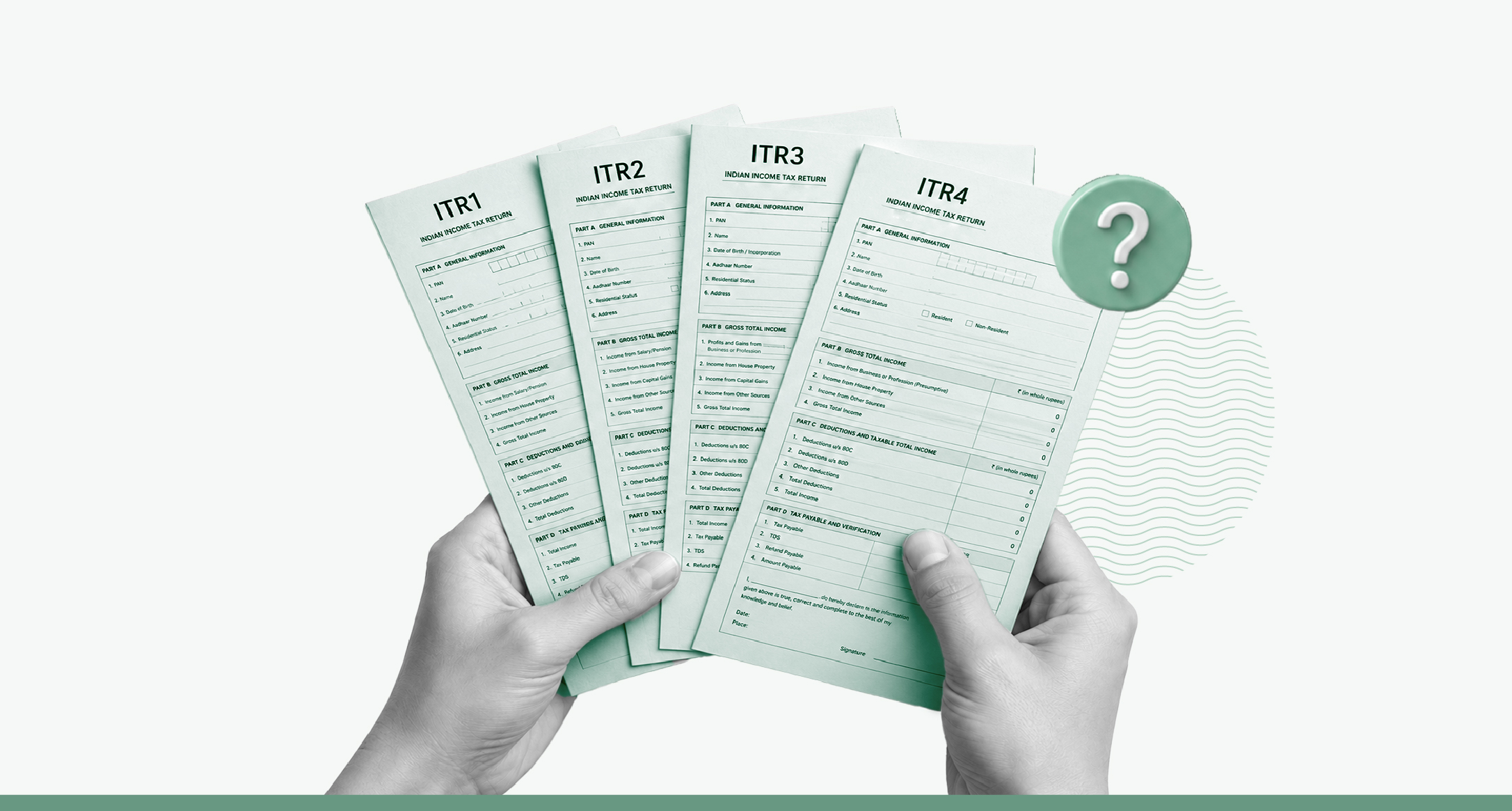
In this article, we’ll explain the four ITR forms commonly used by individual taxpayers, ITR-1, ITR-2, ITR-3, and ITR-4, in simple language. We’ll also highlight the key changes for AY 2026–27 and provide an easy way to determine which form applies to your situation.
For information on filing deadlines, tax regimes, required documents, and the filing process, refer to our complete ITR filing guide for FY 2025–26.
Two changes for AY 2026-27 have widened who can use the simplest form, ITR-1, so some advice you may have read in earlier years no longer holds:
So the blanket rule “any capital gains means ITR-2″ is outdated. The detail matters, read on.
| ITR-1 (Sahaj) | ITR-2 | ITR-3 | ITR-4 (Sugam) | |
| Suitable for | Salaried / pensioners with simple income | Individuals with capital gains or higher income, no business | Business owners & professionals | Small businesses & professionals under presumptive tax |
| Income limit | Up to ₹50 lakh | No limit | No limit | Up to ₹50 lakh |
| Salary / pension | Yes | Yes | Yes | Yes |
| House property | Up to 2 | Any number | Any number | Up to 1 |
| Capital gains | Only LTCG u/s 112A up to ₹1.25 lakh | Yes, all types | Yes, all types | Only LTCG u/s 112A up to ₹1.25 lakh |
| Business / professional income | No | No | Yes | Yes (presumptive only) |
| Who it’s NOT for | NRIs, directors, those with unlisted shares | Those with business income | — | NRIs, directors, those needing audited books |
Use this as a quick filter, then confirm against the detail below.
Let our Qualified Financial Advisors guide you

We will get back to you shortly.
→ ITR-1 is the simplest form, designed for resident individuals with straightforward finances. You can use it if all of these are true:
→ You are a resident individual (not an NRI, and not “resident but not ordinarily resident”).
→ Your total income is up to ₹50 lakh.
→ Your income comes from salary or pension, up to two house properties, and other sources such as interest.
→ Any long-term capital gains are under Section 112A (listed equity or equity mutual funds), are up to ₹1.25 lakh, and you have no capital losses to carry forward.
→ Your agricultural income is up to ₹5,000.
You cannot use ITR-1 if:
→ You have business or professional income, more than two house properties
→ Any short-term capital gains, long-term gains above ₹1.25 lakh from property/gold/other assets, foreign income or assets
→ Income above ₹50 lakh, capital losses to carry forward
→ If you are a company director or hold unlisted equity shares. In any of those cases, move up to ITR-2 (or ITR-3/ITR-4 if you have business income).
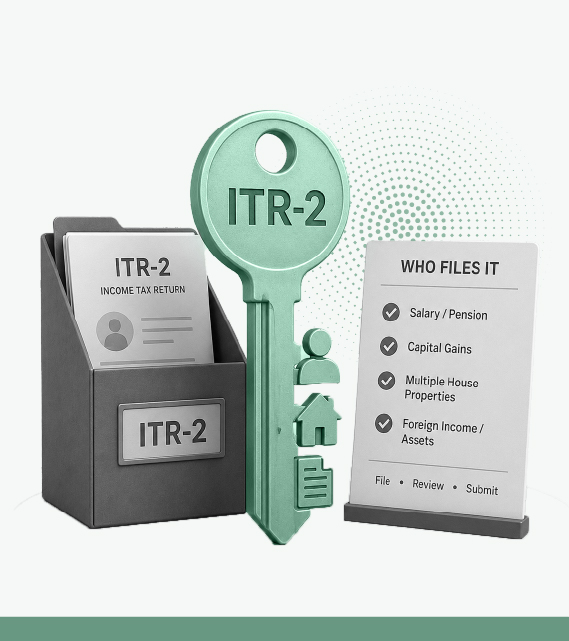
ITR-2 is the form for individuals and Hindu Undivided Families (HUFs) whose finances are a step more complex than ITR-1 allows, but who do not run a business or profession. You should file ITR-2 if you have:
→ Capital gains beyond the small LTCG exception above, for example, short-term gains, larger long-term gains, or gains from selling property, gold, or unlisted shares.
→ More than two house properties.
→ Total income above ₹50 lakh.
→ Foreign income or foreign assets, or you are claiming relief under a tax treaty.
→ A directorship in a company, holdings of unlisted equity shares, or losses to carry forward.
If you also have business or professional income, ITR-2 is not for you, you need ITR-3.
ITR-3 is for individuals and HUFs earning income from a business or profession where you maintain regular books of accounts, for instance, a trader running a proprietorship, a doctor or lawyer in independent practice, or someone with significant trading activity treated as business income. It is the most detailed of the individual forms, because it captures everything ITR-2 does (salary, house property, capital gains, other sources) plus the profit-and-loss and balance-sheet details of your business. Partners earning income from a partnership firm also use ITR-3.
ITR-4 is the simplified route for small businesses and professionals who opt for the presumptive taxation scheme under Sections 44AD, 44ADA, or 44AE. Under presumptive tax, your income is taken as a fixed percentage of your turnover or receipts, so you don’t have to maintain detailed books. You can use ITR-4 if:
→ You are a resident individual, HUF, or firm (other than an LLP).
→ Your total income is up to ₹50 lakh.
→ Your business or professional income is declared on a presumptive basis.
→ As with ITR-1, any LTCG under Section 112A is up to ₹1.25 lakh with no losses carried forward.
You cannot use ITR-4 if your income exceeds ₹50 lakh, you are a company director, you hold unlisted shares, you are an NRI or RNOR, or you are required to maintain audited books of accounts. In those situations, ITR-3 is the correct form.
ITR-5, ITR-6, and ITR-7 exist too, but they are for firms and LLPs, companies, and trusts respectively, not individual taxpayers, so they fall outside this guide.
Let our Qualified Financial Advisors guide you
We will get back to you shortly.
You can usually identify the correct ITR form by answering a few simple questions. Start at the top and stop when you reach your first “yes.”
Do you have income from a business or profession?
Do you have any of the following?
Is your income limited to the following?
As a general rule, if you are unsure between two forms, choose the form that can accommodate all your income sources. Filing with a form that is too simple for your situation can result in a defective return notice and additional compliance requirements. Using a more detailed form than necessary is generally not a problem.
If you file with a form that doesn’t match your income, say, ITR-1 when you actually had short-term capital gains more than the limit, the department can issue a defective return notice under Section 139(9). You then get a limited window to fix it and re-file. Until you do, your return isn’t treated as validly filed, which can delay your refund and, if the deadline passes, expose you to late-filing consequences. A few minutes spent choosing correctly up front saves all of that.
If you’re still unsure after the steps above, you can connect with our advisors by clicking here.
Which ITR form should I file?
The right ITR form depends on your income sources. Most salaried individuals and pensioners use ITR-1, while those with capital gains, foreign assets, or higher incomes typically use ITR-2. Taxpayers with business or professional income generally file ITR-3 or ITR-4, depending on their tax scheme.
Who can file ITR-1 (Sahaj)?
ITR-1 can be filed by resident individuals with total income up to ₹50 lakh from salary or pension, up to two house properties, and other sources such as interest income. It also allows limited reporting of long-term capital gains under Section 112A. It cannot be used by taxpayers with business income, foreign assets, directorships, or unlisted shares.
Who can file ITR-2?
ITR-2 is for individuals and HUFs who do not have business or professional income but have income sources that are not covered under ITR-1, such as significant capital gains, foreign assets, or higher income levels.
Who can file ITR-4?
ITR-4 is meant for resident individuals, HUFs, and eligible firms that opt for the presumptive taxation scheme under Sections 44AD, 44ADA, or 44AE. It is designed to simplify tax filing for small businesses and professionals.
Can I report capital gains in ITR-1 now?
Yes, but only in limited cases. For AY 2026–27, ITR-1 can be used to report long-term capital gains under Section 112A from listed shares or equity mutual funds up to ₹1.25 lakh, provided there are no capital losses to carry forward. Other types of capital gains require ITR-2 or ITR-3.
What is the difference between ITR-3 and ITR-4?
Both forms are used for business or professional income. ITR-4 is for taxpayers using the presumptive taxation scheme, while ITR-3 is for those maintaining regular books of accounts or those who do not qualify for the presumptive scheme.
What is the full form of ITR?
ITR stands for Income Tax Return. It is the form used to report your income, deductions, taxes paid, and tax liability to the Income Tax Department.
What is an ITR form?
An ITR form is the prescribed format used to file your income tax return. Different forms apply to different types of taxpayers and income sources.
How many ITR forms are there?
There are seven ITR forms, from ITR-1 to ITR-7. Individual taxpayers usually file ITR-1, ITR-2, ITR-3, or ITR-4, while the remaining forms are used by firms, companies, trusts, and other entities.
Which ITR form should a salaried person file?
Most salaried individuals file ITR-1. However, depending on factors such as capital gains, foreign assets, or higher income levels, some salaried taxpayers may need to file ITR-2 instead.
Which ITR form is used for capital gains?
In most cases, taxpayers with capital gains and no business income file ITR-2. If business income is also involved, ITR-3 is generally required.
Which ITR form should an NRI file?
NRIs generally file ITR-2 if they do not have business income in India. Those with business or professional income typically file ITR-3.
Which ITR form is for pensioners?
Most pensioners file ITR-1, as pension income is treated as salary income for tax purposes. Depending on their other income sources, some pensioners may need to use ITR-2.
What is ITR-V?
ITR-V is the acknowledgement generated after you submit your income tax return. It serves as proof of filing and is used for verification if you do not complete e-verification online.
Is Form 16 the same as an ITR?
No. Form 16 is a certificate issued by your employer showing salary income and TDS deducted, while an ITR is the return you file with the Income Tax Department.
Is Form 16 mandatory for filing an ITR?
No. You can file your return using other documents such as salary slips, bank statements, Form 26AS, and the Annual Information Statement (AIS).
Can the ITR form be changed in a revised return?
Yes. If you discover that you used the wrong ITR form, you can generally correct it by filing a revised return within the prescribed time limit.
What is ITR-5?
ITR-5 is the income tax return form used by firms, LLPs, Associations of Persons (AOPs), Bodies of Individuals (BOIs), and certain other entities. It is not meant for individual taxpayers

The views in the article /blog are personal and that of the author. The idea is to create awareness and not intended to provide any product recommendations.


Plan Your Retirement with Our Qualified Financial Advisors
Your first financial plan is free