

 Book a free consultation
Will and estate planning: How to smoothly transfer your legacy
By Arman Qureshi
Estate Planning
May 26, 2025


Plan Your Retirement with Our Qualified Financial Advisors

Your first financial plan is free
Without a Will, or with one that was poorly drafted, the law divides your estate by its own fixed order of heirs. That formula applies regardless of what you actually wanted. Inheritance planning is, at its heart, about peace of mind; it’s the assurance that what you spent a lifetime building reaches the people you choose and in the manner you want.
One way to do this is through creating a Will, specially if you want to bypass what the default law has provided for you. The Indian law recognises several types of Wills; each are built for a different situation, and choosing the right one is where estate planning begins.
A financial plan looks after your assets and liabilities while you are alive. Will and estate planning decides what becomes of them afterwards, which is why it belongs alongside your investments rather than as an afterthought.
A privileged Will is the exception the law makes for soldiers, airmen, and mariners who are on an expedition, engaged in actual warfare, or at sea. Sections 65 and 66 of the Indian Succession Act, 1925 let them record their wishes with far fewer formalities, even as oral declarations made in the presence of two witnesses. It recognises that individuals serving in such circumstances may not have the opportunity to prepare and execute a formal Will.
An unprivileged Will is the one almost everyone makes, covering everyone outside active military service. Section 63 of the Indian Succession Act, 1925 governs it, and to be valid it must be in writing, signed by you, and attested by two independent witnesses. Every other type below is a variation of this, defined by who makes it or how it is written.
A conditional Will takes effect only if a specified event happens, and stays dormant until then. A parent might leave a property to a child on the condition that the child finishes a degree. The condition must be lawful, since a court will declare it void if it is illegal, immoral, or impossible to fulfil.
A concurrent Will is one person writing two or more Wills to deal with different parts of their estate. These types of Wills suit scattered estates, separated by type of asset or by geography. Someone might use one Will for assets held in India and another for property abroad, with both valid and administered at the same time. Concurrent Wills run together and are read as a single testamentary plan.
A mutual Will is made when two people, usually spouses, agree on how their property will ultimately be distributed after both have passed away. The defining feature is the underlying agreement: once one person dies and the survivor accepts the benefits under the Will, the survivor is generally bound by the agreed arrangement and cannot later change the final beneficiaries. Couples often use mutual Wills to ensure that assets eventually pass to their children or other chosen heirs rather than being redirected elsewhere.
Also read: The tax side of inheritance in India: What you should know before passing your assets
A joint Will is a single document executed by two or more people, most commonly spouses, setting out their testamentary wishes in one instrument. Although it is one document, it operates as the Will of each person separately and takes effect on each death in turn. Unlike a mutual Will, a joint Will doesn’t necessarily prevent the surviving person from changing their own testamentary arrangements later unless it also contains a binding mutual agreement.
Unlike other types of Wills, a holograph Will is written entirely by the testator in their own handwriting. The inclusion of pre-printed text, typed passages, or entries completed by another person means it no longer qualifies as a true holograph document. Because the entire Will is handwritten, it can provide stronger evidence of authenticity and testamentary intent. However, it remains an unprivileged Will and must still be signed by the testator and attested by two witnesses to be legally valid.
A duplicate Will is an exact replica of the original Will, executed with the same signatures and witness attestations. The two copies are typically stored separately so that one remains available if the other is lost, damaged, or inaccessible. For added security, important estate planning documents may also be kept in safe deposit lockers available at 1 Finance Financial Planning Centres. Since both copies are treated as original Wills, any act intended to revoke one copy may have legal consequences for the Will as a whole.
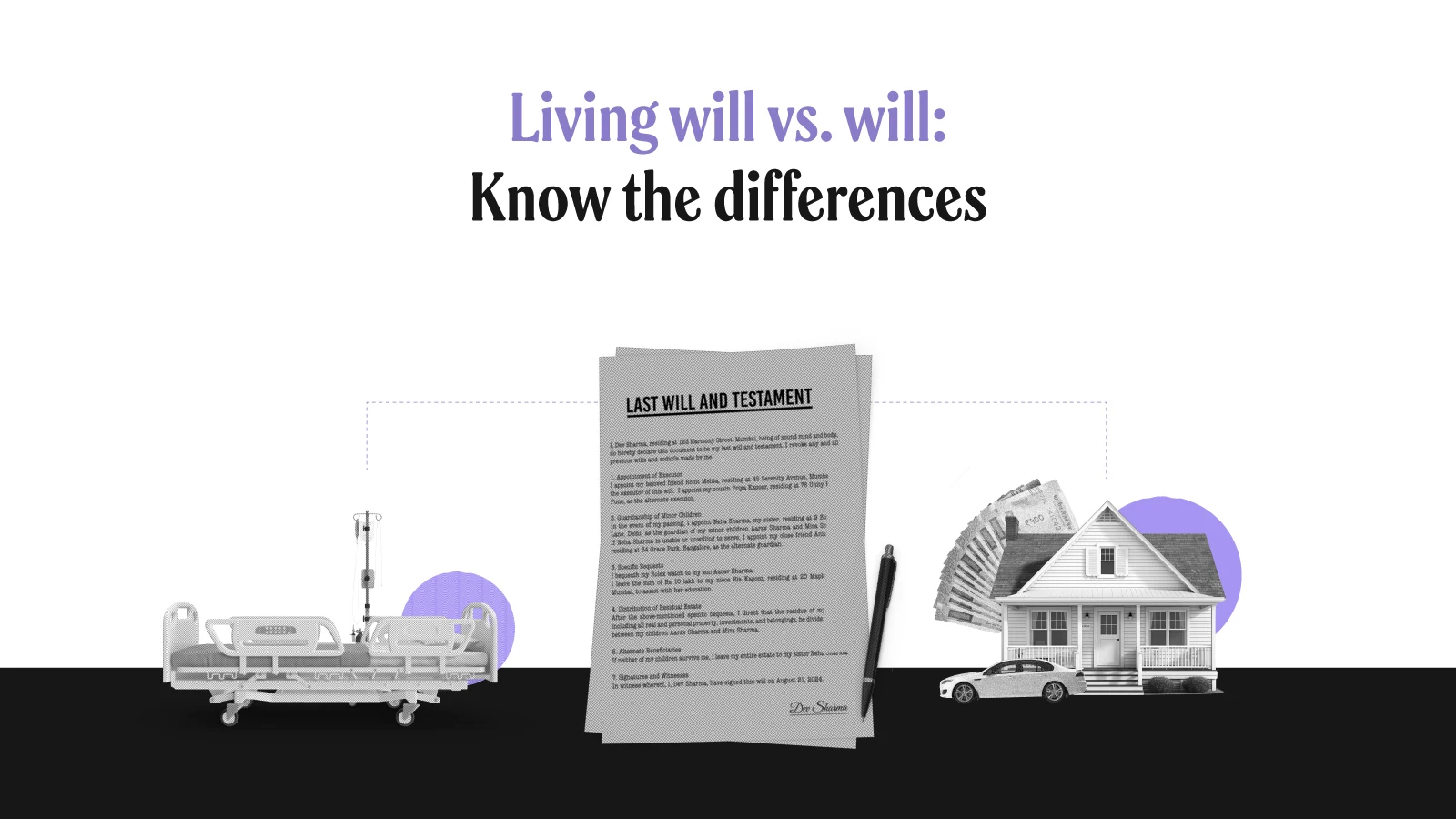
A Living Will sits apart from this ‘types of Wills’ list, because it does a different job. It is an advance medical directive, a record of the treatment you would accept or refuse if illness left you unable to decide. Unlike a Will, it takes effect while you are alive rather than after your death. Maharashtra now lets residents register a Digital Living Will online through the MahaULB portal, an instrument that belongs beside your estate plan rather than inside it.
Consult a Qualified Advisor to get a personalised advice

We will get back to you shortly.
These types of Wills are valid in India only when they satisfy the following conditions under the Indian Succession Act, 1925.
Probate is a court certificate confirming that a Will is genuine and that the executor may act on it. Until recently it was mandatory for certain Wills tied to Mumbai, Kolkata, and Chennai. The Repealing and Amending Act, 2025, which received presidential assent on December 20th, 2025, removed that requirement by deleting Section 213 of the Indian Succession Act. Probate is now optional across India; it still remains the strongest proof of a Will’s validity and still helps where a dispute looks likely.
The estate you have spent a lifetime building passes to a statutory formula after your death if you have not planned a Will, and the people you meant to provide for can spend years untangling it. A few hours spent drafting and attesting the right Will spares them that, at a fraction of what a contested estate costs.
Most homemade Wills stumble on the details that decide whether they hold the right type for your situation and wording that cannot be misread later. A Qualified Adviser/Estate planning lawyer can place your Will within your wider financial plan, so your investments, taxes, and estate work as one rather than in isolation.
No. A Will is valid in India whether or not it is registered, and registration isn’t required under the law. Registering it with the sub-registrar does add a layer of authenticity and makes it harder to dispute, which is why many people choose to.
Yes, a Will can be changed or cancelled as often as you like during your lifetime. You can alter it through a codicil, a short signed and witnessed document that amends the original. Or, you can replace it entirely with a fresh Will that revokes the old one. You can also revoke a Will by destroying it with the intention of cancelling it.
An executor of a Will is the person you name to carry out your Will, collecting your assets, settling debts, and distributing what remains. Almost any adult of sound mind can take the role, whether a family member, a friend, or a professional such as a lawyer, and you can appoint more than one. An executor is allowed to also be a beneficiary under the same Will.

The views in the article /blog are personal and that of the author. The idea is to create awareness and not intended to provide any product recommendations.


Plan Your Retirement with Our Qualified Financial Advisors
Your first financial plan is free