




Investment Alone is Not Financial Planning. Know What Financial Planni...
Many people assume that investing money is the key to financial success. They focus o...


Unit Linked Insurance Plans (ULIPs) are marketed as an attractive blend of life insurance and investment. While ULIPs are intended to provide the dual benefit of insurance coverage and market-linked returns, they have gained notoriety for being mis-sold, often leading investors into unfavourable financial outcomes.
The sale of ULIPs by banks has raised concerns due to the aggressive marketing strategies used and the inherent conflicts of interest. This article dives into the practices of mis-selling ULIPs by bank relationship managers (RMs) and whether they are a good investment or not.
According to the Insurance Regulatory and Development Authority of India’s (IRDAI) reports, banks have emerged as the dominant distribution channel for life insurance products, contributing 33.1% of new individual business life insurance premiums in 2023-24, an increase from just 15.6% in 2013-14.
In FY24, the top 15 banks by market capitalisation made ₹21,773 crores in commissions from the sale and marketing of insurance, mutual funds and other financial products. Banks have now become commission-driven institutions, with some making as much as 25.2% of their total income from commission, exchange and brokerage income.
Source: The Mis-selling Menace, 1 Finance Magazine
Our documentary on mis-selling of financial products, including life insurance, by banks in India talks about such mis-selling events. Watch it here.
An awareness initiative by 1 Finance
The IRDAI established regulations governing ULIP charges through the IRDAI Regulations 2019. These regulations are to protect consumers by capping various charges, but the complexity often confuses investors.
IRDAI regulations require these charges to be clearly disclosed and capped at 12.5% of that year’s annualised premium.
2. Fund management charges: Charges for managing the underlying investment funds. IRDAI has capped fund management charges at a maximum of 1.35% per annum of the fund value. For discontinued policy funds, the cap is reduced to 0.50% per annum.
3. Mortality charges: Mortality charges cover the cost of life or health insurance coverage provided under the ULIP. The charge for the mortality or morbidity risk covered will only be for the pure risk charges for the cover offered and will not include any allowance for expenses.
4. Policy administration charges: These monthly charges cover ongoing policy maintenance costs, including premium collection, policy servicing and statement generation. IRDAI allows these charges to remain constant or increase at a predetermined rate not exceeding specified thresholds.
5. Surrender and discontinuance charges: Investors surrendering ULIP policies before the mandatory 5-year period face discontinuance charges. The regulatory framework caps these charges based on the policy year and premium amount.
Despite these caps, the front-loaded nature of charges means investors may see minimal returns in initial years, contributing to high surrender rates.
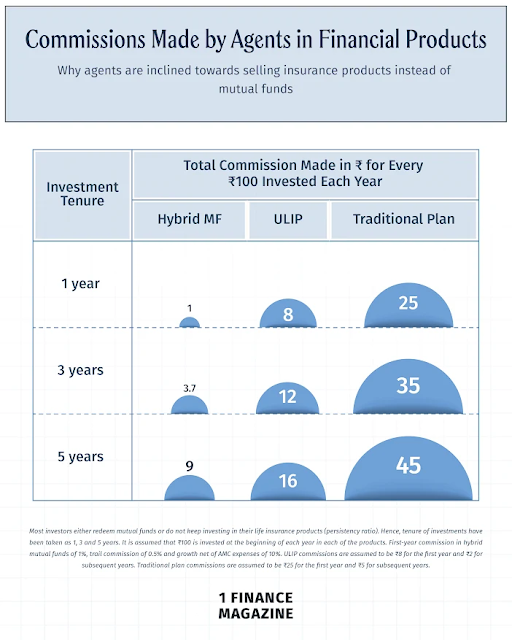
The stark difference in commission structures explains why banks push ULIPs over mutual funds.
Source: The Mis-selling Menace, 1 Finance Magazine
As the tenure shortens, the share of first-year commissions increases dramatically for ULIPs and traditional plans compared to mutual funds. For example, over a 5-year horizon, a ULIP pays 50.0% of its total commission in year one, whereas a hybrid mutual fund pays only 28.5%.
This disparity creates powerful incentives for bank RMs to recommend ULIPs regardless of suitability. Banks can earn up to 65% of the first-year premium as commission on traditional plans, while mutual fund commissions are typically around 1% annually with no upfront payments.
While regulatory caps on charges have improved product economics, the fundamental incentive misalignment between distributor earnings and customer welfare persists. Banks earn 2 to 11.3 times more commission selling insurance products compared to mutual funds, creating irresistible incentives for mis-selling.
The regulatory bodies must act decisively to restore consumer confidence and ensure that financial products serve customer interests rather than commission targets.

The views in the article /blog are personal and that of the author. The idea is to create awareness and not intended to provide any product recommendations.


Many people assume that investing money is the key to financial success. They focus o...

Your financial future is a vital part of your life. It encompasses your dreams, your ...

For most young adults, their early-mid twenties are a transitional period. This is us...