

Boosting Your Credit Score with Timely Credit Card Repayment
Credit cards blogs
Jul 23, 2023

Plan Your Retirement with Our Qualified Financial Advisors

Your first financial plan is free
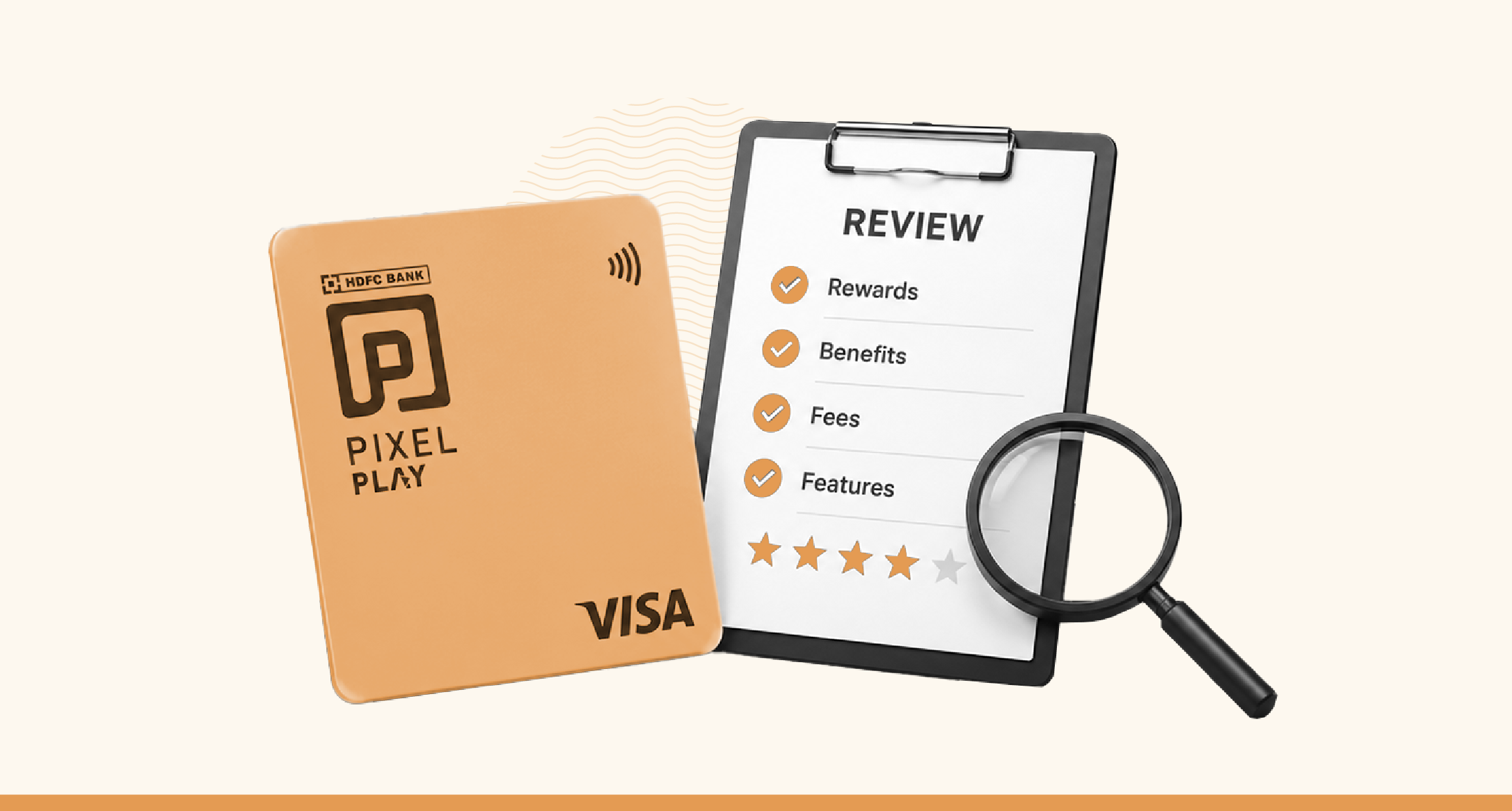
The HDFC Pixel Play Credit Card is the senior of two digital Pixel cards, sitting above the entry-level Pixel Go. What separates it from every other HDFC cashback card is customisation: you choose which merchant categories earn accelerated cashback, you choose your card design, and you choose your statement billing date.
Its closest structural rival in India is the AU LIT card, which runs on a similar pick-your-own-benefits model, though AU lets you customise considerably more, including milestone benefits and memberships. Pixel Play’s customisation is narrower: two brand packs from a fixed menu of five, plus one e-commerce merchant from three.
Three things define the experience:
A secured, FD-backed variant also exists for applicants without income proof or credit history, issued against a lien-marked fixed deposit.
1 Finance Rank:
This card ranks 6th out of cards in its fee segment.
Other fees and charges:
| Fee / Charge | Details |
| Finance charges | 3.60% per month (43.20% per annum) |
| Cash advance fee | 2.5% of the amount withdrawn or ₹500, whichever is higher |
| Cash withdrawal limit | 40% of the credit limit |
| Foreign currency markup | 3.5% |
| Dynamic currency conversion (DCC) markup | Additional 1% on rupee-billed transactions abroad or at overseas-registered merchants |
| SmartEMI processing fee | ₹199 + GST |
| SmartEMI pre-closure charge | 3% of the outstanding principal |
| Rent transactions | 1% fee from the second rent transaction each month |
| Railway/IRCTC surcharge | 1% + GST |
| Payment return charges | 2% of the payment amount (minimum ₹450) |
| Lost/Stolen/Damaged card re-issue | ₹100 |
| Card design-change re-issue | ₹199 + GST (revised from ₹100 + GST on 20 May 2026) |
| Fuel surcharge waiver | 1% waiver on transactions between ₹400 and ₹5,000, capped at ₹250 per billing cycle |
| Interest-free period | 20-50 days |
Late payment charges
| Statement Balance | Late Payment Charge (excluding GST) |
| Below ₹100 | Nil |
| ₹100 – ₹500 | ₹100 |
| ₹501 – ₹5,000 | ₹500 |
| ₹5,001 – ₹10,000 | ₹600 |
| ₹10,001 – ₹25,000 | ₹800 |
| ₹25,001 – ₹50,000 | ₹1,100 |
| Above ₹50,000 | ₹1,300 |
HDFC Bank’s website has conflicting information about the Pixel Play Credit Card. The product page says it is lifetime free with no joining or annual fee. However, the Fees & Charges page and the Most Important Terms & Conditions (MITC) mention a ₹500 joining fee and a ₹500 annual fee.
Please verify and confirm whether the card is truly lifetime free before applying.
Note: The card has no welcome or milestone benefits
To apply for the HDFC Pixel Play Credit Card, you should meet the following criteria:
Nationality: Indian
Employment: Salaried or self-employed
Age: Salaried: 21 to 60 years
Self-employed: 21 to 65 years
Minimum income:
Salaried: Monthly income of ₹25,000 or more
Self-employed: Annual ITR above ₹6 lakh
Note: Existing HDFC Bank credit card holders should check whether the Pixel Play card will be issued with a shared credit limit, as it may reduce the available limit on their other HDFC cards.
| Spend type | Rate | Monthly cap | Spend needed to hit cap |
| Two chosen brand packs | 5% | 500 CashPoints | ~₹10,000 |
| SmartBuy platform | 5% | 500 CashPoints | ~₹10,000 |
| One chosen e-commerce merchant | 3% | 500 CashPoints | ~₹16,700 |
| UPI spends (RuPay variant only) | 1% | 500 CashPoints | ~₹50,000 |
| All other spends | 1% | 15,000 CashPoints | — |
You pick two. Merchants inside each pack are fixed and cannot be mixed:
Separately, you pick one of Amazon, Flipkart or PayZapp for 3%. Packs and e-commerce choice can both be changed once every three months, in the same request, taking effect immediately on acknowledgement.
The maximum you can earn is 2,000 CashPoints per month (24,000 per year), but that’s only if you fully use all four bonus reward categories every month.
A more realistic example from HDFC is this:
₹8,000 on your selected Packs → 400 CashPoints (5%)
₹7,000 on your chosen e-commerce brand → 210 CashPoints (3%)
₹6,000 on other eligible spends → 60 CashPoints (1%)
₹3,000 on fuel → 0 points
₹1,000 converted to EMI → 0 points
Total rewards: 670 CashPoints on a ₹25,000 spend, which works out to an effective reward rate of about 2.7%.
That’s a good return for a card with little or no annual cost, but don’t expect to earn 5% on all your spending.
HDFC’s terms are not clear about the reward limit for the 5% Packs.
Since HDFC’s documents don’t clearly confirm either interpretation, it’s best to check your rewards during the first couple of months before planning your spending around it.
CashPoints can expire in two ways:
None. Airport lounge access is not listed as a benefit on either Pixel card.
The card isn’t travel-hostile, just travel-indifferent:
That forex structure makes this a card to leave at home when travelling internationally.
| Card | Headline rate | Annual fee | Fee waiver | Best for |
| HDFC Pixel Play | 5% on two chosen packs | ₹500 (often LTF) | ₹1 lakh | Customisation, moderate concentrated spend |
| HDFC Pixel Go | 1% flat, 5% SmartBuy | ₹250 | ₹50,000 | Lower income bar, simplicity |
| Amazon Pay ICICI | 5% on Amazon (Prime) | Nil | — | Amazon-heavy shoppers |
| Cashback SBI | 5% on all online spends | ₹999 | ₹2 lakh | Diversified online spenders |
| HDFC Millennia | 5% on 10 partner brands | ₹1,000 | ₹1 lakh | Broad partner coverage |
| Swiggy HDFC | 10% on Swiggy | ₹500 | — | Food delivery and Instamart |
| Axis ACE | 5% utilities via GPay, 1.5% flat | ₹499 | — | Bills and simplicity |
The honest positioning: if your spending concentrates on one platform, a co-branded card beats Pixel Play. If it spreads thinly across everything online, Cashback SBI beats it. Pixel Play wins in the middle — spending clustered in two or three brand categories, at a level where the caps don’t bite, with no fee to justify.
Against Pixel Go specifically: Play if you’ll actively manage your packs and meet the income bar; Go if you want flat, no-thought earning at a lower entry point.
After going through dozens of discussions from actual Pixel Play cardholders, I think the reality lies somewhere in the middle. The card itself looks attractive on paper, but the ownership experience seems to depend on what goes wrong—and whether you ever need customer support.
My biggest concern is customer service. Several users reported long delays, support tickets being closed without proper resolution, and being redirected between PayZapp and HDFC. Since Pixel support is handled through PayZapp rather than HDFC’s regular credit card channels, resolving issues appears to be slower than with a standard HDFC card. While these are individual experiences, the number of similar complaints suggests this is something prospective cardholders should keep in mind.
I also think the shared credit limit deserves more attention than HDFC gives it. Some users said adding the Pixel card reduced the available limit on their other HDFC cards, and they weren’t aware this would happen. That’s not necessarily a deal-breaker, but it’s something applicants should understand before applying.
That said, the criticism isn’t one-sided. Just as many users reported being happy with the card, especially if they received it lifetime free. Several felt the reward structure is among the better ones in HDFC’s portfolio, and they appreciated that CashPoints can effectively be redeemed as cash through PayZapp instead of being limited to a voucher catalogue. A few users who initially had issues also said those problems were eventually resolved and decided to keep the card.
The strongest consensus I found was that the card offers good value if you can get it lifetime free and if its reward categories match your spending habits. On the other hand, if you already own cards like Millennia or another cashback-focused HDFC card, the incremental value may be limited.
I also came across a few claims that don’t hold up against HDFC’s official terms. For example, some users said government transactions earn rewards, but the card’s terms clearly exclude them. Likewise, while some complained that issues cannot be escalated to HDFC directly, the official documentation does provide multiple escalation channels, including HDFC’s grievance redressal process and, if required, the RBI Ombudsman. Whether those channels work as smoothly in practice is a separate question, but they do exist.
Overall, my impression is that Pixel Play is a good rewards card with a few rough edges rather than a bad card. If everything works as expected, it can deliver solid value. But if you run into billing, reward-credit, or servicing issues, you may need more patience than you would with a traditional HDFC credit card.
Get it if:
Skip it if:
That three-day window matters. Miss it and HDFC issues both network variants by default — a physical Visa card in the standard “ICE” colour plus a digital RuPay card — sharing one credit limit and one combined statement. You’ll have made none of the choices the card is sold on.
The FD-backed variant is also applied for exclusively through PayZapp.
To maximise value from the HDFC Pixel Play Credit Card:
Published on 03 Aug 2026, 1:58 pm IST

The views in the article /blog are personal and that of the author. The idea is to create awareness and not intended to provide any product recommendations.


Plan Your Retirement with Our Qualified Financial Advisors
Your first financial plan is free