
 Book a free consultation
ITR in FY 2025-26: When will your ITR be picked for compulsory scrutiny? Check the Income Tax Department’s new guidelines
By Anulekha Ray
ITR Filing
Jul 3, 2025
Plan Your Retirement with Our Qualified Financial Advisors

Your first financial plan is free
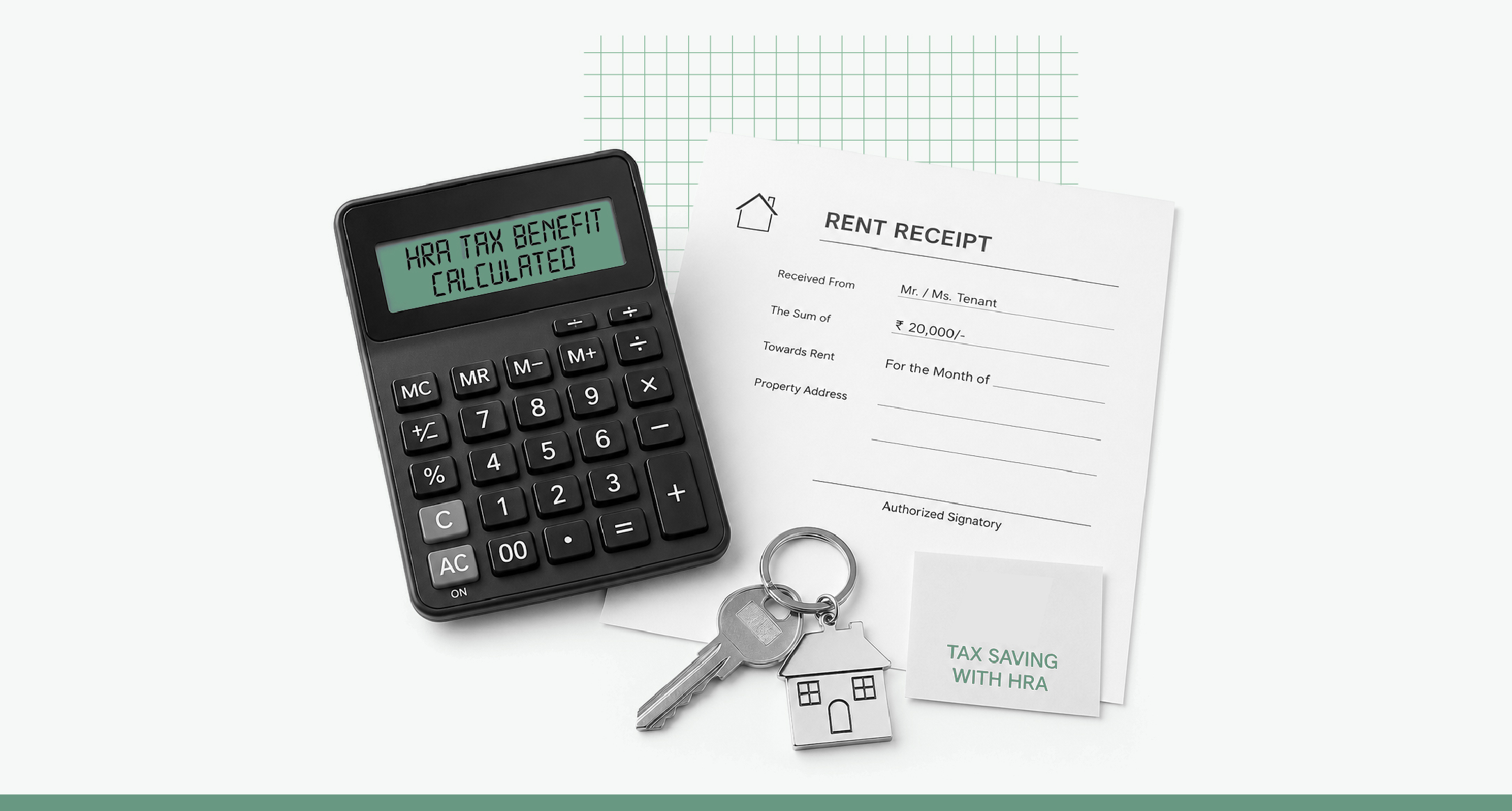
House Rent Allowance (HRA) is one of the most valuable tax breaks for salaried people who pay rent. Under Section 10(13A) of the Income Tax Act, part of the HRA your employer pays you is exempt from tax, but only if you live in rented accommodation, actually pay rent, and file under the old tax regime. This article shows exactly how the exemption is calculated, how much you can claim, and the documents you need.
For how HRA fits your regime choice, see our old vs new tax regime guide.
Key takeaways
HRA is a part of your salary meant to cover rent. Under Section 10(13A), read with Rule 2A of the Income Tax Rules, a portion of it is exempt from tax if you are salaried, live in rented accommodation, and pay rent. If you live in your own house or pay no rent, the entire HRA is taxable.
One condition decides whether any of this matters: HRA exemption is available only under the old tax regime. If you choose the new regime, the whole HRA you receive is added to your taxable salary, with no exemption. This is often the single biggest reason salaried people who pay significant rent stay on the old regime.
The exempt amount is the lowest of these three figures. You do not get to choose, the law takes the smallest:
Here, “salary” means basic salary plus dearness allowance (where it forms part of retirement benefits) plus commission based on a fixed percentage of turnover. It does not include other allowances.
Take someone living in Mumbai (a metro city) with a basic salary of ₹50,000 a month (₹6,00,000 a year), HRA of ₹25,000 a month (₹3,00,000 a year), and rent of ₹18,000 a month (₹2,16,000 a year).
The Income Tax rules say your HRA exemption is the lowest of these three amounts:
Now compare the three numbers:
The smallest is ₹1,56,000, so that is the amount of HRA that is tax-free.
Since you actually received ₹3,00,000 as HRA, the remaining ₹1,44,000 (₹3,00,000 − ₹1,56,000) is added to your taxable salary.
The easiest way to think about it is this: the government doesn’t let you claim an HRA exemption bigger than (a) the HRA you received, (b) a percentage of your basic salary, or (c) the portion of your rent that exceeds 10% of your salary. You calculate all three limits and simply pick the smallest one.
Mostly, the rent minus 10% of salary calculation is often the smallest, which is why your rent largely determines how much HRA exemption you actually get.
The 50% rate applies only if you live in a metro city. For FY 2025-26 (AY 2026-27), only four cities count as metro:
Every other city, including Bengaluru, Hyderabad, Pune, and Ahmedabad, is treated as non-metro and uses the 40% rate for this year.
An important update to note: from FY 2026-27 onwards, four more cities, Bengaluru, Hyderabad, Pune, and Ahmedabad, are added to the metro list, taking it to eight cities eligible for the 50% rate. That change applies to next year’s return, not the one you are filing now, so for FY 2025-26 stick to the four-city list.
The city where you live and pay rent decides the rate, not where your employer is based. Living in Noida or Gurgaon counts as non-metro even if your office is in Delhi.
Pay ₹2,499 upfront and get 100% cashback.
Filing will be done by Planmytax.ai, powered by 1 Finance

We will get back to you shortly.
HRA exemption is only for salaried employees who receive HRA as part of their salary and pay rent. It is not available to:
Yes, if the arrangement is genuine. Your parents must actually own the house, you must genuinely pay rent to them, and they must declare that rent as income from house property in their own return. Keep proof, a rent agreement, bank transfers, and receipts. Rent paid to a spouse is far more likely to be challenged, because such arrangements often fail the test of being genuine.
From 1 April 2026, new rules make it mandatory to disclose your relationship with the landlord when claiming HRA, especially where the landlord is a family member, so this needs to be handled cleanly.
Yes, both can be claimed under the old regime if the facts support it. The common case is owning a house in one city while renting in another because of work. If you own a house and rent in the same city, you generally cannot claim HRA, unless you can justify it, for example, your owned house is far from your workplace or is genuinely not available to live in.
Keep these ready and retain them for several years in case of scrutiny:
During the year, submit these to your employer through Form 12BB so your TDS is calculated correctly. If you did not declare HRA to your employer in time, you can still claim the exemption while filing your return, the ITR calculation takes priority, and any excess TDS comes back as a refund.
HRA is a genuine relief for the rent you actually pay, and it is worth claiming in full when you are eligible. The line to hold is honesty: pay rent you truly pay, to a landlord who really owns the home, with receipts and bank transfers that support the claim. Manufactured rent arrangements, a paper agreement with a relative, or rent that never actually moves, are exactly what the new disclosure rules are meant to catch, and they carry real risk. Claim what is real, keep the proof, and the exemption is yours.
Pay ₹2,499 upfront and get 100% cashback.
Filing will be done by Planmytax.ai, powered by 1 Finance
We will get back to you shortly.
How is HRA exemption calculated?
It is the lowest of three amounts: the actual HRA received, 50% of salary for metro cities (40% for non-metro), and rent paid minus 10% of salary. Salary here means basic pay plus dearness allowance plus any turnover-based commission.
Which cities are metro for HRA in FY 2025-26?
Only Delhi, Mumbai, Kolkata, and Chennai. All other cities use the 40% rate this year. From FY 2026-27, Bengaluru, Hyderabad, Pune, and Ahmedabad are added to the metro list.
Can I claim HRA under the new tax regime?
No. HRA exemption is available only under the old regime. Under the new regime, the entire HRA you receive is fully taxable.
Can I claim HRA if I pay rent to my parents?
Yes, if it is genuine. Your parents must own the house, you must actually pay rent, and they must report it as income in their return. Keep a rent agreement, receipts, and bank transfer proof.
Is the landlord’s PAN required to claim HRA?
Yes, if your annual rent exceeds ₹1 lakh. If the landlord has no PAN, a signed declaration to that effect is required.
Can I claim both HRA and home loan interest?
Yes, under the old regime, if the facts support it, typically when you own a house in one city and rent in another for work. Claiming both in the same city needs a genuine justification.
This guide is for general informational purposes and is accurate to the best of our knowledge as of June 2026. The figures are illustrative; your actual exemption depends on your salary structure, rent, and city. Tax laws can change, and individual circumstances vary. Please verify current details on incometax.gov.in and consult a qualified Chartered Accountant or tax advisor before acting on any information here.

The views in the article /blog are personal and that of the author. The idea is to create awareness and not intended to provide any product recommendations.


Plan Your Retirement with Our Qualified Financial Advisors
Your first financial plan is free