
 Book a free consultation
Can you revise your ITR after receiving a refund? Rules, timelines and tax implications
By Tejashree Satpute
ITR Filing
Aug 21, 2026
Plan Your Retirement with Our Qualified Financial Advisors

Your first financial plan is free
Key takeaways
From April 1st, 2026, the TDS on salary is governed by a new law, the Income Tax Act 2025. It replaces the Income Tax Act 1961, which had run for over 60 years. The tax rates and slabs are unchanged, but the forms, the section numbers, and the working behind your monthly deduction have all been redone.
This reset leaves most salaried earners with the same few doubts. When does your employer deduct TDS, and when it doesn’t? How is the monthly TDS amount worked out? And how do you claim back anything extra with ITR filing?
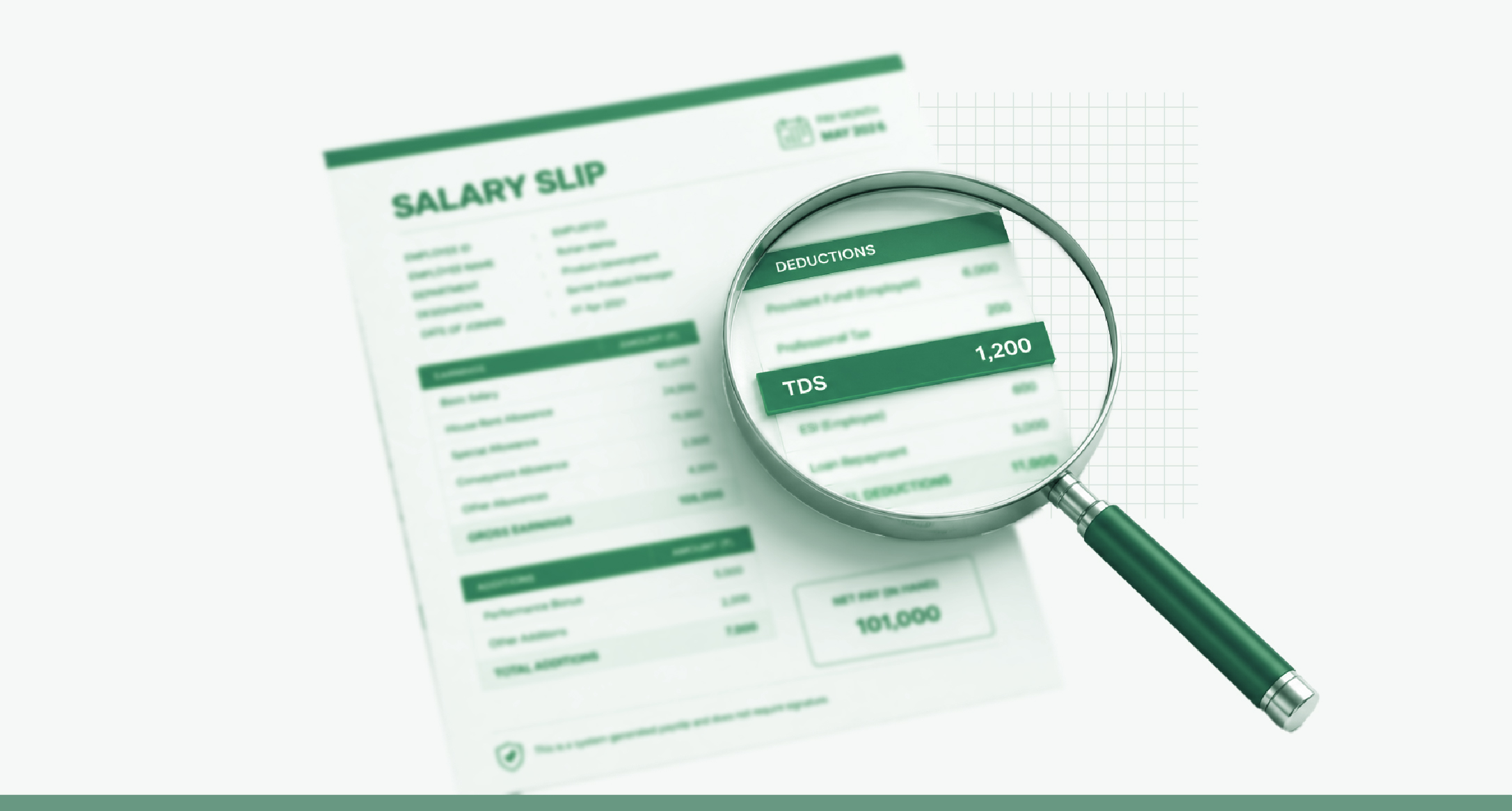
TDS on salary stands for Tax Deducted at Source on your pay. It is the income tax your employer removes from your salary each month and deposits with the government against your PAN. Instead of paying a year’s tax in one go, you pay it in small monthly amounts as you earn. By the year’s end, these deductions add up to the tax due on your salary, and your final position is settled when you file your ITR.
Not every salary earner sees a deduction, though. Under Section 392 of the Income Tax Act 2025, your employer cuts TDS only when your estimated yearly income crosses the basic exemption limit. This final tax figure is calculated only after applying all your eligible deductions and rebates. If your estimated tax for the year is zero, your employer will not deduct any TDS.
Three concepts determine this calculation at different stages. The standard deduction (₹75,000) comes off your gross salary right at the beginning. The basic exemption limit, which is ₹4 lakh under the new tax regime and ₹2.5 lakh under the old regime, dictates the threshold where your income officially enters the tax net. Finally, the Section 87A rebate reduces or completely cancels out your final tax bill if your total tax liability (excluding cess) falls within ₹60,000 for the new tax regime and ₹12,500 for the old tax regime.
Under the new tax regime, a salary of up to ₹12.75 lakh becomes completely tax-free. First, the ₹75,000 standard deduction is subtracted from your gross pay, reducing your taxable income to exactly ₹12 lakh. This ₹12 lakh is higher than the ₹4 lakh basic exemption limit; hence, applying the progressive slabs on ₹12 lakh gives tax on paper about ₹60,000.
| Tax slabs | Amount | Tax payable |
|---|---|---|
| Up to ₹4 lakh at 0% | ₹4,00,000 | Nil |
| 4,00,000 – 8,00,000 @ 5% | ₹4,00,000 | ₹20,000 |
| 8,00,000 – 12,00,000 @10% | ₹4,00,000 | ₹40,000 |
| Total tax liability on ₹12 lakh | – | ₹60,000 |
| Section 87A rebate | – | – ₹60,000 |
| Total tax applicable | – | 0 |
Scroll right to view full table →
As you can see, the Section 87A rebate brings tax liability to zero. As there’s no TDS to cut, which is why many salaried earners below this level find a blank TDS line on their payslips.
Even with zero TDS, you are still required to file your Income Tax Return (ITR) because your total income crosses the basic exemption limit. On the administrative side, your employer will report your TDS details every quarter using Form 138 (the renamed Form 24Q). After the tax year ends, they must provide you with Form 130 usually around June 15th. Form 130 replaces the old Form 16, serving as your official salary TDS certificate that outlines your allowed deductions and any tax paid on your behalf.
Consult a Qualified Financial Advisor today

We will get back to you shortly.
Your employer follows a set 5-step method, projecting your whole year and working back to a monthly number.
Step 1: Estimate your yearly gross salary.
Your employer adds up everything you will earn in the tax year, from April 1st to March 31st, including known bonuses and recurring allowances.
Step 2: Subtract the deductions and exemptions you qualify for.
Under the new tax regime, this is mostly the flat ₹75,000 standard deduction, with little else to claim. The old tax regime allows more, a ₹50,000 standard deduction plus the HRA, Section 80C investments (like PPF, tax-saving instruments), health insurance, and home loan claims you declare through Form 124, the renamed Form 12BB under the Income Tax Act 2025.
Step 3: Apply the slab rates of your chosen regime to the income that remains.
The slab system works like a row of buckets. Your income fills them from the bottom up, and each bucket is taxed at its own rate.
The first bucket is tax-free, the next is taxed at 5%, the one above at 10%, and so on. Only the income that spills into a higher bucket pays the higher rate, never your whole salary.
Old tax regime slab rates for individuals below 60
| Annual taxable income | Tax rate |
|---|---|
| Up to ₹2.5 lakh | Nil |
| ₹2.5 lakh to ₹5 lakh | 5% |
| ₹5 lakh to ₹10 lakh | 20% |
| Above ₹10 lakh | 30% |
Scroll right to view full table →
New tax regime slab rates for the Year 2026-27
| Annual taxable income | Tax rate |
|---|---|
| Up to ₹4 lakh | Nil |
| ₹4 lakh to ₹8 lakh | 5% |
| ₹8 lakh to ₹12 lakh | 10% |
| ₹12 lakh to ₹16 lakh | 15% |
| ₹16 lakh to ₹20 lakh | 20% |
| ₹20 lakh to ₹24 lakh | 25% |
| Above ₹24 lakh | 30% |
Scroll right to view full table →
Step 4: Add the rebate, any surcharge, and the cess.
Current income tax surcharge brackets
| Net taxable income | Surcharge rate |
|---|---|
| ₹50 lakh to ₹1 crore | 10% |
| ₹1 crore to ₹2 crore | 15% |
| ₹2 crore to ₹5 crore | 25% |
| Over ₹5 crore (Old tax regime) | 37% |
| Over ₹5 crore (New tax regime) | 25% |
Step 5. Divide the year’s tax across the months left.
With a full year ahead, your monthly TDS is the yearly tax divided by 12. A mid-year joiner has it spread across the months from their joining date.
Take an employee earning ₹15 lakh in gross salary under the new tax regime. After the ₹75,000 standard deduction, ₹14,25,000 is taxable, and the new slabs produce a tax of ₹93,750.
How the ₹15 lakh earner’s tax forms on taxable income of ₹14,25,000
| Slab | Income taxed in this band | Rate | Tax |
|---|---|---|---|
| Up to ₹4 lakh | ₹4,00,000 | Nil | ₹0 |
| ₹4 lakh to ₹8 lakh | ₹4,00,000 | 5% | ₹20,000 |
| ₹8 lakh to ₹12 lakh | ₹4,00,000 | 10% | ₹40,000 |
| ₹12 lakh to ₹14.25 lakh | ₹2,25,000 | 15% | ₹33,750 |
| Total tax | ₹93,750 |
Scroll right to view full table →
Each band taxes only the income inside it. The first ₹4 lakh draws nothing, the next two bands take 5% and 10%, and only the ₹2,25,000 above ₹12 lakh meets the 15% rate.
A 4% cess on ₹93,750 adds ₹3,750, lifting the yearly tax to ₹97,500. Divided across 12 months, it gives ₹8,125, which gives your monthly TDS on salary.
The TDS rate on salary runs on an average rate, and not the top slab. For this earner, that average works out to 6.5%, or ₹97,500 against ₹15 lakh.
Is TDS 100% refundable? It depends on your final tax for the year. If your TDS adds up to more than the tax you owe, the extra gets refunded once ITR filing is done.
You file the ITR by July 31st after the tax year. It totals your real tax and sets it against the TDS already cut.
You can check that TDS in your Form 130 and your Annual Information Statement (AIS) on the income tax portal. If the TDS was higher, the income tax department refunds the difference, usually within a few weeks.
A nil tax means every rupee of TDS is refunded to you. When you do owe some tax and the TDS deducted was larger, only the surplus over your liability returns. The reverse leaves a balance to settle, since a tax higher than the TDS means you pay the shortfall at ITR filing.
Your TDS on salary turns on your regime, your deductions, and the slabs your income crosses. Income that never reaches your payslip, like interest, rent, or capital gains, still adds to your tax. So your TDS is only part of what you owe, and the rest shows up when you file your ITR.
A Qualified Financial Advisor builds the picture from your full income, not just your salary slip. They can tell you early whether to set aside advance tax or expect a refund. They also weigh the old tax regime against the new on your real numbers. A short conversation before the year ends turns your TDS from a surprise into a figure you planned for.

The views in the article /blog are personal and that of the author. The idea is to create awareness and not intended to provide any product recommendations.


Plan Your Retirement with Our Qualified Financial Advisors
Your first financial plan is free