

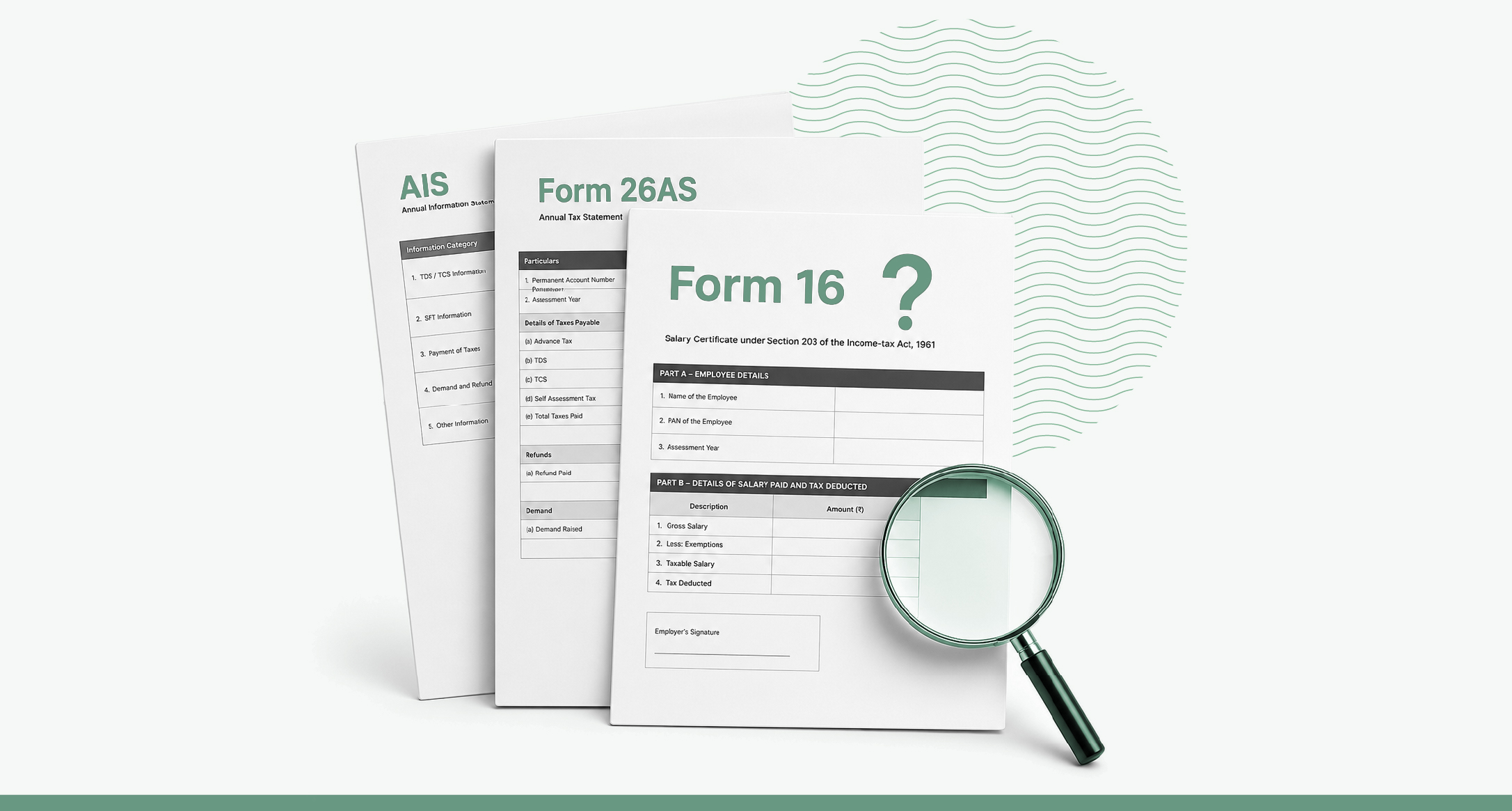
Quick answer: Form 16 only reports your salary and the TDS on it. If you also earned interest, dividends, capital gains, freelance income, crypto gains, or foreign RSUs during FY 2025-26, none of that is on Form 16 — but the Income Tax Department already has it. Leaving it out is the single most common reason salaried taxpayers get a mismatch notice. This guide walks through what you actually need to report, which ITR form applies, and how to file so your return agrees with the department’s records.
Last year, Nikita filed her income tax return the way she always had. She downloaded Form 16, logged into the income tax portal, keyed in the details, and hit submit. The whole thing took under twenty minutes.
A few weeks later, a notice arrived. Her return didn’t match the department’s records.
She hadn’t fudged anything — her salary was reported exactly as her employer declared it. What she’d left out was the interest on her fixed deposits, dividends from a few shares, and capital gains from mutual funds she’d redeemed for a holiday. None of it appears on Form 16. All of it sat in the department’s records, waiting to be matched.
Nikita isn’t an exception. For most salaried Indians today, she’s the rule.
Is Form 16 enough to file your ITR?
No. Form 16 does exactly one job: it reports your salary and the tax deducted at source on it. It is not a summary of your financial year, and it never claimed to be.
The problem is that the way salaried Indians earn has changed, while the filing habit hasn’t. The same professional who once had only a salary now typically also has a savings account paying interest, a fixed deposit or two, a demat account with some stocks, SIPs that occasionally get redeemed, maybe a freelance invoice, sometimes RSUs from a foreign parent company, and occasionally a bit of F&O or intraday trading.
Every one of those is income. Every one is taxable. Almost none of it flows through Form 16. Treating Form 16 as the whole story is like reading the first chapter of a book and assuming you know the ending.
What income do you actually have to report (besides salary)?
Here’s what typically sits outside Form 16, and why each one matters to you:
- Savings and FD interest. Interest from your savings account and fixed deposits is taxable, and it’s the most commonly forgotten item on a return. Your bank reports it whether or not you remember to.
- Dividends. Dividends from shares are now taxed in your hands at your slab rate. The old tax-free-dividend era is gone, and this quietly catches a lot of investors.
- Capital gains. Selling shares or redeeming mutual funds creates a capital gain or loss. Short-term and long-term gains are taxed differently and reported separately, holding by holding. This is where returns get genuinely fiddly.
- F&O and intraday trading. The law treats this as business income, not investment income — which means a different ITR form and its own rules on turnover and set-off.
- Crypto (VDAs). Gains are taxed at a flat 30%, reported under a separate head, and you cannot set off losses against other income. The rules are rigid and easy to get wrong.
- Freelance income, rent, and foreign RSUs. Side income must be declared, rental income has its own computation, and RSUs or shares in a foreign company must be disclosed as foreign assets — a requirement with steep penalties if ignored, even when no extra tax is due.
Each of these forces a decision, and getting the decision wrong has real consequences.

File your ITR for free with a Qualified CA
Pay ₹2,499 upfront and get 100% cashback.
Filing will be done by Planmytax.ai, powered by 1 Finance
 Book a free consultation

Thank you for showing interest!
We will get back to you shortly.
Which ITR form should you use?
This is where most self-filers slip, because the form depends on your mix of income, not just your salary. As a rough guide for AY 2026-27:
- ITR-1 (Sahaj) — salary/pension, income from up to two house properties (newly expanded this year), and interest income. Simplest form, but limited. Read more on ITR 1
- ITR-2 — salary plus capital gains, more than one house property, or any foreign assets or RSUs. Read more on ITR 2
- ITR-3 / ITR-4 — if you have business or professional income, including F&O and intraday trading or freelance work under presumptive taxation. Read more on ITR 3
Pick the wrong form and your return can be marked defective under Section 139(9), which in practice means it’s treated as if you never filed at all. The right form is the foundation everything else sits on — and it’s the first thing a finanical advisor pins down before touching a single number.
What is the AIS, and why does it decide whether you get a notice?
This is the shift that changes everything. In the past, small omissions usually slipped through. Now they don’t.
Before you even sit down to file, the department already has a detailed picture of your year. It pulls your interest, dividends, share sales, mutual fund transactions, and large financial movements directly from your banks, brokers, employer, and mutual fund registrars, and compiles them into your Annual Information Statement (AIS), alongside Form 26AS.
When your return doesn’t line up with this data, the system flags the mismatch automatically. Your refund can be put on hold, and a notice can follow, often months later, when you’ve long forgotten the details.
So filing has quietly turned from an act of declaration into an act of reconciliation. You’re no longer just telling the department what you earned; you’re demonstrating that your version of the year agrees with theirs, line by line. Reconciling your return against your AIS before you file is exactly the check that turns a would-be notice into a non-event — and it’s the single most valuable thing a tax advisor does for you.
What happens if your ITR doesn’t match the department’s data?
It’s not hypothetical. In one recent enforcement drive, the department identified around 90,000 salaried taxpayers who had wrongly claimed roughly ₹1,070 crore in deductions and asked them to correct their returns. Where a claim is judged to be deliberate misreporting rather than an honest slip, the penalty can reach 200% of the tax due.
There’s very little room left for “close enough.” A mismatch can mean a held-up refund, interest under Section 234A/B/C, a defective-return notice, or, at the worst end, a misreporting penalty. Each of those costs far more time and money than getting the return right the first time.
Old regime or new regime — which should you pick?
For AY 2026-27, the new regime is the default. It offers lower slab rates but strips away most deductions (80C, 80D, HRA, home-loan interest under Section 24). The old regime keeps those deductions but at higher rates.
There’s no universal winner — it depends on your total income and how much you can genuinely claim with proof. One important catch: if you file after the due date, you can be locked into the new regime and lose access to the old regime’s deductions entirely. That single timing mistake can cost you real money, which is why the regime choice is worth running properly rather than guessing. An advisor models both against your actual numbers instead of leaving it to a rule of thumb.
Old vs new tax regime 2026: Which one saves you more?
What are the ITR filing deadlines for AY 2026-27?
Filing for FY 2025-26 (AY 2026-27) is already open. The deadlines are staggered this year:
- 31 July 2026 — salaried individuals and capital-gains filers (ITR-1 and ITR-2)
- 31 August 2026 — business and professional income, non-audit cases (ITR-3 and ITR-4)
- 31 October 2026 — cases requiring a tax audit
- 31 December 2026 — last date for a belated return
- 31 March 2027 — last date to file a revised return
Filing early has real advantages: faster refunds, fewer portal glitches, and time to fix a mismatch calmly instead of at midnight on the deadline. Note that even a one-day delay makes your return belated, with late fees and lost benefits — so the safe target is comfortably ahead of your date, not on it.
So, do you need help — or can you do this yourself?
File your ITR for free with a Qualified CA
Pay ₹2,499 upfront and get 100% cashback.
Filing will be done by Planmytax.ai, powered by 1 Finance
Thank you for showing interest!
We will get back to you shortly.
Let’s be honest about it. If you have a single salary and nothing else, filing is still a quick, do-it-yourself job, and you shouldn’t overthink it.
But if you look like most people reading this — salary plus interest, plus some capital gains, maybe freelance income or RSUs — then filing is now a genuine reconciliation exercise where mistakes are easy to make and expensive to fix. The case for advice isn’t that you’re incapable. It’s that the downside of a small oversight now dwarfs the cost of having it checked properly. A second, expert set of eyes is there to catch the mismatch before the department does.
How 1 Finance makes filing a non-event
Filing an ITR is no longer data entry — it’s a matching exercise: putting your full income in the right place and making sure it agrees with what the department already holds.
That’s exactly what we do. We bring all of your income together in one view — salary, interest, capital gains, freelance earnings, and foreign holdings. We reconcile it against your AIS and Form 26AS so there’s no mismatch waiting to surface. We pick the correct form and the right regime for your situation, and we claim only what you can actually support with proof.
The goal is simple: a return that’s accurate, agrees with the department’s records, and that you never have to think about again.
File your ITR with 1 Finance this year. Click here to know more.
Frequently asked questions
Does Form 16 include my FD interest and dividends?
No. Form 16 only covers your salary and the TDS on it. Interest, dividends, capital gains, and other income must be added separately when you file.
Will I get a notice if I forget to report interest income?
You can. Your bank reports interest to the department, so it appears in your AIS. If your return doesn’t include it, the system may flag a mismatch, hold your refund, or issue a notice.
What is the difference between the AIS and Form 26AS?
Form 26AS focuses on tax deducted and deposited against your PAN. The AIS is broader — it also captures interest, dividends, securities transactions, and high-value dealings reported by third parties. Both should agree with your return.
Which ITR form do I use if I trade F&O or intraday?
F&O and intraday are treated as business income, which generally means ITR-3, not the simpler ITR-1 or ITR-2.
How is crypto taxed when I file?
Gains on virtual digital assets are taxed at a flat 30%, reported under a separate head, and losses cannot be set off against other income.
What’s the last date to file ITR for AY 2026-27?
31 July 2026 for salaried and capital-gains filers (ITR-1/ITR-2), and 31 August 2026 for non-audit business and professional filers (ITR-3/ITR-4).