

ITR-1 (Sahaj) AY 2026-27: Who can file, eligibility criteria, new 2-house property rule, capital gains limit & online filing guide
By Arman Qureshi
ITR Filing
Jun 18, 2026
Plan Your Retirement with Our Qualified Financial Advisors

Your first financial plan is free
If you are a doctor, lawyer, architect, accountant, consultant, or another eligible professional, Section 44ADA offers a simplified way to calculate your taxable income. Instead of maintaining detailed books of account and claiming individual business expenses, you can declare a prescribed percentage of your gross receipts as income, subject to the conditions in the Income Tax Act.
This article explains who can use Section 44ADA, the eligibility conditions, the turnover limits, how presumptive income is calculated, which ITR form to file, and when the regular method of computing business income may be more suitable.
For the overall filing process, see our ITR filing guide for FY 2025-26. For return filing instructions, see our ITR-4 guide.
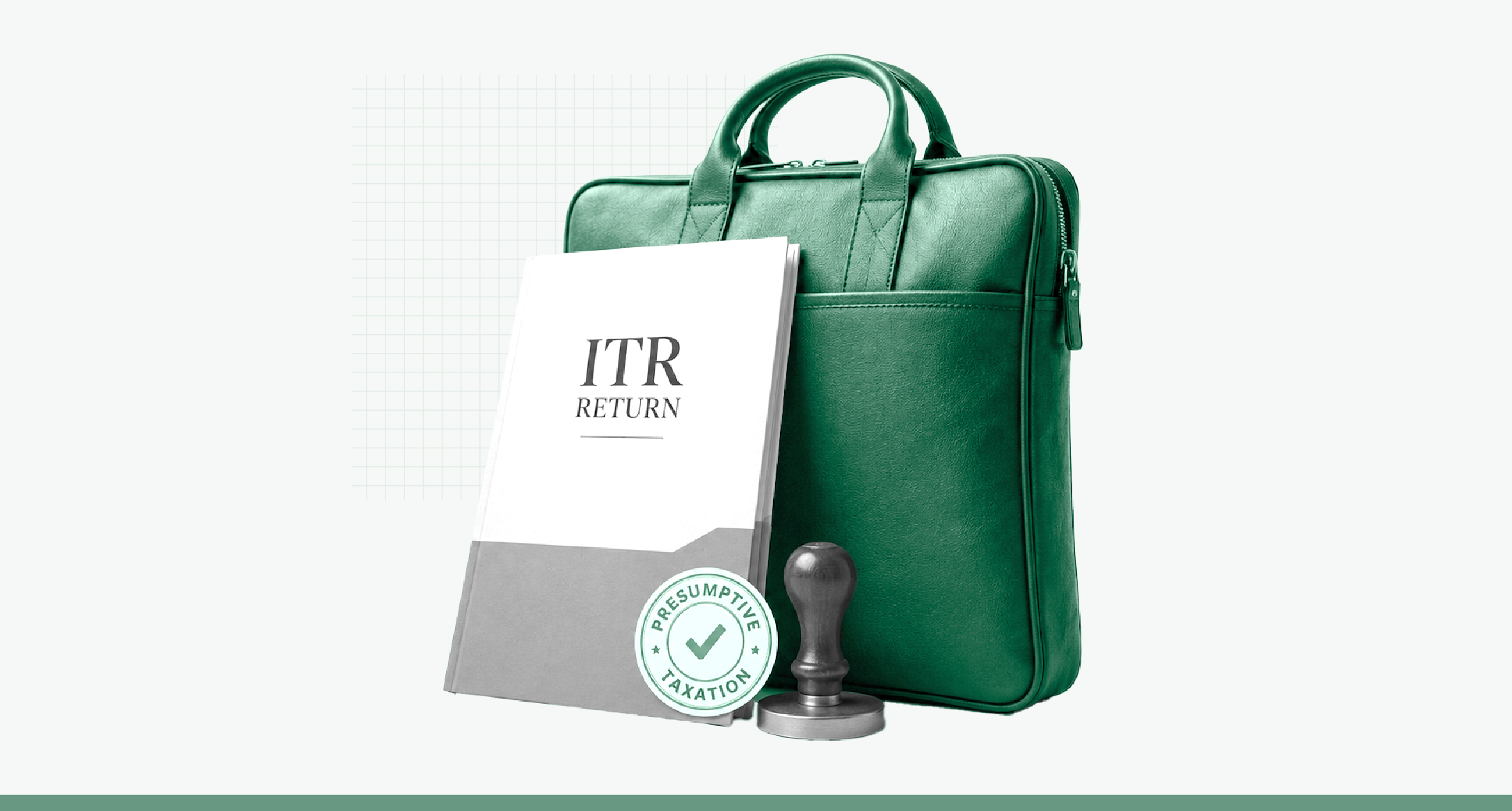
Section 44ADA is a presumptive taxation scheme for eligible professionals. Instead of maintaining detailed books of account and claiming individual business expenses, you can declare 50% of your gross receipts as taxable income, subject to the conditions in the Income Tax Act.
The remaining 50% is treated as covering your business expenses, including rent, salaries, travel, equipment, and depreciation. You cannot claim these expenses separately.
If you are eligible for the scheme and declare at least 50% of your gross receipts as income, you are generally not required to maintain books of account under Section 44AA or undergo a tax audit under Section 44AB.
Eligibility depends on both your profession and the type of taxpayer.
Section 44ADA is available to specified professions listed under Section 44AA. These include legal, medical, engineering, architectural, accountancy, technical consultancy, and interior decoration professions, along with other notified professions such as company secretaries, film artists, authorised representatives, and certain information technology professionals providing technical consultancy.
The scheme is available only to resident individuals, Hindu Undivided Families (HUFs), and partnership firms. Limited Liability Partnerships (LLPs) and non-residents cannot use Section 44ADA.
If your work does not fall within a notified profession under Section 44AA, Section 44ADA may not apply. Depending on the nature of your activity, other provisions of the Income Tax Act, including Section 44AD, may be relevant.
You can use Section 44ADA if your gross professional receipts during the financial year do not exceed:
Gross receipts are calculated on your professional fees. GST collected on behalf of the government is not included in gross receipts.
If your gross receipts exceed the applicable limit, Section 44ADA is not available. You must compute your income under the regular provisions of the Income Tax Act and file the applicable return.
Under Section 44ADA, 50% of your gross receipts is treated as your taxable professional income.
For example, if your gross receipts are ₹60 lakh and you qualify for the ₹75 lakh limit because cash receipts do not exceed 5%, your presumptive income is ₹30 lakh.
You may declare income higher than 50% if your actual profit is higher.
If you declare income below 50% and your total income exceeds the basic exemption limit, you may be required to maintain books of account under Section 44AA and comply with the audit provisions of Section 44AB, where applicable.
Under Section 44ADA, business expenses and depreciation are treated as having been allowed through the presumptive income calculation. You cannot claim them separately.
The written-down value of depreciable assets is reduced as if depreciation had been claimed.
If you choose the old tax regime, you can still claim eligible deductions under Chapter VI-A, such as Sections 80C, 80D, and 80CCD(1B), subject to the conditions in the Income Tax Act. These deductions are generally not available under the new tax regime.
Section 44ADA reduces compliance by replacing detailed expense calculations with a fixed presumptive income.
If your actual business expenses are significantly higher than 50% of your gross receipts, computing your income under the regular provisions and filing ITR-3 may result in a lower taxable income. Calculate your tax liability under both methods before deciding.
Use ITR-4 if you are eligible for Section 44ADA and satisfy the conditions for filing that return.
Use ITR-3 if you compute your income under the regular provisions, are not eligible for Section 44ADA, or are otherwise required to file ITR-3.
Before filing, total your gross receipts, verify the TDS reflected in Form 26AS and the Annual Information Statement (AIS), report your presumptive income, add any other taxable income, choose your tax regime, pay any balance tax due, submit your return, and complete e-verification within 30 days.
For Assessment Year 2026-27, the due date for non-audit ITR-4 filers is 31 August 2026.
If your tax liability after TDS exceeds ₹10,000 during the financial year, Section 44ADA allows you to pay your entire advance tax in a single instalment by 15 March. This replaces the four-instalment schedule that applies to most other taxpayers.
If you do not pay the required advance tax by the due date, interest may apply under Sections 234B and 234C.
If your clients deduct TDS under Section 194J or any other applicable provision, verify that the credit appears in Form 26AS before filing your return and claim it in your ITR.
The five-year lock-in that applies to Section 44AD does not apply to Section 44ADA. Eligible professionals can choose whether to use the presumptive taxation scheme each year, subject to the conditions in the Income Tax Act.
Before changing your method of taxation, compare your tax liability under both methods and keep records that support the method you choose.
Section 44ADA is a presumptive taxation scheme for eligible professionals. It allows you to declare 50% of your gross professional receipts as taxable income instead of maintaining detailed books of account, subject to the conditions in the Income Tax Act.
Resident individuals, Hindu Undivided Families (HUFs), and partnership firms carrying on a specified profession under Section 44AA can use Section 44ADA if they satisfy the prescribed gross receipts limit. LLPs and non-residents are not eligible.
Section 44ADA applies only if your work falls within a specified profession under Section 44AA, such as technical consultancy. Whether a particular IT service qualifies depends on the nature of the services provided.
Yes. If you declare income below 50% of your gross receipts and your total income exceeds the basic exemption limit, you may be required to maintain books of account and comply with the applicable audit provisions.
Section 44AD applies to eligible businesses, while Section 44ADA applies to specified professions. The eligibility conditions, turnover or gross receipts limits, and presumptive income percentages differ between the two schemes.
If your actual professional expenses are significantly higher than 50% of your gross receipts, calculate your tax liability under both the presumptive and regular methods before choosing the one that applies to your situation.
This guide is for general informational purposes and is accurate to the best of our knowledge as of July 2026. Tax laws, limits, and deadlines can change, and whether a specific profession qualifies under Section 44ADA depends on the notified list and your facts. Please verify current details on incometax.gov.in and consult a qualified Chartered Accountant before acting on any information here.
Published on 18 Jul 2026, 3:31 pm IST

The views in the article /blog are personal and that of the author. The idea is to create awareness and not intended to provide any product recommendations.


Plan Your Retirement with Our Qualified Financial Advisors
Your first financial plan is free