

Financial Strategies for People in Their 40s: How to Make the Most of Your Money?
Investing
Jun 14, 2023

Plan Your Retirement with Our Qualified Financial Advisors

Your first financial plan is free
Key takeaways
Every investor starts the SIP with a specific financial goal in mind. For the time being, those regular contributions feel sufficient to keep the goal on track. Yet, inflation can change the value of how much you are saving now. A Step-Up SIP addresses this by increasing your SIP contribution gradually each year, helping your savings grow alongside your changing financial needs.
To understand this clearly, let’s assume you have an active SIP of ₹10,000 a month for a while now, aimed at a financial goal 20 years ahead. You’ve kept this amount fixed since day one. The current headline retail inflation in India increased to 4.82% in August 2026 but think about this scenario. What if this rate reaches double digits by the time your goal comes due?
Inflation raises the cost of the goods and services your financial goal may eventually require. A goal that costs ₹50 lakh today could require a much larger corpus 20 years from now as the cost of the underlying expenses rises. This means your target corpus also needs to account for the increased cost of achieving the goal. Will the corpus you’re building be sufficient for your financial goal? A 20-year Step-Up SIP example makes the difference easier to see.
This example uses a small-cap fund on purpose and runs the calculation through 1 Finance Increasing SIP Contribution Calculator. Let’s say you start this small-cap SIP at 30 and remained invested till 50; a 20-year investment tenure gives enough time for sharp short-term swings to smooth out. This volatility is a known characteristic of a small-cap fund category. This is well past the 7-to-10-year minimum most advisers look for before recommending small-cap exposure in the portfolio at all. Additionally, a Step-Up SIP also fits an investor at that age, since income, and the appetite to take on risk, is likely still growing across those same 20 years.
One caveat matters here. An actual portfolio would hold other funds too. Since a small-cap fund carries more volatility than most other categories, leaning on it alone, without any supporting allocation in steadier funds as retirement age gets closer, raises the risk beyond what this illustration shows. This example considers small-cap in isolation purely to demonstrate the impact of periodic increase of SIP contribution on the final corpus.
Deciding how much of an actual portfolio should sit in small-cap, alongside everything else a person’s goals and risk appetite call for, needs a closer, more informed look than a single-fund example can give. And it’s the judgement a Qualified Financial Adviser is positioned to make alongside you.
If you continue a regular ₹10,000 SIP without any top-up for the next 20 years in a small-cap fund’s Direct Growth plan, it builds a corpus of approximately ₹76.57 lakh. Increasing the SIP by 10% every year takes the corpus to nearly ₹1.61 crore, which is ~₹84.18 lakh more than the unchanged SIP. Both calculations use the same fund, starting SIP amount and 20-year investment period, with an assumed average annual return of 10%.
What a 10% step-up does to your corpus over 20 years
| Flat SIP | Step-up SIP (10% a year) | |
|---|---|---|
| Monthly amount, year 1 | ₹10,000 | ₹10,000 |
| Monthly amount, year 10 | ₹10,000 | ₹23,579 |
| Monthly amount, year 20 | ₹10,000 | ₹61,159 |
| Total invested over 20 years | ₹24 lakh | ₹68.73 lakh |
| Corpus at 10% expected return | ~₹76.57 lakh | ₹1.61 crore |
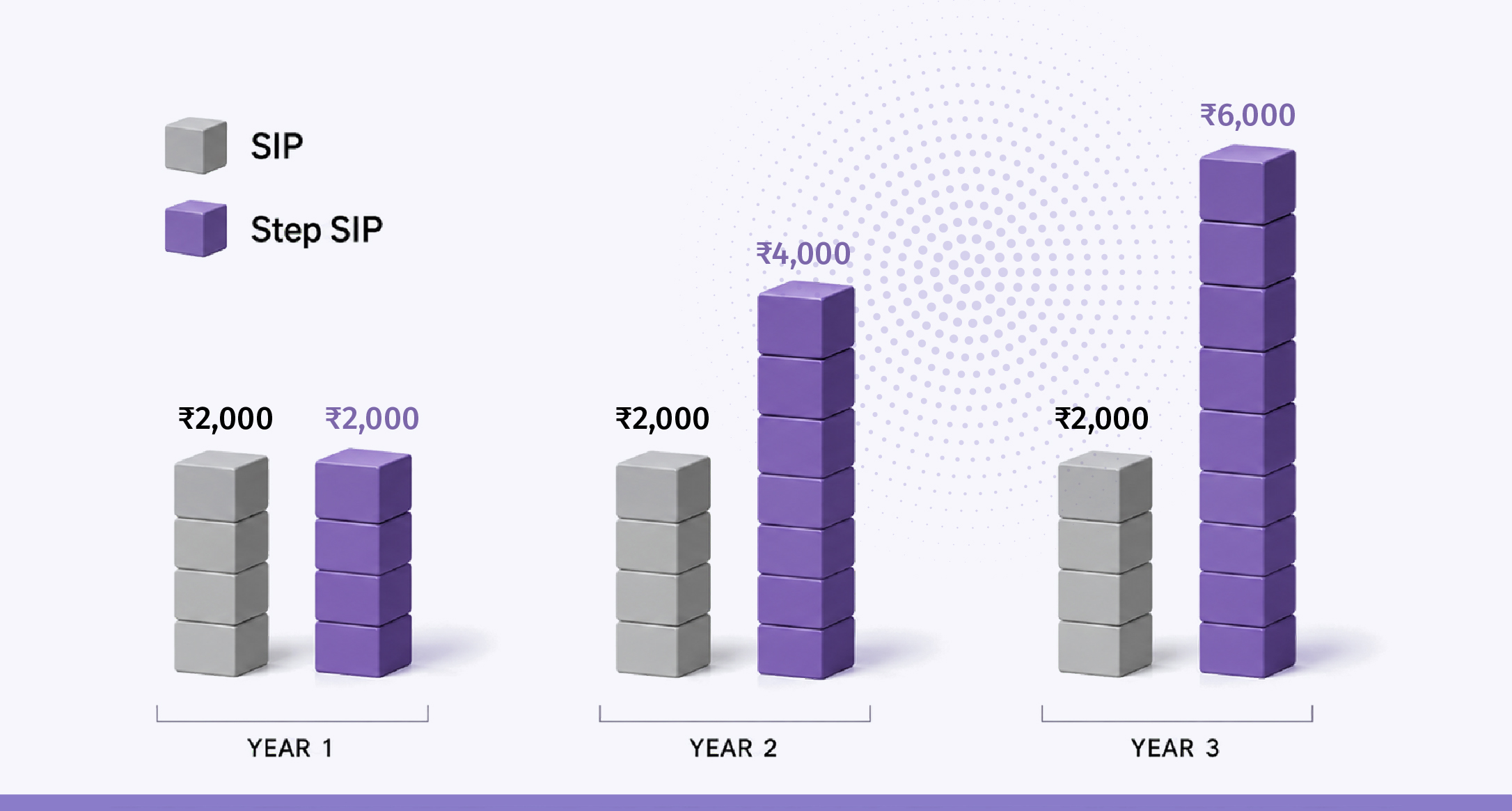
In this way, a Step-Up SIP raises your monthly contribution by a fixed percentage every year.
Up for something different? Try our financial crossword.
If inflation reaches a double-digit number by the time your goal comes closer, the additional ~₹84.18 lakh via Step-Up SIP could cover a substantial part of the inflation-driven increase in your goal’s cost. This reduces the amount you would need to arrange from other sources when the goal arrives.
Also, this small-cap volatility tests your conviction. A period of downturn during the 7th year or 12th year signals the fund’s underperformance. So, the first instinct of an investor is usually to stop the on-going SIP right there. However, it’s usually not the wise decision.
A Step-Up SIP earns much of its advantage by staying invested through the full market cycle. Your contributions are larger in the later years, so pausing during a downturn means those larger contributions miss the opportunity to participate in the subsequent market recovery. The units you could have accumulated at lower prices would also have had more time to grow when the market recovered, adding to the compounding effect over the remaining investment period.
Also read: How to avoid costly mutual fund SIP mistakes that wipe out your wealth
Let’s assume your fund earns ₹50,000 in a year and your corpus at that point is ₹2 lakh. Under the Growth option, the ₹50,000 is added to your corpus, taking it to ₹2.5 lakh. If the fund earns another 10% the following year, the return would be calculated on ₹2.5 lakh, giving you ₹25,000, given the fund actually earns exactly 10% in the next year.
Under a Dividend or IDCW option, if that ₹50,000 is paid out instead, the next year’s 10% return would be calculated on the original ₹2 lakh, giving you only ₹20,000.
Also read: There’s a commission of ₹27,335 crore inside your mutual fund. Here’s who it goes to
The same compounding effect makes the choice between direct and regular plans significant over 20 years. In this example, Step-Up SIP grows to about ₹1.61 crore at a 10% return. With a regular plan, assuming the additional 1% point in ongoing commission reduces the return to 9%, the same SIP grows to about ₹1.46 crore. That is a difference of roughly ₹15.29 lakh (₹1.61 crore − ₹1.46 crore) in the final corpus; it’s your money that could have remained invested and compounded instead of going towards trail commissions.
The impact will vary with your SIP amount, investment period and assumed return. Want to see what this difference could mean for your own SIP? Try 1 Finance Mutual Fund Commission Calculator to compare the potential corpus under direct and regular plans.
A financial goal can change significantly over a long investment horizon, so your investment approach needs room to adapt. Reviewing your SIP as your income and priorities change can help you keep your contributions aligned with what you aim to achieve. Use your current financial position and goal timeline to decide an amount you can increase comfortably each year.
A Step-Up SIP lets you increase your SIP contribution by a fixed amount or percentage at regular intervals, usually every year.
You start with a fixed SIP amount and increase it periodically according to your chosen step-up rate. This allows your contributions to grow over time.
A Step-Up SIP calculator is the financial tool that estimates the potential corpus generated from an SIP that increases periodically. It typically considers your starting SIP, annual step-up rate, investment period and expected return.
The annual increase can depend on your income growth, financial goals and investment capacity. A percentage-based increase, such as 5% or 10%, can help you gradually raise your contribution. You should consult first with a Qualified Financial Advisor to make this decision to align with your overall financial plan.
A Step-Up SIP can help you accumulate a larger corpus in the long run because your investment increases over time. However, the outcome depends on factors such as the step-up rate, investment period and returns.

The views in the article /blog are personal and that of the author. The idea is to create awareness and not intended to provide any product recommendations.


Plan Your Retirement with Our Qualified Financial Advisors
Your first financial plan is free