Popular searches
Get to know your policy better
Product scoring may vary based on gender, age, policy tenure and sum assured.

Gender
Age Group

The lowest age in the selected range is considered for price evaluation (e.g., 25 - 29)
The lowest age in the selected range is considered for price evaluation (e.g., 25 - 29)
Sum Assured
What Personalised Financial Advice Is Actually Worth
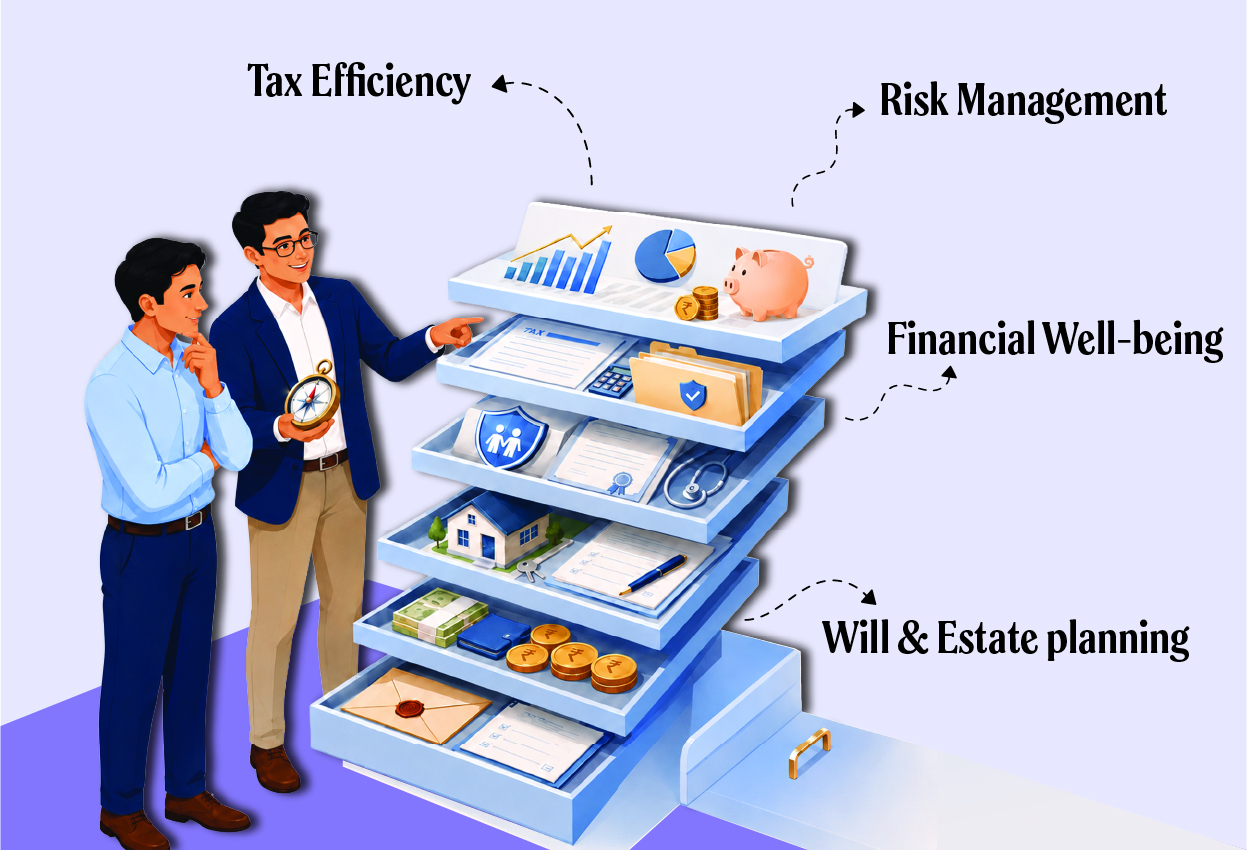
Most financial advice in India is evaluated by a single question: did the portfolio beat the benchmark? That question captures, at best, one of the several ways advice creates value — and almost never the largest one. When structured financial planning is measured across its full scope — corrections to existing inefficiencies, forward-looking goal design, behavioural coaching through difficult decisions, and continuous monitoring across institutions and years — the total value runs between 153 and 301 basis points net portfolio value, after deducting the full advisory fee. In every instance, the single biggest source of that value is something that never appears on any portfolio performance report.
A will drafted before a family dispute could begin. An advance tax instalment timed to avoid a six-figure penalty. A home loan prepayment executed pre-retirement to live debt-free. A nomination error corrected across eleven accounts before it could have locked a surviving spouse out of her own wealth. A health insurance top-up secured at forty-three — closing a ₹1 crore protection gap the client did not know existed.
This article proposes a measurement framework built around four distinct dimensions of advisory value, illustrates it through examples, and examines how artificial intelligence is reshaping which of those dimensions can be automated and which remain irreplaceably human.
Why Performance Reports Miss the Most Valuable Work
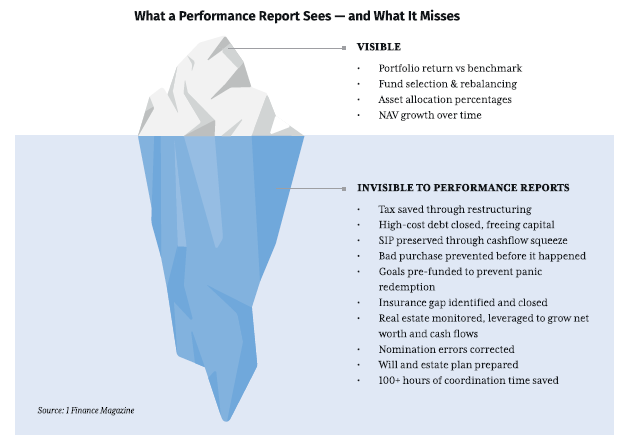
The default method for evaluating financial advice in India is portfolio performance — whether the client’s investments outperformed a benchmark, a category average, or a fixed deposit rate. This is an important number, but it is consistently among the least informative measures of the full value advisory work delivers. When advisory is limited to investments and financial assets alone, the entire picture skews and anchors purely towards returns, over other more relevant and in-control factors such as risk, volatility, horizon, and most importantly, meeting the goals and aspirations for which financial planning and investments are carried out.
A performance report does not capture a tax-loss harvest timed to offset gains, a high-cost debt closed to free capital for compounding, an endowment surrendered and redeployed at three times the yield, a drift in allocation caught before it became a problem, or the hundreds of hours an advisor spends coordinating across institutions and tracking deadlines. These actions — drawn from across all six dimensions of holistic financial planning — exist outside the frame entirely.
The measurement gap matters because what goes unmeasured goes underdelivered. When the most consequential advisory work is invisible to both the client and the advisor’s own tracking, it receives less time, less recognition, and less systematic attention than fund selection and portfolio review.
The Compounding Cost of Measuring Advice by Returns Alone
The consequences of this measurement gap compound. An advisor whose value is measured by returns alone has every incentive to optimise for that metric. Time goes toward fund selection, rebalancing, and chasing alpha — work that is measurable. It does not go toward the estate review that finds nominees unchanged since a divorce, the liability audit that identifies debt bleeding wealth monthly, or the insurance review that exposes a protection gap large enough to undo a decade of savings. These actions require deep engagement, behavioural understanding, and cross-goal thinking. They are harder to perform and impossible to report — so they are the first to be deprioritised.
For the client, the cost is real. An advance tax deadline missed by a week attracts a penalty that no one anticipated. A fixed deposit left to auto-renew at a lower rate for three years compounds into lakhs of foregone returns. An NPS contribution left unoptimised means tax benefits permanently forfeited. A nomination form left unchanged after a life event can trigger a legal dispute that takes years to resolve. Each of these costs is avoidable. None of them appear on a return figure.
When the most valuable advisory work is invisible to the measurement framework, it becomes invisible to the advisory practice itself. What remains unmeasured is eventually underdelivered.
For the advisory profession, this creates a credibility problem. Clients who evaluate advice only by returns will conclude that fees are too high — because the bulk of the value they receive is invisible. Advisors who cannot demonstrate their full impact will struggle to justify fees, retain clients through flat markets, and differentiate from algorithmic alternatives that optimise the same single metric at a fraction of the cost.
Four Distinct Dimensions of Value That Financial Advice Delivers
The framework proposed here separates the value of financial advice into four distinct dimensions. Each addresses a different aspect of the client’s financial life, operates through a different mechanism, and is identified by a single boundary test to ensure no overlap.
Together, they cover the full scope of advisory value across all six dimensions of holistic financial planning.
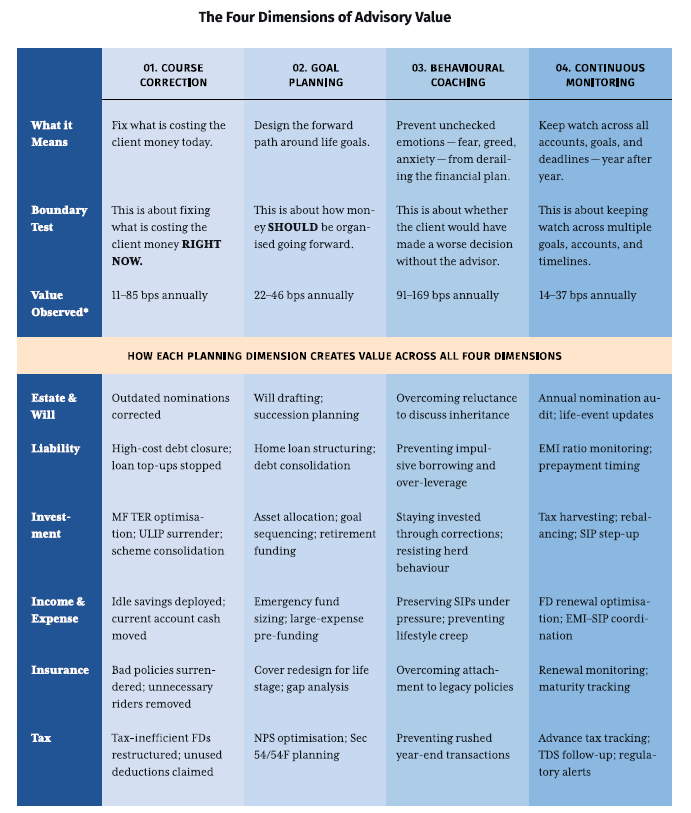
Each of the four value dimensions can appear in any area of financial planning. Liability alone, for example, can involve all four:
- closing a high-cost overdraft (Course Correction),
- structuring a home loan to protect equity compounding (Goal Planning),
- preventing an impulsive purchase (Behavioural Coaching), and
- monitoring prepayment timing (Continuous Monitoring).
The dimensions describe the nature of advisory value, not the financial domain it acts on.
This distinction matters. An advisor who tracks only investment performance may score well on Course Correction but miss the far larger value in the other three dimensions. A client whose portfolio looks well-managed may still carry an outdated will, an unmonitored insurance gap, or a tax structure costing lakhs every year. The four-dimension lens turns a vague sense of “my advisor does a lot” into a structured audit of where value is and is not being delivered.
Across every case examined, Behavioural Coaching was the single most consistent source of value — contributing 91–169 basis points regardless of age, city, net worth, or life stage. It was also the enabling condition without which much of the other value would not have been realised. A fund switch has no value if the client does not act on it. A retirement plan has no value if the client panics and redeems equity three years before the planned withdrawal. Behavioural Coaching is the mechanism through which the other three dimensions are executed.
How This Framework Measures Advice Value
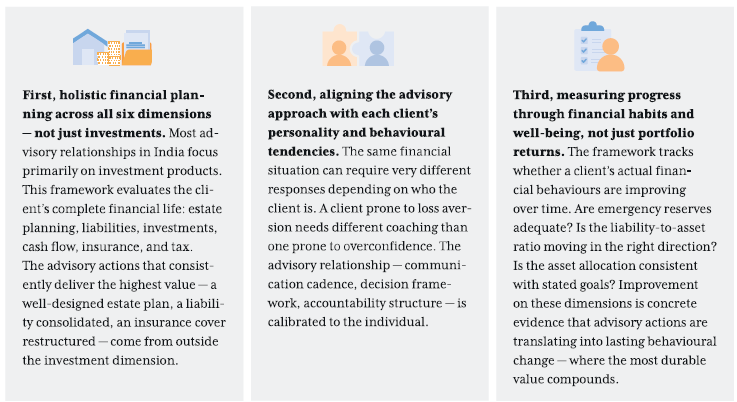
The measurement approach rests on three principles that distinguish it from conventional portfolio-centric evaluation.
The Calculation: Counterfactual, Annualised, Net of Fees
Every value estimate in this framework is built on a single question: what would the client’s financial outcome have been without the advisory action? The difference between that unadvised path and the actual advised outcome is the gross value of the intervention.
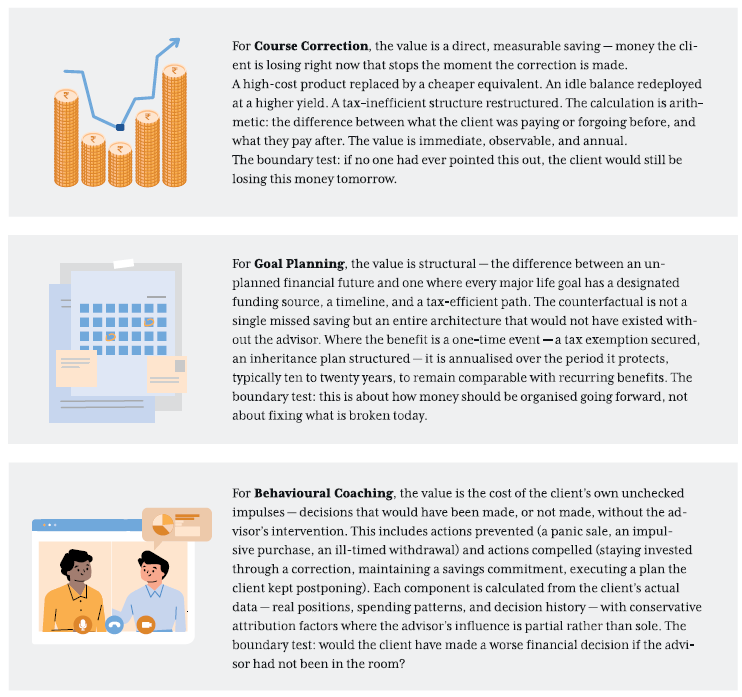
A note on attribution: not every positive outcome is solely the advisor’s doing. This framework applies three conservative attribution tiers to each component. Where the advisor’s intervention was the direct and sole cause of the outcome — for instance, identifying an overcharging insurance policy and replacing it — the full value is attributed (100%). Where the advisor played a strong enabling role but the client also contributed meaningfully, such as staying invested through a correction after the advisor’s counsel, a 75% attribution factor is applied. Where the advisor’s influence was one of several factors, such as a spending reduction that also required family consensus, a 50% factor is used. And where the connection between the advisory action and the outcome is plausible but indirect — for example, the long-term compounding benefit of a savings habit the advisor helped initiate — attribution drops to 33%. Every basis-point figure in the case studies reflects these discounts already applied. The intent is to err on the side of understating value rather than overstating it.
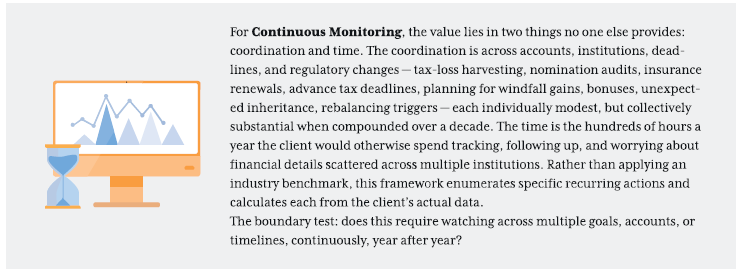
The net advice value formula: gross value across all four dimensions, expressed in basis points on net worth, minus the annual advisory fee (also in bps on net worth). The fee is calculated as a percentage of investable assets and converted to the same denominator. The result is the net annual value delivered, independent of market returns.
Case Studies
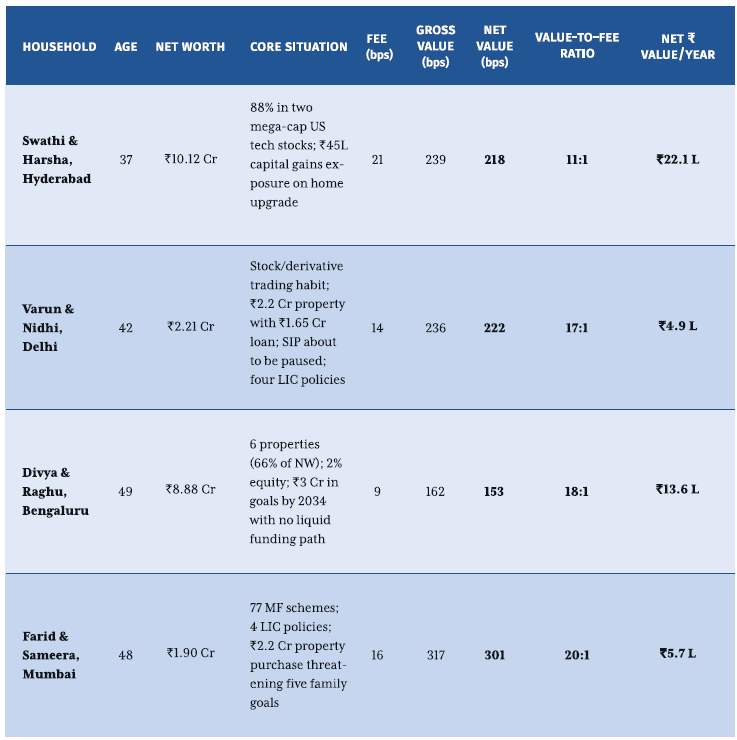
The four cases below illustrate how the framework applies to real Indian households across different cities, life stages, and financial complexities. Financial data reflects actual baseline figures as of the dates stated. All basis-point calculations represent the value of specific advisory actions.
When Concentration and Tax Collide
Swathi & Harsha, Hyderabad
Net worth: ₹10.12 crore. Combined income exceeding ₹1.5 crore per year, half in company stock. ₹7.3 crore sitting in just two US tech stocks. 32 scattered mutual fund schemes. An auto loan at 9%. And a planned home upgrade to an under-construction property in Hyderabad — expected delivery 2029 — that would require selling the very stocks they had spent years accumulating.
Swathi, 35 and Harsha, 37, are both in tech, raising a young child, and eyeing a home upgrade before Hyderabad prices climb further. For 3–5 years their finances had been on autopilot — stock vests piling up in two companies, 32 mutual fund schemes multiplying without a plan. The home upgrade forced the issue: selling ₹3.14 crore of stock would hand ₹20 lakh to the taxman. The builder was offering a 10% discount for paying upfront, and the couple was leaning towards it — not realising that this would mean forfeiting their Section 54F eligibility, a capital gains exemption worth far more than the discount.
How a Finance Advisor Added Value
Working with an advisor, Swathi and Harsha found a way through. Instead of paying upfront and losing the 54F benefit, the stock sale was restructured around the 10-tranche schedule that preserved the exemption — converting the ₹20 lakh capital gains liability to zero. The home purchase was funded through a bridge of EPF withdrawal and a home loan at 7.5%, preserving equity that continues compounding. The 32 mutual fund schemes were consolidated into 8, bringing portfolio TER down from 1.32% to 0.71%. The auto loan was closed early. And the couple’s savings rate, which had been under 10% of cash income, was restructured to 25% — with each new stock vest now being diversified rather than left to re-concentrate.
A household that had been drifting — losing money to unnecessary costs, sitting on a concentrated portfolio, and about to walk into a tax trap — now has a clear financial plan, a diversified portfolio, and a tax-efficient path to the home they wanted. The advisor’s continuing role — monitoring the 54F compliance window, coordinating taxes, tracking SIPs, and harvesting annual exemptions — ensures these gains are not quietly unwound.
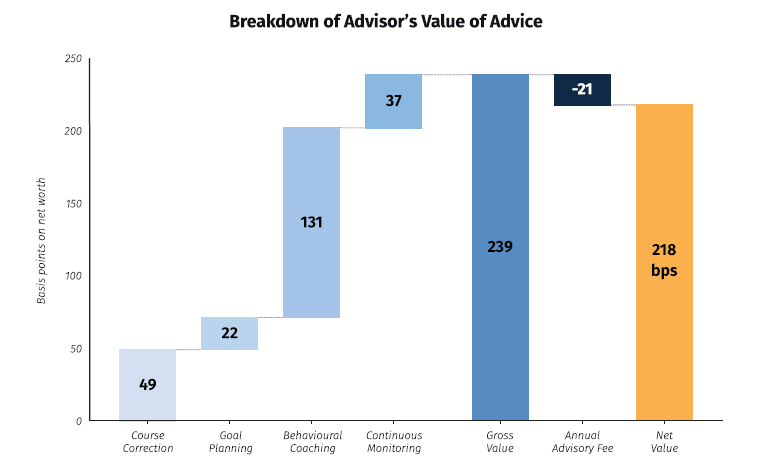
Course Correction (49 bps / ₹5.0L) — bridge funding spread on EPF-plus-loan, TER reduction across 32→8 mutual fund schemes, early auto loan closure. Goal Planning (22 bps / ₹2.2L) — Section 54F structuring premium at 50% attribution (client knew of the exemption; advisor designed the 10-tranche execution). Behavioural Coaching (131 bps / ₹13.3L) — concentration attachment (volatility drag on ₹7.3 Cr in two stocks), annual vest diversification, breaking 3–5 years of financial paralysis, savings rate transformation from <10% to 25%. Continuous Monitoring (37 bps / ₹3.7L) — 54F compliance monitoring, credit card rewards optimisation, cross-jurisdiction tax coordination, SIP continuity tracking, stress testing, annual tax gain harvesting.
Five Quiet Leaks in a Portfolio That Looked Fine
Varun & Nidhi, Delhi
Net worth: ₹2.21 crore. Varun is a Credit Risk Analyst with twenty years of experience, earning ₹41 lakh per year; Nidhi earns ₹35 lakh. One son, fourteen — college fees in four years, retirement in thirteen. Monthly SIP of ₹60,000 under threat from rising EMI commitments on a ₹2.2 crore property purchased with a ₹1.65 crore home loan. Four LIC endowment policies, a bank overdraft at 12%, a ₹10 lakh fixed deposit earning 4.5% post-tax, and a ₹6.5 lakh FD parked to service home loan EMIs. But the most expensive line item was invisible: Varun’s stock and derivative trading habit — a pattern of speculative positions, transaction costs, and recurring losses quietly compounding year after year.
Varun and Nidhi are in their early forties and earn well — ₹76 lakh between them — and have been disciplined about SIPs. But Varun’s career assessing institutional credit risk had given him misplaced confidence in individual securities. Over two years, he had been actively trading stocks and derivatives — netting a loss of approximately ₹1 lakh per year after brokerage and taxes. The couple held four endowment life policies returning under 5%. A ₹1.5 lakh overdraft was running at 12%. And a ₹10 lakh FD was yielding an effective 4.5% after tax.
The most consequential risk was not the trading losses — it was the SIP. Rising home loan EMI disbursement tranches on the ₹2.2 crore property were stretching the monthly cashflow. A ₹6.5 lakh fixed deposit had been parked to service EMIs — earning 6.5% pre-tax while the home loan charged 8.5%. The pressure was building toward a two-year pause in the ₹60,000 monthly SIP. That interruption, compounding at 12% over the remaining thirteen-year horizon, would destroy significant wealth — capital that could never be recovered.
How a Finance Advisor Added Value
The advised path addressed every leak — and added a behavioural intervention the couple had not anticipated. LIC policies were surrendered, proceeds redeployed to equity. The overdraft was closed. The ₹10 lakh FD was moved to a tax-efficient alternative. The ₹6.5 lakh FD earmarked for EMI was restructured — part applied to prepay the home loan, reducing the interest burden and freeing monthly cashflow. But surrendering the endowment policies also exposed a protection gap: four policies had provided only ₹16 lakh in life cover for a family with a ₹1.65 crore home loan and a fourteen-year-old son. A ₹1 crore term plan was put in place at a fraction of the annual premium. The son’s higher education — four years away — was mapped to a dedicated portfolio in Nidhi’s name. Retirement was goal-mapped to 2039 with a probability-tested path. And the ₹60,000 monthly SIP was preserved — protected by the cashflow restructuring that the FD-to-loan prepayment and endowment surrender had unlocked.
The hardest conversation was about the trading. It was difficult for Varun to accept that his personal trading was a cost centre, not an edge. The advisory work was sustained: showing him the cumulative transaction costs, the realised loss history, and the opportunity cost of capital that would have compounded at 12% in a simple index fund. The trading habit was not eliminated overnight — it was gradually replaced with a systematic investment plan that matched his analytical instincts to a disciplined framework. A household that had been bleeding value through five quiet leaks — and one habit it had never questioned — now has clean portfolios, a protected SIP, a right-sized insurance structure, a son’s education plan, and an advisor monitoring home loan prepayment timing, annual tax harvesting, and the behavioural discipline that keeps the trading impulse from returning.
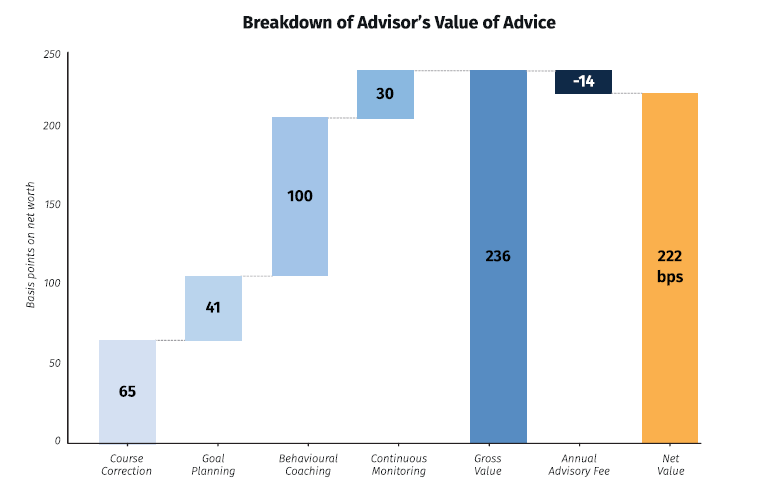
Course Correction (65 bps / ₹1.4L) — LIC surrender and equity redeployment; overdraft closure; FD redeployment to tax-efficient alternative; FD-to-EMI restructuring saving ₹26,000/yr by prepaying home loan instead of holding tax-inefficient FD. Goal Planning (41 bps / ₹0.9L) — insurance cover redesign from endowment to ₹1 crore term; son’s education goal-mapped to dedicated equity portfolio in Nidhi’s name; SIP tranche fund design to protect continuity through cashflow pressure; property hold/exit framework for ₹2.2 crore investment; retirement goal mapping to 2039. Behavioural Coaching (100 bps / ₹2.2L) — preventing the two-year SIP pause that would have cost annual compounding; trading cessation. Continuous Monitoring (30 bps / ₹0.7L) — annual LTCG harvesting, portfolio rebalancing, property value monitoring for ₹2.2 crore investment, and home loan EMI monitoring with prepayment timing optimisation.
The Real Estate Fortress That Left Retirement Unfunded
Divya & Raghu, Bengaluru
Net worth: ₹8.88 crore. Raghu is a Cloud Architect earning ₹95 lakh per year; Divya manages the household. Two daughters — elder nineteen, younger thirteen. Six properties across Bengaluru: an occupied home, three rental apartments, and two non-yielding residential holdings. Annual rental income of ₹10 lakh. Asset allocation: 66% real estate, 22% debt, 10% gold — and just 2% in equity. Five major goals ahead: the elder daughter’s post-graduation fees and marriage by 2034, the younger daughter’s higher education and marriage by 2039, and a ₹12 crore retirement corpus — eight years away.
Raghu is 49 and has spent two decades building a career in cloud infrastructure and, in parallel, assembling six Bengaluru properties. The instinct made sense at each step — property felt tangible, rent felt reliable, and equity felt volatile. But the cumulative result is ₹5.85 crore in real estate and just ₹17.8 lakh in equity — two per cent. With ₹3 crore in goals arriving within eight years, the mismatch is stark. Real estate cannot be redeemed in tranches or timed to a daughter’s admission letter. Selling under time pressure typically means a 15–20% haircut on market value.
How a Finance Advisor Added Value
The advisory work began with the most difficult conversation: that six properties and a ₹95 lakh salary had created the illusion of wealth without building the liquidity to fund a single goal on time. The plan designed a systematic equity accumulation path — redirecting future savings into goal-mapped equity SIPs and building dedicated portfolios in each family member’s name for tax-efficient long-term compounding. NPS contributions were increased from ₹10,000 to ₹46,600 per month, capturing additional tax benefits. Tax-inefficient fixed deposits were moved to more efficient alternatives. Each of the five goals was assigned a funding source, a timeline, and a probability-tested path — structured as a milestone roadmap until 2039.
But the plan was only as durable as the couple’s willingness to follow it. Raghu and Divya had never held meaningful equity. Their first significant market correction would test every instinct that had led them to property in the first place. The behavioural coaching was sustained and specific: helping them understand that equity volatility over eight years is a feature, not a risk; that rental income alone cannot fund lumpy goals; and that the next property purchase — which they were actively considering — would lock capital into the one asset class they already had far too much of. The estate planning was equally critical: a will was drafted for the first time, mapping succession across institutions and six properties, with nominations audited and aligned. Health insurance was redesigned with a super top-up raising cover to ₹25 lakh, and term insurance was right-sized downward as the growing corpus began to self-insure.
A household that had built a real estate fortress while leaving its financial future unfunded now has a structured equity accumulation plan, five goals with designated funding sources, estate clarity across six properties, and an advisor monitoring the behavioural discipline needed to hold equity through its first full market cycle. The most valuable action was not a product switch — it was convincing a Cloud Architect that the next eight years required a fundamentally different asset allocation.
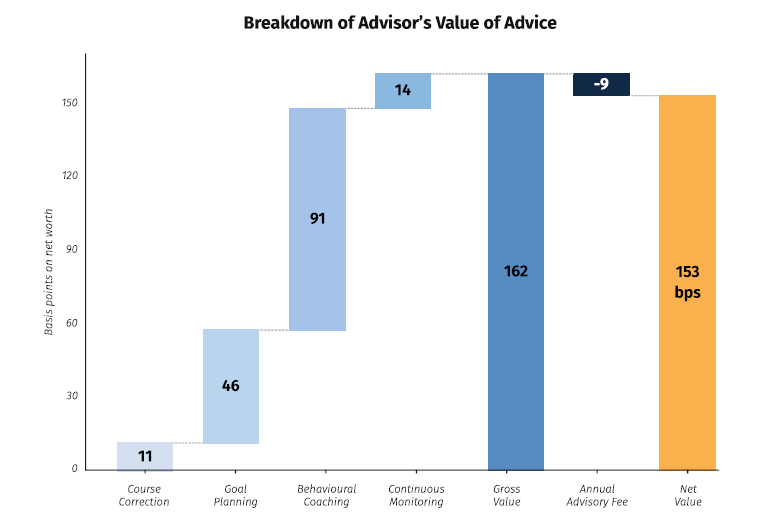
Course Correction (11 bps / ₹1.0L) — NPS contribution optimisation; replacing tax-inefficient fixed deposits with arbitrage fund alternatives. Goal Planning (46 bps / ₹4.1L) — phased equity gifting strategy building ₹84 lakh in tax-efficient equity across family members’ names; 5-goal milestone roadmap with pre-designated funding until 2039; estate and succession planning across six properties and institutions; health insurance redesign for retirement and term cover right-sizing. Behavioural Coaching (91 bps / ₹8.1L) — reversing a six-property real estate accumulation pattern and preventing a seventh purchase that would have locked ₹1.25 crore in the one asset class already at 66%; building equity volatility resilience for a couple with near-zero equity experience; shifting the retirement income mindset from rental dependence to diversified portfolio income. Continuous Monitoring (14 bps / ₹1.2L) — annual LTCG harvesting, portfolio rebalancing, annual nomination audit across six institutions, and multi-property rental coordination across six properties.
The Property Purchase That Looked Affordable Until It Was Not
Farid & Sameera, Mumbai
Net worth: ₹1.90 crore. Farid earns ₹77 lakh per year in a senior aviation industry role; Sameera manages the household. Two daughters, sixteen and thirteen. Five major family goals ahead — from the elder daughter’s education next year to retirement in 2042. Portfolio scattered across 77 mutual fund schemes and four LIC endowment policies. Three properties across two cities — one under active litigation. Eyeing a ₹2.2 crore home in Mumbai — the EMI of ₹1,02,000 felt barely more than the ₹75,000 rent they were already paying.
Farid and Sameera are in their late forties, raising two daughters, and feeling the pull of homeownership. Farid’s career in aviation has built a comfortable income — ₹77 lakh a year — but their finances had grown without a plan. 77 mutual fund schemes accumulated through years of ad-hoc purchases, four underperforming traditional life policies, and three properties across two cities — a plot, an investment flat, and one caught in litigation. There was no structured savings plan. Every conversation circled the same question: should they buy? At ₹1,02,000 per month, the EMI was only ₹27,000 more than rent. With income of ₹77 lakh, the EMI represented just 16% of annual earnings — well within any bank’s comfort zone. They had all but decided to buy.
How a Finance Advisor Added Value
The analysis revealed what the EMI-versus-rent framing obscured. When society maintenance, property tax are included, the true annual cost of ownership totals ₹12.96 lakh — against ₹9 lakh in rent. A ₹3.96 lakh annual gap, compounding across seventeen years, would push retirement probability down to 58% and threaten four of the five family goals. A ₹77 lakh income made the EMI look comfortable — precisely what made the decision dangerous. The advisory work was fundamentally behavioural: helping Farid and Sameera see past the EMI anchor and understand that deferring to 2030 was the financially responsible path.
In parallel, the 77 mutual fund schemes were consolidated into six goal-aligned schemes — cutting down TER from 1.75% to 0.74%. The four LIC policies were surrendered, with proceeds redeployed to equity at significantly higher expected returns. Investments were restructured across both names for tax efficiency — higher-gain assets positioned in Sameera’s name to optimise capital gains treatment within the framework of Indian tax law, taking advantage of her independent exemptions as a non-earning spouse. Each of the five family goals — from the elder daughter’s professional course fees in 2027 to a ₹7 crore retirement corpus by 2042 — was assigned a dedicated funding source, a timeline, and a probability-tested path.
A household that had been drifting toward a property purchase it could not truly afford — while bleeding value through 77 high-cost funds and underperforming insurance products — now has a clean portfolio mapped to five specific goals, full clarity on how each goal will be funded, a realistic home-purchase timeline in 2030, and an advisor coordinating LTCG harvesting, annual rebalancing, litigation tracking, and milestone monitoring across all five goals and three properties. The most valuable action was a decision prevented — one that a ₹77 lakh income made look easy, and future simulation proved devastating.
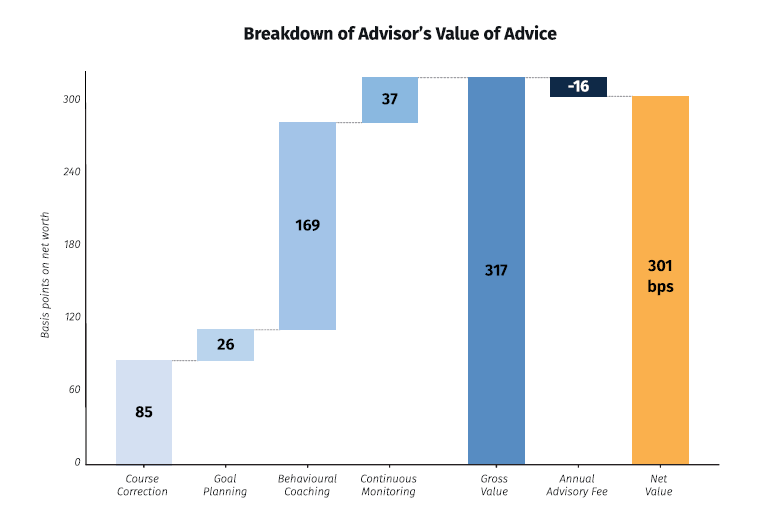
Course Correction (85 bps / ₹1.6L) — consolidating 77 schemes into 6 goal-aligned direct funds, surrendering 4 LIC policies and redeploying to equity. Goal Planning (26 bps / ₹0.5L) — goal-aligned portfolio design (77 schemes restructured to 6 goal-mapped funds), 5-goal probability framework spanning 2027–2042, and spousal tax-efficient investment structure positioning higher-gain assets in Sameera’s name. Behavioural Coaching (169 bps / ₹3.2L) — dismantling the EMI-versus-rent anchoring bias that a ₹77 lakh income made deceptively comfortable and that would have destroyed five family goals; closing the gap between a high household income and its actual savings deployment. Continuous Monitoring (37 bps / ₹0.7L) — annual LTCG harvesting, portfolio rebalancing, and multi-property coordination including litigation tracking across three properties in two cities.
What These Cases Reveal — And What It Means for the Profession
These four households differ in every surface dimension — age, city, net worth, life stage, and the nature of the problem. Yet the pattern that emerges from the data is remarkably consistent, and it carries implications for how the advisory profession measures, communicates, and delivers value.
- Behavioural Coaching is the single most consistent and largest source of value. It contributed 91–169 basis points in every case. In each instance, it was the enabling condition without which the other three dimensions would not have been fully realised. Advisors who underinvest in this area are leaving the single largest source of client value on the table.
- The most valuable advisory actions are invisible to conventional measurement. A tax liability restructured to zero. A SIP preserved through a cashflow squeeze. A property purchase averted. A retirement corpus protected from first-year equity redemption. None of these appear in a return figure. Continuous Monitoring prevents wealth from leaking quietly, year after year, yet because the work is invisible and ongoing, it is the first to be deprioritised. Advisors who systematically deliver it create a compounding advantage clients cannot replicate alone. If the measurement framework does not capture these actions, the highest-value work remains unseen — and what remains unseen is eventually underdelivered.
- Advisory fees represent a small fraction of the value delivered. Across the four cases, advisory fees ranged from 9 to 21 basis points, whilst net advice value ranged from 153 to 301 basis points — a value-to-fee ratio of roughly 11:1 to 20:1. The fee is not the cost of advice. It is the cost of access to the mechanism through which all four dimensions of value are delivered — corrections that pay for themselves in the first year, planning that compounds over decades, coaching that protects against the most expensive decisions, and monitoring that catches the gaps no one else is watching.
- AI will reshape the profession but not replace it. Course Correction is the most immediately automatable type: portfolio audits, idle balances earning below-market rates, and redundant fund overlaps are already within the capability of well-designed algorithms. The savings are arithmetic, and the detection is pattern-based — precisely the terrain where machine intelligence excels.
Goal Planning is partially automatable: simulations, tax-optimisation engines, and asset-liability matching models grow more sophisticated each year, and an AI-driven planning tool can generate a structurally sound financial plan faster than any human. But the plan’s value depends on the client’s willingness to follow it — and that willingness is a human variable that no model controls.
The two highest-value dimensions resist automation in a fundamental way.
Behavioural Coaching requires trust, empathy, and the accumulated context of a long relationship. An algorithm can flag that a SIP is about to be paused, but it cannot sit across the table from a client in a market correction and provide the reassurance that keeps the commitment intact. It cannot read the hesitation in a voice, sense that a spouse’s resistance is the real barrier to a decision, or judge when to push and when to wait.
Continuous Monitoring depends on sensing when circumstances have shifted before the numbers show it — a career change that has not yet appeared in the cashflow data, a family dispute that will eventually affect estate planning, a regulatory change whose second-order effects require immediate action. These are judgement calls that require integrating signals across domains, institutions, and human contexts simultaneously. AI will make advisors faster at diagnostics and modelling. But the irreplaceable edge lies in trust, relationship, and coordinated judgement — precisely where the largest and most consistent value is found.
For advisors seeking to apply this framework, the four-dimension structure serves as a diagnostic. Which dimensions are being actively delivered, and which are being left to chance? If the advisory relationship is primarily focused on investment selection — Course Correction and parts of Goal Planning — then the two highest-value dimensions may be going undelivered. The client is paying for advice but receiving only a fraction of the value that a complete advisory relationship can provide.
- Measuring value is only half the work — communicating it is the other half. Basis points are the language of the framework, but they are not the language of a client review meeting. An advisor who tells a client ‘we delivered 317 basis points of net value this year’ will get a polite nod; an advisor who says ‘your advisory fee of ₹30,000 this year delivered ₹6.03 lakh in measurable financial actions — a 20:1 return on that fee’ will get the client’s full attention. The translation matters. In a client conversation, absolute rupee figures are more intuitive than basis points, ratios are more persuasive than percentages, and specific actions are more memorable than categories. Rather than saying ‘Behavioural Coaching contributed 169 bps’, the advisor might say: ‘The single most valuable thing we did this year was help you defer that property purchase — that one decision protected five of your family’s goals and preserved ₹3.96 lakh annually in capital that is now compounding toward your retirement.’ Advisors who build this translation into their annual review process will find that client retention, referrals, and willingness to pay for comprehensive advice all improve — because the client finally sees the full picture.
The question is not whether advice justifies its cost — the evidence from these four households suggests it does. The question is whether the profession will adopt the frameworks needed to make that value visible — to clients, to regulators, and to itself. Track financial habits and well-being alongside portfolio returns. The largest source of compounding value may be a savings habit preserved, a tax structure redesigned, or a decision avoided because someone was watching the complete picture.
A Note on Methodology
The basis-point figures in this article are calculations grounded in actual household data, not projections of future performance. Key assumptions include: 12% long-term equity return (conservative relative to past Nifty 50 returns); actual TER differentials between fund schemes for each household; Indian tax law as of the relevant assessment years; and behavioural coaching value assessed based on the specific tendencies identified in each household’s financial profile and the actions deployed against them. Net value is calculated as gross value across all four dimensions minus the annual advisory fee. Actual outcomes will vary with market conditions, client execution, and changes in tax law.
Industry Perspective - Soumya Rajan, Founder and CEO of Waterfield Advisors
1. In 2010, after over 16 years at Standard Chartered, you stepped away to build a wealth advisory firm that charged clients directly for advice and took no commissions from product manufacturers, at a time when the entire industry was distributor-led. You’ve called turning down distribution the hardest business decision you’ve ever made. What made you so certain this model was right, and what does straddling both models actually cost an advisor and their clients in the long run?
When I left Standard Chartered in 2010 and founded Waterfield in 2011, the conviction came from an inescapable observation: advice cannot be truly objective if its economics depend on what gets sold. In the aftermath of the global financial crisis, I saw clients increasingly question large institutions because what was being done in proprietary books and what was being advised to clients did not always appear aligned. Once you see that divergence clearly, it becomes difficult to rationalise it away.
Needless to say, the decision was difficult because the distributor-led model is inherently easier to scale. It allows the client to perceive advice as “free,” while the economics are embedded within the product. Fee-based advice, by contrast, requires the client to pay explicitly for judgment. In our early years, clients would often say that by paying an advisory fee, they were effectively incurring a “double layer of fees.” It was only with the introduction of SEBI’s RIA regulations in 2012 that the distinction between embedded costs and explicit fees became clearer and more defensible.
The long-run cost of straddling both models is mathematical as much as it is philosophical. The moment revenue is linked to product placement the distributor is simultaneously optimising for client outcomes and for revenue capture, while potentially disregarding suitability. Over time, that misalignment manifests as unnecessary complexity, increased risk, duplicated exposures, and persistent cost leakage. In one case I discussed recently, a large listed-company promoter family was paying ₹4–5 crore annually in fees on a portfolio that was largely fixed-income oriented, with no single point of accountability for portfolio construction or risk. That, in very concrete terms, is what misalignment looks like in practice.
2. You once drew a striking comparison, that in developed markets advisory accounts for nearly 60% of wealth management; while in India it remains a fraction of that. Yet when you speak to Indian families, many are surprised to discover that genuinely personalised, conflict-free advice even exists as an option. Where does this awareness gap come from, and whose responsibility is it to close it: the regulator, the advisor, or the client?
India’s problem is not lack of financial participation. It is the imbalance between participation and judgment. As of late March 2026, SEBI’s recognised intermediary list showed just 993 investment advisors. At the same time, India had crossed 20 crore demat accounts in August 2025, and AMFI data for February 2026 showed 27.06 crore mutual fund folios. Even allowing for multiple accounts and folios per investor, the ratio is telling: Market access has scaled vastly faster than fiduciary advice.
That awareness gap exists because product distribution is easier to scale, easier to explain, and easier to monetise. This is “scaling without judgment”: Product-linked models offer faster revenue visibility and lower barriers to entry, whereas advisory requires documented suitability, client agreements, ongoing review and the willingness to charge up-front for independent judgment. Those are all good features, but they are harder to scale systematically.
The responsibility to bridge the gap is shared: Regulators must improve the plumbing, advisors must explain value better, and clients must ask sharper questions. The regulator’s role is particularly important because the frictions are material. For instance, one of the biggest barriers today is that moving a client from a distributor code to an advisory/direct structure can still be operationally cumbersome and, in some cases, treated economically like a fresh transaction. If India wants advisory to scale, transitions must become simpler and less punitive.
3. You have often compared a good financial advisor to a doctor or a lawyer, professionals whose value is never questioned even though it rarely shows up as a direct return on investment. In your 14 years at Waterfield, there must have been moments where a client, after moving to a genuine advisory relationship, finally understood what they had been missing. What does that moment typically look like? And how do you help clients who haven’t had that moment yet see and appreciate the value that never shows up on a statement?
In practice, the “aha moment” is rarely a single event. It is usually a gradual shift in how clients perceive their own financial lives.
Clients begin to understand the value of advisory when they see their financial life as a system rather than as a bag of products. Drawing from the case studies we published recently, that moment comes when investors see all assets mapped together, when their investment portfolios reflect conviction, when ownership structures are outlined clearly, and when hidden inefficiencies are quantified: duplicated PMS exposures, overlapping strategies, unclear liquidity buckets, several lakhs and crores in annual fee leakage, and no clearly articulated risk posture. Once that diagnostic is done properly, the value of advisory stops being abstract.
That is why I compare a good advisor to a doctor or a lawyer. Their value is not exhausted by a single visible output. It lies in diagnosis, prevention, sequencing and judgement. Waterfield was built on that broader lens from the start. We look at not just investments, but also legacy and succession planning, structuring, philanthropy and governance. That was the original thesis, and it remains the heart of the model.
For those who have not yet had that moment, the only honest way to demonstrate value is through evidence: Show the overlap, measure the fees, identify the concentration, test the liquidity assumptions, and ask whether the current structure can survive an inflection point. Once clients see that, the conversation changes from “why should I pay a fee?” to “why was nobody looking at this holistically before?”
4. Behavioural coaching is widely acknowledged as the most underestimated source of advice value — yet it is the hardest to demonstrate. At the ultra-HNI level, where clients are typically sophisticated and confident in their own judgement, what does behavioural coaching actually look like in practice? And are high-net-worth clients more or less susceptible to the same emotional patterns — panic-selling, performance-chasing, overconfidence — that affect retail investors?
Wealth does not immunise people against behavioural error, but it certainly increases the cost of being wrong.
I have observed the same recurring patterns across investor segments: Overconfidence in rising markets, panic in drawdowns, and liquidity decisions taken without reference to long-term obligations. Those patterns do not disappear at the UHNI level. In fact, they often become more dangerous because the decisions are larger, more complex, and harder to reverse.
Consider the case of an entrepreneur whose company is listed on Nasdaq and who suddenly had 80–90% of net worth tied to a single stock. That is a behavioural and strategic problem, not a product-selection one. Sell too quickly, and you destroy value, or wait too long, and the concentration risk becomes existential. As advisors, our goal is to not react theatrically, but to sequence decisions: how much to liquidate, when, across which jurisdiction, with what tax consequences, and in what estate structure.
So behavioural coaching at this level is as much about preventing panic-driven decisions during market downturns as it is about putting enough structure around wealth so that decisions are not taken under the influence of excitement, grief, fatigue or ego. That is where a trusted advisor earns the fee.
5. You have described the advisory relationship as one that becomes most valuable precisely at the inflection points — a business exit, an inheritance, a health event. What happens to families that do not have an ongoing advisory relationship when those moments arrive? And in your experience, how long does it take to repair what was lost?
When a business exit, inheritance or health event arrives, time compresses. Families have to make decisions that would ideally have been prepared for years earlier.
In the absence of an ongoing advisory relationship, what is usually missing is not intelligence, but architecture: no formal investment policy, no separation of family pools from individual capital, no ownership map, no agreed liquidity framework, misallocation of capital, no estate structure robust enough to survive stress. For most of our clients, the first step has always been diagnostic because there was no integrated view of the balance sheet to begin with.
Repair is possible, but prevention is, of course, far cheaper. If wealth structuring is done only after a windfall, or governance is discussed only after a family disagreement, or estate issues are addressed only after illness, then value is lost through timing, taxation and fractured decision-making.
That is precisely why Waterfield expanded early into succession, structuring and philanthropy, not just portfolio advice. We saw that the most consequential failures in wealthy families begin as design failures.
6. Beyond portfolio decisions, the most consequential advisor interventions are often human ones — a conversation that stops a client from selling a business too early, walking away from a family arrangement, or making a decision in grief or panic that cannot be undone. Can you share what that kind of intervention looks like in practice — and what it tells us about the role a truly personalised advisor plays in a client’s life?
The most consequential interventions are often the ones that do not necessarily result in an immediate change in the portfolio, but they materially alter the outcome over the course of time.
In practice, this often means introducing structure into moments that are inherently unstructured: a business sale driven by timing rather than readiness; a liquidity decision taken without reference to long-term obligations; a family arrangement being negotiated without clarity on financial consequences.
The advisor’s role in these situations is to reframe the problem: What is the objective? What are the second-order effects? What happens if this decision is irreversible?
These interventions are particularly important because many high-stakes financial decisions are made under conditions of urgency, grief, optimism, or external pressure. That is to say, they are made under conditions that are not purely rational. The cost of getting them wrong is not always recoverable.
What this tells us is that a truly personalised advisor operates across time, not transactions. The value lies in continuity and having enough context to recognise when a decision is being driven by circumstance rather than intent, and in having the trust to challenge it.
7. After everything a family goes through — and everything a good advisor helps them navigate — what is the most meaningful change you see in families who have had access to genuinely personalised advice over a long period? Not in their portfolio, but in how they relate to their wealth and to each other.
The biggest change is in the family’s relationship with wealth.
Over time, wealth becomes less mysterious and less destabilising. Conversations move from products to purpose, from reaction to agency, from individual preference to family governance. In my experience, that is when wealth starts behaving like capital rather than like an accumulation of disconnected bets.
There is also a shift in who participates. In interviews and writing over the years, I have argued that advisors need to bring women more deliberately into investment and family-business discussions. One reason is practical: many women inherit control without having been included early enough in the process. Another is demographic: women often outlive men and therefore end up carrying a disproportionate share of long-term stewardship. Waterfield’s own effort in this area has not been symbolic; as of 2022, more than 50% of staff and leadership were women, and a dedicated proposition for women clients, HERitage, also emerged from that conviction.
So the most meaningful long-term outcome is that wealth stops being a source of anxiety and becomes something that can be discussed, governed and transmitted with greater maturity.
8. India’s mass-affluent segment is growing rapidly, yet remains substantially underserved by personalised advice. What does India need to do — in terms of regulation, advisor education, and client awareness — to make the kind of advice you have built at Waterfield accessible at a scale that actually matches the opportunity?
Coincidentally, I wrote about this in my newsletter, CuriouSR, and shared 8 actionable points that can help advice truly scale in India:
- Increase Awareness for Advisory: A movement on the lines of ‘Mutual Fund Sahi Hai’. Collaborate with industry bodies and large platforms to increase public awareness of the value of SEBI-registered advice. Publicise success stories and highlight the importance of registration for investor protection.
- AI-integrated Digital Infrastructure: Standardised, regulator-aligned tools for risk profiling, suitability mapping, documentation, audit trails, and periodic reviews would allow advisors to spend more time on judgment and less on process. Intelligent systems can flag inconsistencies, prompt periodic reviews, and automate record-keeping in ways that improve both compliance quality and efficiency.
- Talent Development: Structured training programmes that go beyond product knowledge, covering financial planning, behavioural finance, governance, estate structuring, and ethical decision-making. Apprenticeship models within established advisory firms, mentorship frameworks, and clearer progression from junior planner to lead advisor would help professionalise the field.
- Ease of Transition from Distributor to Advisory Model: Offer practical transition support and relaxed requirements for AMFI-registered mutual fund distributors or other financial intermediaries who wish to migrate to the fiduciary RIA model.
- Reduced Ongoing Compliance for Low-Volume RIAs: Offer proportionate compliance requirements and lower deposit/net worth standards for individual and small-scale RIAs handling fewer clients, incentivizing new solo practitioners and niche firms.
- Ease of Transition for an Investor from Distributor to Advisory Model: Allow a simple switch for investors to move from a Distributor Code to an Advisory Direct Code/Share Class instead of treating the change as a redemption and taxable event. This is perhaps the single biggest hurdle for the industry today.
- Fixed Fees Slab: Raise the maximum fixed fee slab (currently Rs. 1.5 lakh per client annually) to allow greater compensation for advisors delivering high-value and complex financial planning services.
- Fee Structures: Continue enhancing flexibility in payment structures and fee options, including allowing tailored, performance-based, or multi-year fee arrangements by mutual consent.
These measures require a multi-stakeholder approach, one that calls for regulators, advisors, platforms and clients to work in concert with one another. No single intervention, in isolation, will be sufficient; the system must evolve as a whole.
Once there is alignment between incentives, regulation, and client awareness, the advisory model can begin to scale more naturally. We have created extraordinary access to financial markets in India; what we have not yet created, at the same scale, is access to independent, fiduciary judgment. I truly believe that bridging that gap is not just an industry opportunity, but an economic necessity.
Note: This is an edited excerpt from our interview with Soumya Rajan
Table of Contents
Share:


Share: