
 Book a free consultation
How Much Do You Really Need to Save for Retirement?
May 25, 2026

Plan Your Retirement with Our Qualified Financial Advisors

Your first financial plan is free
Key takeaways
As a non-government employee, suppose you retire this year at 60 with ₹1 crore in your NPS account; the amount being the result of decades of hard work, disciplined savings, and countless financial planning decisions. But retirement makes you reevaluate it. How does NPS pay after 60 years? Can this NPS corpus be converted into a steady monthly income, supporting your lifestyle during retirement? NPS’ Retirement Income Scheme is its resolution.
Under NPS withdrawal rules, at least ₹20 lakh must be used to buy an annuity, giving you a fixed pension for life. The remaining ₹80 lakh comes to you as a lump sum. While it is your money, deciding how to use it wisely can feel overwhelming. Withdraw too much, and the corpus may not last; leave it untouched, it forgoes the compounding opportunities.
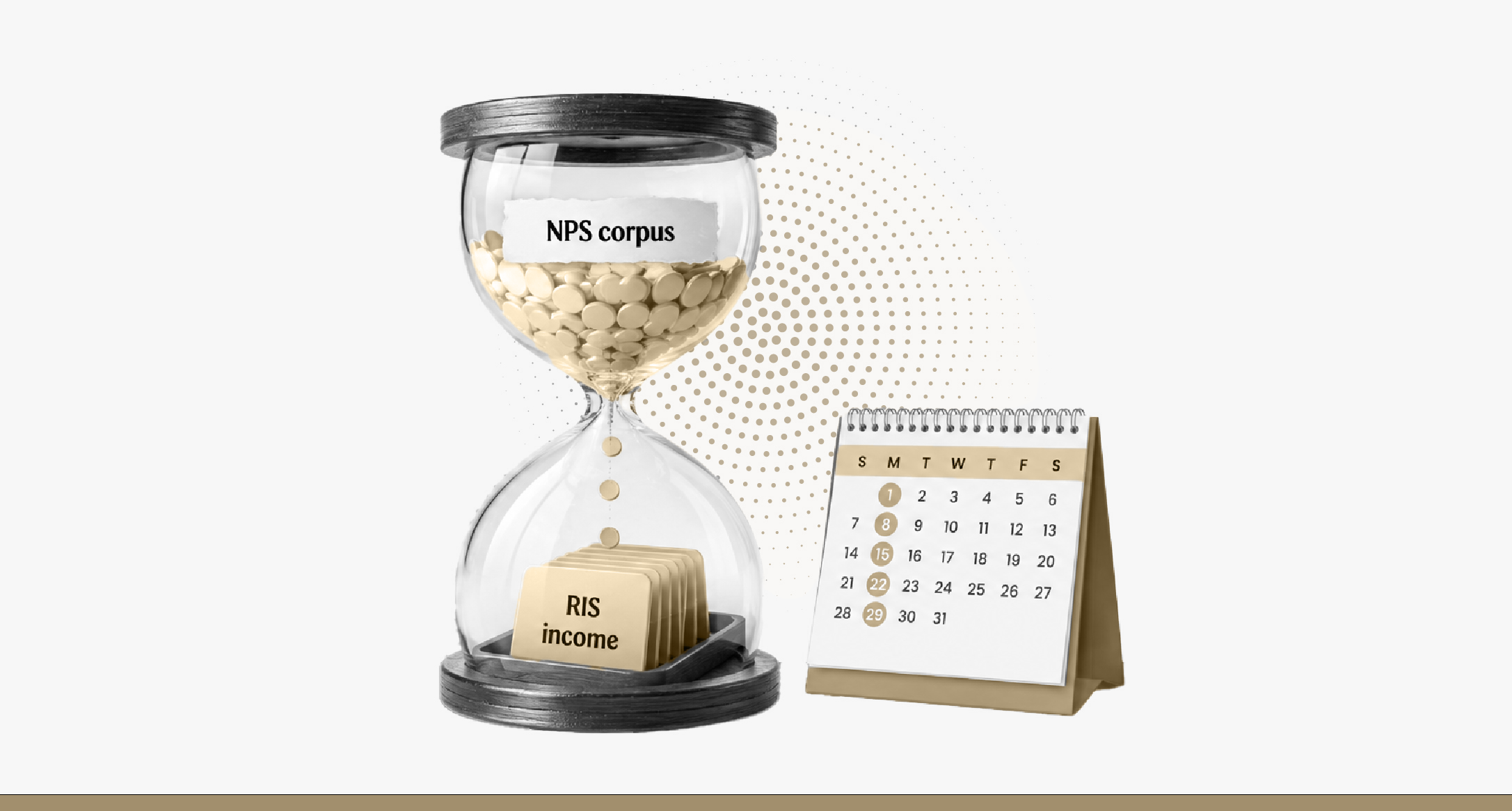
PFRDA’s Retirement Income Schemes (RIS) aims to solve this dilemma by converting the corpus into a regular income stream while keeping the balance invested for potential growth. And we will show you how RIS works with a worked example.
‘Retirement Income Scheme’ is a lifecycle fund inside NPS, called RIS Steady, built for the retirement years. It holds 35% in equity at 60 and eases to 10% by 75, so the corpus keeps earning while you draw on it. The scheme applies to retirees who wish to leave their lump sum inside NPS rather than withdraw it in full.
Taken in cash, ₹80 lakh becomes a 25-year responsibility. You need to decide where to park the money and how to generate a steady income from it. Fixed deposits may offer stability, but their returns may not always keep pace with inflation. Other fixed-income options, such as debt mutual funds, can provide additional flexibility, but they too face inflation and interest-rate risks over long retirement periods.
Across 25 years, these decisions play a major role in determining how long your corpus lasts. Managing them can also become more challenging with age. The same person who carefully managed investments during their working years may find it increasingly burdensome to do so in their 70s.
Retirement Income Scheme (RIS) is built to take most of that off your hands. The corpus stays inside NPS, the fund rebalances itself along the lifecycle glide path, and the withdrawal rate is set each year by a formula instead of a fresh decision.
Consult a Qualified Financial Advisor today

We will get back to you shortly.
NPS retirement income scheme converts your ₹80 lakh into a monthly income through a structured drawdown mechanism. This determines how much of the corpus can be withdrawn each year while the balance remains invested.
The default method is the Systematic Payout Rate (SPR). Here, the annual payout is linked to the years remaining until age 85. At age 60, with 25 years left, the payout rate works out to 1/25, or 4%. Applied to an ₹80 lakh corpus, the first year’s payout looks like this.
RIS payout for the first year, at age 60
| Step | Figure |
|---|---|
| Lump sum in RIS | ₹80,00,000 |
| Years left to 85 (at age 60) | 25 |
| Payout rate (1/25) | 4% |
| Payout for the year (4% of ₹80 lakh) | ₹3,20,000 |
| Monthly income (divide by 12) | ₹26,667 |
Scroll right to view full table →
That 4% applies only in the first year. Each year thereafter, the payout rate rises because the years remaining to age 85 fall by one. If the corpus also earns investment returns, the monthly income rises further. Assuming RIS Steady earns a steady 8% a year, the progression would look like what’s mentioned in the table.
In the early years, the 8% return is higher than the SPR (4% up to age 64). As a result, even after you receive monthly payouts, the corpus continues to grow. That’s why the monthly income at age 65 is calculated on a larger corpus than the original ₹80 lakh.
Assumption: RIS earns a steady 8% a year on ₹80 lakh under the Systematic Payout Rate (SPR) route
| Your age | Opening corpus | 8% return | SPR rate that year | Approx. monthly income | Closing corpus* |
|---|---|---|---|---|---|
| 60 | ₹80 lakh | ₹6.4 lakh | 4.% | ₹26,667 | ₹83.2 lakh |
| 65 | ₹97.33 lak0h | ₹7.79 lakh | 5.% | ₹40,556 | ₹1 crore |
| 70 | ₹1.06 crore | ₹8.45 lakh | 6.7% | ₹59,200 | ₹1.08 crore |
| 75 | ₹1.05 crore | ₹8.4 lakh | 10% | ₹87,500 | ₹1.03 crore |
| 80 | ₹73.8 lakh | ₹5.9 lakh | 20% | ₹1,23,000 | ₹65 lakh |
| 85 | ₹31.8 lakh | ₹2.54 lakh | 100% | ₹2,65,000 | ₹0 |
Scroll right to view full table →
At a 100% SPR, the entire remaining corpus (along with the year’s investment return) is assumed to be paid out during the year, leaving no balance thereafter.
RIS also offers a second method called Systematic Unit Redemption (SUR). Instead of fixing a payout rate, SUR fixes the number of units redeemed at each withdrawal. The rupee amount you receive therefore depends on the scheme’s NAV.
Systematic Unit Redemption (SUR) payout for the first year at age 60
| Step | Figure |
|---|---|
| Lump sum in RIS | ₹80,00,000 |
| Illustrative NAV per unit at 60 | ₹40 |
| Units held (₹80 lakh/₹40) | 2,00,000 |
| Units sold each year (to last 25 years) | 8,000 |
| Illustrative first year’s payout (8,000*₹40) | ₹3,20,000 |
| Monthly income (divide by 12) | ₹26,667 |
Scroll right to view full table →
An alternative to RIS is to use the ₹80 lakh to purchase a second annuity, over and above the mandatory annuity bought with ₹20 lakh under NPS withdrawal rules. At an assumed annuity rate of 6.5%, ₹80 lakh would generate about ₹5.2 lakh a year, or roughly ₹43,000 a month, for life.
The comparison highlights the trade-off. The annuity starts with a higher and guaranteed income. RIS starts lower, at about ₹26,667 a month under the SPR route, but allows the corpus to remain invested and gives payouts the potential to grow over time. However, the second annuity stays constant at ~₹43,000 per month.
In the illustration above, the payout from a retirement income scheme overtakes the annuity around the sixth or seventh year and continues to rise thereafter.
Also read: Retirement planning in India 2026: Why 75% of Indians are not prepared
The ₹80 lakh lump sum may be one of the largest financial assets you will manage in retirement. Whether it is placed in retirement income schemes, used to buy a second annuity, or split between the two can have a lasting impact on your retirement income. A Qualified Financial Advisor (QFA) can evaluate these options in the context of your retirement plan, estimate their long-term income potential, and assess the trade-offs involved.
The objective of retirement income schemes is to arrive at an income strategy, which fits your financial needs throughout retirement.



The views in the article /blog are personal and that of the author. The idea is to create awareness and not intended to provide any product recommendations.


Plan Your Retirement with Our Qualified Financial Advisors
Your first financial plan is free