


Cold Wallet vs. Hot Wallet: Understanding the Key Differences
Crypto
Jan 5, 2025

Plan Your Retirement with Our Qualified Financial Advisors

Your first financial plan is free
Key takeaways
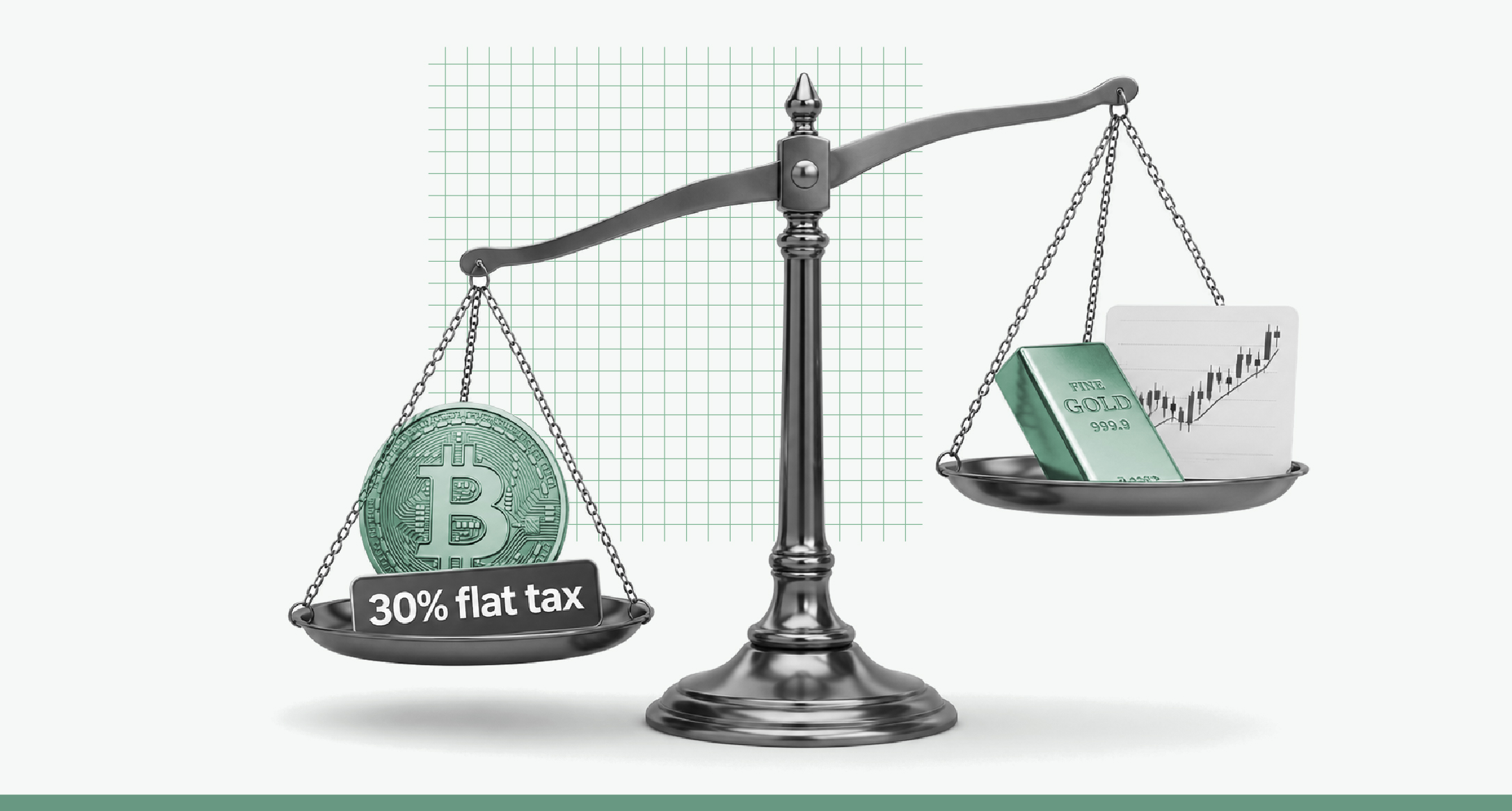
The 30% tax on crypto in India is the most visible feature of this country’s crypto tax regime. Section 115BBH of the Income Tax Act subjects virtual digital assets (VDAs) to a separate set of tax provisions that apply irrespective of your income tax slab or the period for which the asset is held.
These provisions play a significant role in determining the effective crypto tax and, consequently, the post-tax value of its returns. Evaluating a crypto transaction, therefore, requires considering the tax implications that arise across the entire transaction rather than the headline tax rate alone.
Section 115BBH, introduced in the Union Budget 2022, taxes income from the transfer of a Virtual Digital Asset (VDA) at a flat 30%, with a 4% health and education cess added on top. That cess lifts the minimum effective crypto tax rate to 31.2% from 30%. High earners pay a surcharge above this, which pushes the real cost higher still.
The term ‘Virtual Digital Asset’ has a broad scope and includes cryptocurrencies, crypto tokens, stablecoins, and non-fungible tokens (NFTs). The tax provisions apply uniformly across all categories of VDAs, without any preferential treatment for a particular type of digital asset.
The crypto tax liability arises when a transfer of a VDA takes place. A transfer isn’t limited to selling crypto for Indian rupees or another fiat currency. It also includes exchanging one cryptocurrency for another, swapping tokens, or using crypto to purchase goods or services. Each such transaction is treated as a separate taxable event for the purpose of computing tax under Section 115BBH.
Crypto acquired through mining, staking, or as payment for goods or services is subject to a different tax treatment at the time of receipt. The value of the crypto received is generally taxable as income based on its fair market value on the date of receipt. If those tokens are sold or transferred at a later date, Section 115BBH applies to the gains arising over and above the value that was already taxed when the crypto was received.
Also read: ITR filing guide for crypto investors
Taxation on cryptocurrency deviates from the usual principles applicable to other assets in India. Factors that usually influence an investor’s tax liability, such as income level, investment horizon, and eligible expenses, don’t receive similar consideration in the case of Virtual Digital Assets. This implies that crypto tax treatment remains identical to a person earning ₹6 lakh a year and the one earning ₹60 lakh a year.
The period for which the asset is held also carries no tax advantage. Unlike certain traditional investments that distinguish between short-term and long-term holdings, crypto gains are subject to the same tax rate. For example, Bitcoin sold after ten years faces the identical tax to Bitcoin sold after ten days, removing the long-term benefit that shares and mutual funds reward.
Deductions are almost entirely blocked. The price you paid to buy the asset is all that comes off your gain, while exchange fees, gas charges, internet costs, etc., stay outside the sum, even though every one of them lowers what you actually earn.
No, you cannot offset crypto losses against gains in India. In fact, Section 115BBH inflicts the most damage here, catching out even seasoned traders. A loss on one VDA can’t reduce a gain on another. Nothing lets it offset your salary, your business income, or any other head. Carrying it into a future year is blocked as well, which leaves a losing year with nothing behind it to soften a profitable one later.
A worked example shows how sharply this bites. Suppose you make ₹2,00,000 on Bitcoin and lose ₹1,50,000 on a different token in the same financial year. The money actually in your pocket is ₹50,000, yet the Income Tax Department looks only at the ₹2,00,000 gain and charges 31.2% on it.
An illustrative example: Crypto gains and losses are taxed separately under Section 115BBH
| What happened | Amount |
|---|---|
| Profit on Bitcoin | ₹2,00,000 |
| Loss on another token | ₹1,50,000 |
| Your real gain for the year | ₹50,000 |
| Taxable gain under Section 115BBH | ₹2,00,000 |
| Tax at 31.2% | ₹62,400 |
| Your position after tax | Down ₹12,400 |
This ₹12,400 proves that crypto portfolio-level performance is largely irrelevant for tax purposes. Under Section 115BBH, every taxable gain is evaluated on its own, irrespective of losses elsewhere in your crypto portfolio. As a result, tax planning for crypto requires looking at individual transactions rather than your net profit or loss for the year.
Section 194S adds a 1% tax deducted at source on VDA transfers, applying once annual transfers cross ₹50,000 for specified persons and ₹10,000 for everyone else. Indian crypto exchanges deduct it automatically, and in a peer-to-peer trade the buyer carries the obligation instead.
The detail that surprises traders is the base the 1% applies to. TDS is charged on the full sale value, not on your profit, which means even a loss-making trade still triggers a deduction. Move ₹10,00,000 through a series of trades across a year and roughly ₹10,000 leaves your account through TDS, whatever those trades earned or lost.
This money returns to you in time. It appears in your Form 26AS and AIS, and you claim it as a credit against your final tax, with any excess refunded at ITR filing. Through the year, though, it sits with the tax department instead of in your trading account, and active traders often feel that cash-flow drags more sharply than the headline rate.
Crypto gains are never equal to post-tax gains. Under the minimum effective tax rate of 31.2%, every ₹100 of taxable profit leaves ₹68.80 in your hands.
Consider an investment that generates a 20% capital gain. If your profit is ₹20 on every ₹100 invested, the crypto tax liability works out to ₹6.24 (31.2% of ₹20), leaving you with a post-tax gain of ₹13.76, or approximately 13.8%. Similarly, a 50% gain translates into a post-tax return of about 34.4% after paying tax on the profit.
In practical terms, the returns displayed in your portfolio represent pre-tax gains. The amount that ultimately contributes to your wealth is the return that remains after meeting your tax liability. Factoring in post-tax returns while evaluating crypto investments provides a more accurate picture of their financial outcome.
Crypto transactions are reported separately in the Income Tax Return and do not form part of the regular capital gains schedules. Income from the transfer of Virtual Digital Assets (VDAs) must be disclosed in Schedule VDA in ITR-2, while taxpayers earning crypto-related business income generally use ITR-3.
Crypto held on foreign exchanges may attract additional disclosure requirements for resident and ordinarily resident taxpayers. These disclosures are separate from reporting taxable gains in your return.
Enforcement has moved from theory into practice. The Income Tax Department has detected ₹888.82 crore in undisclosed crypto income and issued more than 44,000 notices, built on the TDS trail that every exchange transaction leaves behind. Exchanges, custodians, and wallet providers must now furnish transaction data directly to the department, which cross-checks it automatically against what each taxpayer files.
Accurate reporting of crypto transactions has therefore become an important part of tax compliance.
The tax on crypto in India India influences more than the tax payable on your gains. It shapes the returns you ultimately retain, the way transactions are taxed, and the compliance requirements that follow. Factoring in these tax implications before investing can help set more realistic return expectations and avoid surprises at the time of filing your income tax return.
Yes. The 1% TDS deducted on crypto transactions is not an additional tax. It is available as tax credit while filing your Income Tax Return. If the total TDS deducted during the year exceeds your actual tax liability, you can claim the excess amount as a refund. Your eligibility for a refund depends on your final tax computation and the TDS reported in your return.
There is no legal mechanism to avoid crypto tax if a taxable crypto transaction has taken place. Income arising from the transfer of Virtual Digital Assets is taxable under the applicable provisions of the Income Tax Act. Tax planning can help you estimate your post-tax returns, but it does not eliminate the tax liability.
There is no minimum exemption limit specifically for crypto gains taxable under the Virtual Digital Asset provisions. The flat tax rate applies irrespective of the amount of taxable gains, subject to the applicable tax provisions governing the transaction.
Merely holding crypto does not trigger tax. Tax liability generally arises when a taxable event takes place, such as selling, exchanging, or otherwise transferring a Virtual Digital Asset. Certain forms of crypto income, such as staking rewards or mining income, may be taxable when received.
Yes. Exchanging one cryptocurrency for another is treated as a transfer of a Virtual Digital Asset and can attract tax under the applicable provisions of the Income Tax Act. The absence of a cash withdrawal or bank transfer does not alter the tax treatment of the transaction.
Disclaimer: This article is for educational purposes only and doesn’t constitute investment, legal, or tax advice. Virtual Digital Assets lack a dedicated regulated framework in India, and SEBI-registered advisors cannot advise on them. The provisions cited fall under the Income Tax Act 1961, applicable to income up to March 31st, 2026, with the Income Tax Act 2025 governing periods after that date.

The views in the article /blog are personal and that of the author. The idea is to create awareness and not intended to provide any product recommendations.


Plan Your Retirement with Our Qualified Financial Advisors
Your first financial plan is free