

Should You Opt For Arbitrage Funds For Your Emergency Corpus?
ITR Filing
Jan 20, 2025

Plan Your Retirement with Our Qualified Financial Advisors

Your first financial plan is free
Filing taxes as a small business owner, consultant, or freelancer often brings a unique compliance challenge: balancing simplicity with optimal tax savings. The Income Tax Department designed ITR-4 (also known as Sugam) specifically to reduce accounting burdens for eligible small taxpayers.
The right ITR-4 deductions can reduce your taxable income and, in turn, your overall tax liability for Tax Year 2026-27. If you have paid life insurance premiums, contributed to NPS, bought health insurance, paid education-loan interest, made eligible donations or paid rent, some of these expenses may qualify for a deduction, depending on your tax regime and the conditions applicable to each provision.
For Tax Year 2026-27, these deductions are governed by the Income Tax Act 2025, which has introduced new section numbers for several provisions familiar under the earlier law. Each deduction also comes with its own eligibility requirements and documentation. Keeping the relevant receipts, certificates and payment records ready helps you claim the benefits correctly and substantiate them if required.
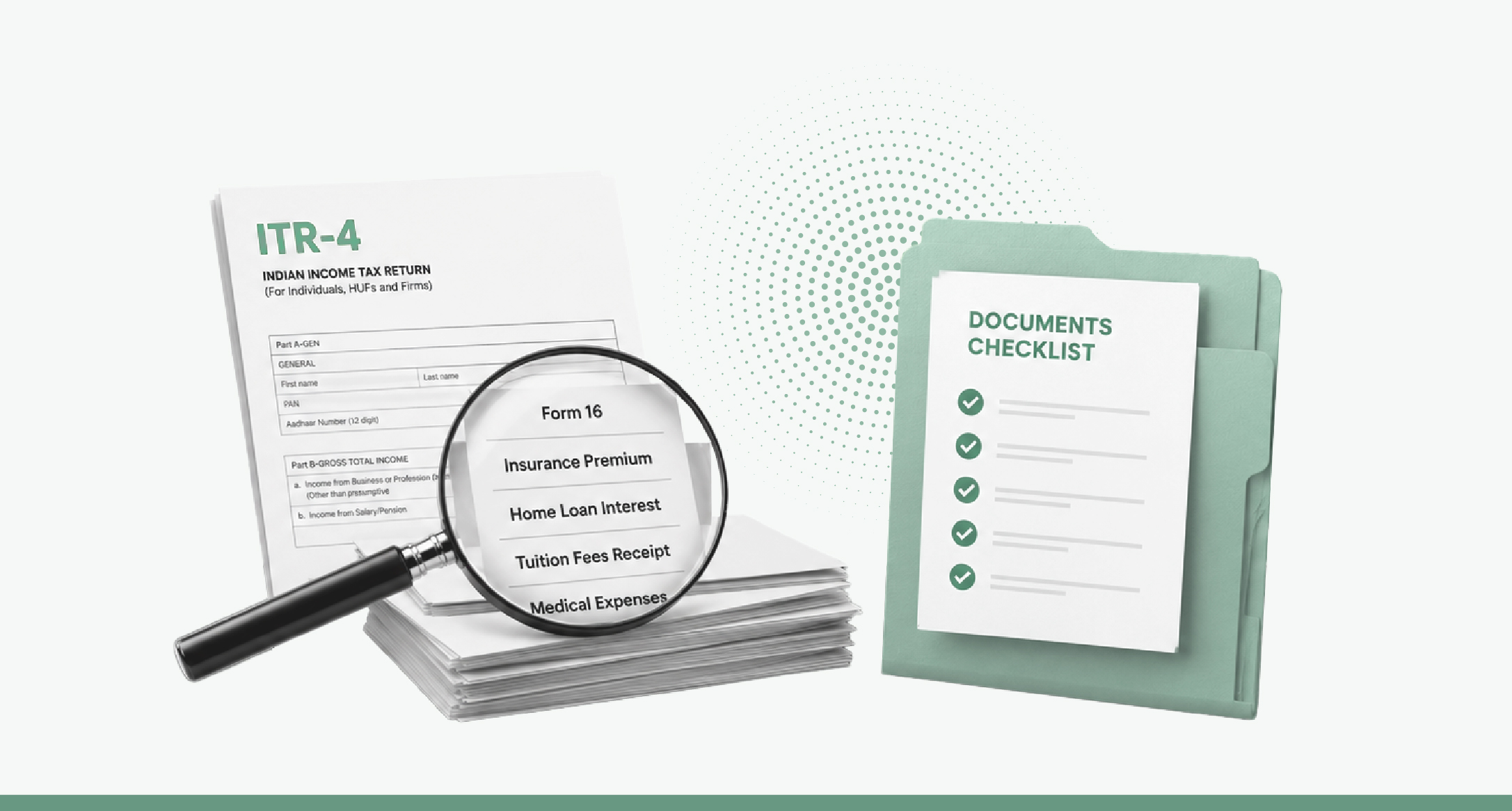
This ITR-4 deductions guide covers the limits that apply and the documents you need to keep ready before filing your return.
The most relevant deductions for an ITR-4 taxpayer include:
| Deduction | Income Tax Act 2025 | What you can claim |
|---|---|---|
| Eligible investments and payments | Section 123 | Up to ₹1.5 lakh, subject to the specified investments and payments |
| NPS contributions | Section 124 | Eligible own/employer contributions, subject to the applicable limits |
| Agnipath contribution | Section 125 | Eligible contribution to the Agniveer Corpus Fund |
| Health insurance and medical expenses | Section 126 | Eligible health insurance premiums and specified medical expenses |
| Medical treatment of dependent with disability | Section 127 | ₹75,000; ₹1.25 lakh for severe disability, subject to conditions |
| Specified medical treatment | Section 128 | Up to ₹40,000; ₹1 lakh for a senior citizen |
| Education-loan interest | Section 129 | Eligible interest paid on a higher-education loan |
| Eligible home-loan interest | Sections 130/131 | Available only for loans and properties meeting the statutory conditions |
| Electric-vehicle loan interest | Section 132 | Up to ₹1.5 lakh, subject to the specified loan conditions |
| Eligible donations | Section 133 | Deduction depends on the recipient and applicable percentage |
| Rent paid without HRA | Section 134 | Up to ₹60,000 a year, if you don’t receive HRA from the employer |
| Disability deduction | Section 154 | Deduction for an individual with a qualifying disability |
The Income Tax Act 2025 substantially retains the familiar deduction framework but renumbers the provisions. For example, Section 123 carries the ₹1.5 lakh deduction for specified investments and payments, while Section 126 deals with health insurance and specified medical expenditure.
This is the most important point before collecting documents. Under the default new tax regime, most Chapter VIII deductions are not available. In particular, Section 123 cannot be claimed under the new tax regime. The Income Tax Department’s guidance confirms that Section 123 is available only when the taxpayer is eligible to use the old tax regime.
For taxpayers with business or professional income, choosing the old regime also involves the prescribed option and filing requirements. Therefore, don’t assume that having made an eligible investment automatically means you can claim the deduction in ITR-4.
Some deductions continue to have specific treatment under the new regime. For example, eligible employer contributions to NPS under Section 124 can continue to qualify.
So, the right sequence follows this: Choose the applicable tax regime. Then, identify the deductions available under that regime. Collect the supporting documents and then enter the eligible amounts in ITR-4.
Section 123 is the new Act’s equivalent of the familiar Section 80C basket. An individual or HUF can claim up to ₹1.5 lakh for specified payments and investments listed in Schedule XV. These include qualifying payments such as:
The ₹1.5 lakh is an aggregate limit, not a separate ₹1.5 lakh for each investment.
Keep these documents ready:
The ITR-4 utility requires additional information for Section 123 claims, including the eligible amount and policy or document identification details.
Important: You don’t normally attach these receipts to your ITR. Keep them safely in case the Income Tax Department asks you to substantiate the claim.
Check out: Calculate how making prepayments on your loan can save you interest and shorten your loan tenure with 1 Finance Loan Prepayment Calculator
Section 124 covers deductions relating to contributions to a pension scheme notified by the Central Government, including the NPS framework. It covers different types of contributions, including eligible employer contributions and the additional deduction available for an individual’s own contribution, subject to the conditions and limits in the section. The additional ₹50,000 NPS deduction continues under the new Income Tax Act.
Keep these documents ready:
The ITR-4 utility requires PRAN-related information for applicable NPS deductions.
Section 126 covers eligible health insurance premiums, certain preventive health check-ups and specified medical expenditure. For an individual, the provision allows deductions for eligible health insurance covering the taxpayer and family and for parents, with the limits increasing where the relevant insured person is a senior citizen. It also provides for specified medical expenditure in cases involving senior citizens where the statutory conditions are met.
Documents to keep ready:
| For health insurance | For eligible medical expenditure |
| Health insurance premium receipt Policy document Policy number Insurer’s name Proof of payment | Hospital or medical bills Prescriptions Payment receipts Evidence establishing the senior-citizen status, where relevant Insurance reimbursement details, if any |
The ITR-4 utility specifically asks for the insurer’s name, policy number and health-insurance amount when claiming the deduction.
If you are claiming a deduction for the maintenance, medical treatment, training or rehabilitation of a dependent with a disability, Section 127 may apply. The deduction is ₹75,000, increasing to ₹1.25 lakh for severe disability, subject to the statutory conditions.
Documents to keep ready:
For specified disability claims, the ITR-4 utility requires information such as the nature and type of disability, dependent details, PAN/Aadhaar and the acknowledgement details of the applicable form.
Section 128 provides a deduction for eligible medical treatment of specified diseases. The deduction is limited to the amount actually paid or ₹40,000, whichever is lower. For a senior citizen, the limit increases to ₹1 lakh, subject to the conditions of the section.
Documents to keep ready
The deduction must be reduced by amounts received from an insurer or reimbursed by an employer for the same treatment.
If you have taken an eligible loan for higher education for yourself or a specified relative, the interest actually paid during the tax year can qualify for deduction under Section 129. The deduction is available for the initial tax year in which interest is paid and the following seven tax years, or until the interest is fully paid, whichever is earlier.
Documents to keep ready:
The ITR utility requires information such as the lending institution, loan account number, sanction date, loan amount, outstanding amount and interest paid for applicable education-loan claims.
The Income Tax Act 2025 retains deductions for interest on certain housing loans, but these provisions apply only to loans that satisfy specific statutory conditions.
Section 131 provides a deduction of up to ₹1.5 lakh for specified loans sanctioned between 1 April 2019 and 31 March 2022, subject to conditions including the value of the property and ownership requirements. Section 130 covers another specific category of housing loans and provides a deduction of up to ₹50,000, again subject to conditions relating to the loan and property.
Documents to keep ready
Don’t claim these deductions merely because you have a home loan. Check whether the loan sanction date, property value and other statutory conditions match the relevant section.
The amount you can deduct depends on the category of recipient. Some donations qualify for 100% deduction, while others qualify for 50%, and certain donations are subject to the applicable percentage-of-income limit.
There is also an important payment condition: a donation exceeding ₹2,000 must not be paid in cash to qualify for deduction. For donations to eligible institutions, the claim is also subject to the information furnished by the recipient and the department’s verification process.
Documents to keep ready
Don’t rely only on the receipt. Check that the organisation is eligible for deduction under Section 133.
Section 134 provides a deduction for certain taxpayers who pay rent for their residential accommodation but do not receive HRA. The deduction is subject to the statutory formula and is capped at ₹60,000 a year. The section also contains conditions relating to ownership of residential property and other circumstances.
For Tax Year 2026-27, the corresponding declaration is Form 31, which replaces the earlier Form 10BA. The Income Tax Department requires details such as the rented property’s address, rent paid, payment mode and landlord details.
Documents to keep ready
Form 31 must be furnished along with the return, so do not leave this declaration until after filing the ITR.
Claiming deductions under the wrong tax regime: The most common mistake is assuming that every investment or payment qualifies for a deduction regardless of the regime chosen. For example, the ₹1.5 lakh deduction under Section 123 is not available under the new tax regime.
Claiming the same payment twice: An investment or expense should not be claimed under two different provisions for the same tax year.
Using a payment receipt without checking eligibility: A receipt proves that you paid something. It does not automatically prove that the payment qualifies for a deduction. Check the section’s conditions before entering the amount in ITR-4.
Ignoring the information required in the ITR: Some deductions require more than the amount paid. For example, ITR-4 requires policy/document identification details for Section 123, PRAN for applicable NPS deductions and insurer and policy details for Section 126.
Forgetting the separate form: If a deduction requires a prescribed form, filing the ITR without completing that form can prevent the claim from being allowed.
The objective behind the ITR-4 deductions guide is to claim deduction you are legally entitled to, with the records and information needed to support it.

The views in the article /blog are personal and that of the author. The idea is to create awareness and not intended to provide any product recommendations.


Plan Your Retirement with Our Qualified Financial Advisors
Your first financial plan is free