


The REIT revolution: History of Real Estate Investment Trusts and how ...
Learn how REITs opened real estate investing to all

 Book a free consulation
Get advice on investing, insurance, tax planning, loan management, etc, for free with a Qualifed Financial Advisor
reit
The real estate investment trust (REIT) market of India has steadily evolved from an unfamiliar concept into a serious, mainstream investment avenue. After Embassy Office Parks REIT laid the foundation and Mindspace and Brookfield REITs strengthened investor confidence, Knowledge Realty Trust REIT entered this matured phase with India’s largest office portfolio built around Global Capability Centres (GCCs) and Fortune 500 tenants. That’s why for you, the real question must focus on whether this REIT can add more portfolio strength to your existing one.
So, let’s find out if this REIT deserves a place in your portfolio.
Knowledge Realty Trust REIT was first registered with the Securities and Exchange Board of India (SEBI) on October 18, 2024, with its units being listed on both National Stock Exchange (NSE) and Bombay Stock Exchange (BSE) on August 18, 2025.
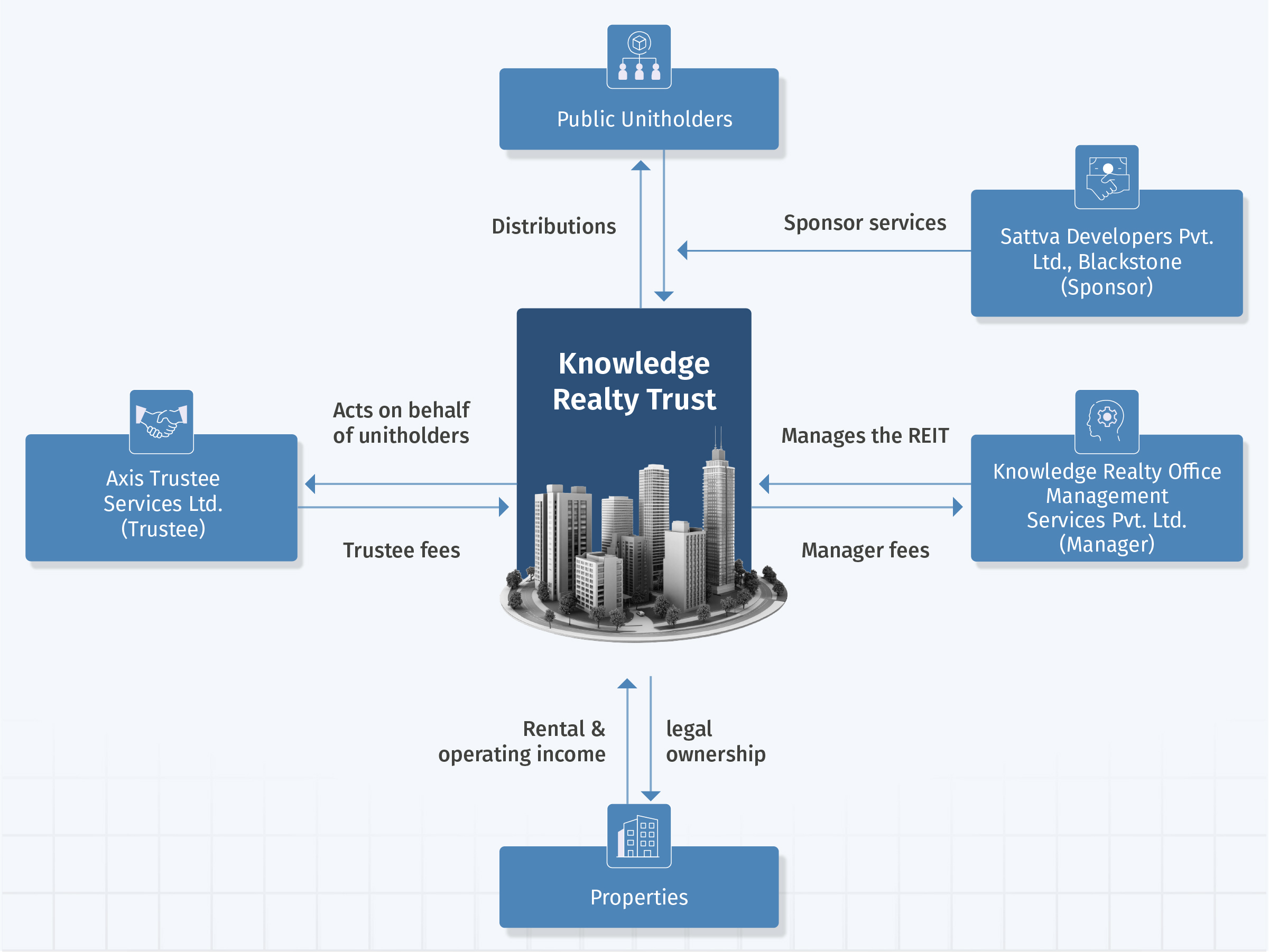
The REIT is backed by experienced sponsors: Sattva Group, a leading Indian real estate developer, contributes deep local expertise in commercial and office properties, while Blackstone, one of the world’s largest private equity and real estate investors, adds global experience in property management and REIT governance. Together, they provide a strong foundation for Knowledge Realty Trust, combining local development insight with international investment expertise.
As of September 2025, its assets are located across key cities with a strong portfolio occupancy. Occupancy represents the share of a property’s rentable space that’s actually leased to tenants. The occupancy stands at 99% in Hyderabad, 98% in GIFT City, 95% in Chennai, and around 88% in Mumbai, Bengaluru, and Gurugram.
The REIT has performed quite well in its debut, as reported in its Earnings Presentation Q2 FY2026, as of September 2025.
Gross asset value (GAV): It stands at approximately ₹64,551 crore, reinforcing its position as the current largest office-focused REITs in the market.
Revenue: It reached ~₹2,202 crore, reflecting a 17% year-on-year growth. This increase highlights steady leasing momentum and rental income stability.
Net operating income (NOI): It rose to ₹1,954.4 crore in September 2025, marking a 20% year-on-year growth, driven by strong occupancy and operational efficiency.
Distributions: The REIT announced a total distribution of ₹690 crore (₹1.56 per unit), underlining its income-focused return profile for investors.
1. Largest office REIT with long leases
With its GAV reaching ₹64,000 crore and 37.1 million square feet of completed space, this REIT debuts as one of the most secure income profiles among listed office REITs. The real strength, however, lies in lease stability. A weighted average lease expiry (WALE) of 8.1 years, combined with 92% committed occupancy, delivers strong cash-flow visibility. For you, this can mean a lower vacancy risk.
2. Focus on Grade A office campuses in key cities
The REIT’s portfolio strategy is centered on large, integrated Grade A offices, like global capacity centres (GCCs) and Fortune 500 companies. It hosts more than 450 tenants. Such tenants usually commit to long-term leases, consolidating long-term operational continuity and a stronger income profile for investors.
3. Stronger debt profile
The REIT benefits from a strong debt profile, highlighted by its AAA/Stable CRISIL/ICRA-rated non-convertible debentures worth ₹1,600 crore. Through strategic refinancing, the REIT has reduced its average debt cost from 8.6% in March 2025 to 7.4% in September 2025. This means lower borrowing costs improve net distributable cash flows, supporting more reliable distributions per unit.
4. Strong global backing and sponsor strength
The backing by Sattva Group and Blackstone brings together deep experience in managing institutional real estate.
Blackstone holds an equal ownership stake in this REIT with the Sattva Group, according to the final offer document filed with SEBI. Blackstone contributes extensive experience in institutional real estate investment, asset management, and REIT operations globally. Sattva Group, as the co-sponsor, brings deep local development and operational expertise.
Together, this backing provides financial depth, global execution standards, and strong capital support. For investors, this significantly reduces operational risk. Hence, you can treat this investment as long-term, yield-generating business.
1. Sensitive to economic and office demand
The REIT is inherently tied to the office sector, making its overall performance sensitive to broader economic as well as corporate trends. Hiring cycles, business expansion plans, and demand from sectors like technology and consulting directly influence leasing activity. Hence, slower corporate growth or hybrid work culture can reduce occupancy levels and limit rental escalations.
2. Possesses concentration risk
The REIT’s focus remains exclusively in one asset class, which is commercial offices. This introduces concentration risk. Its performance is therefore closely tied to trends in office market, and to demand for Grade A office spaces in key cities. If structural changes reduce office demand, like downsizing by large tenants, the REIT’s performance can be affected. You must consider this when evaluating the REIT’s role in your portfolio.
3. Limited history of operations as a listed REIT
Although this REIT is backed by strong sponsors and high-quality portfolio, it still possesses some risk. It was formed and listed only in 2025. Its long-term performance through full economic and office market cycles remains untested. You should note that while the underlying assets are strong, that doesn’t automatically guarantee distribution stability. You need to monitor leasing trends, its occupancy ratio, and market conditions carefully.
Since the REIT is traded like a stock, you can buy units directly, anytime during market hours. This provides both liquidity and flexibility to you. All you need is a trading account, opening which can take a few minutes if you aren’t already registered. Once your account is up, search for Knowledge Realty Trust under its ticker names: KRT (NSE) and 544481 (BSE), and place your order.
Currently, mutual funds and ETFs do not hold Knowledge Realty Trust in significant amounts, so direct investment can be the most effective way to gain exposure.
Today, Knowledge Realty Trust REIT represents a significant option in India’s commercial real estate market. Whether it becomes a core component of your portfolio depends on how it complements your overall investment strategy.
It can suit a long-term portfolio when the investor understands exactly the role it serves. It provides indirect ownership of premium-quality office real estate, offering predictable income and potential growth from rent escalations. However, it does not replace the need for proper asset allocation or clarity about your risk appetite.
Before allocating to Knowledge Realthy Trust REIT, gain perspective from a Qualified Financial Advisor (QFA). Effective investing hinges on how this asset aligns with your full financial picture: goals, risk tolerance, timelines, taxes, and portfolio. An advisor integrates these elements into a cohesive, personalized plan.
DIY investing risks overexposure to real estate, misallocation of funds, or overlooking tax and liquidity implications can impact your broader financial strategy. It can also carry risks, such as poor diversification or misjudging your tolerance for volatility, which may lead to costly mistakes.
Self-managing feels straightforward and cost-free initially. Yet sustained success demands ongoing research, disciplined choices, and emotional restraint amid volatility. Emotional reactions or impulses often erode returns. A QFA curbs these biases, anchoring you to your long-term strategy. Get your first free curated financial plan today!

The views in the article /blog are personal and that of the author. The idea is to create awareness and not intended to provide any product recommendations.


Get advice on investing, insurance, tax planning, loan management, etc, for free with a Qualifed Financial Advisor
Explore
Learn how REITs opened real estate investing to all
Know the risks and rewards of investing in Embassy REIT before you decide.

Housing affordability, which means being able to buy or rent a home without straining...