

Direct vs. regular mutual funds: What shall you opt?
Deciding between direct vs. regular mutual funds is one of the first dilemmas that ne...

 Book a free consulation
Get advice on investing, insurance, tax planning, loan management, etc, for free with a Qualifed Financial Advisor
With several new all-time highs in the last few months, the allure of gold shines brighter than ever. Traditionally viewed as a safe-haven metal, gold has always been a popular investment for those looking to hedge against inflation. The question now is how to include gold in your portfolio, whether through mutual funds, ETFs, sovereign gold bonds, or other forms.
With the Reserve Bank of India (RBI) halting new tranches of sovereign gold bonds, investors now have limited choices, primarily gold mutual funds and ETFs. Rather than opting for gold mutual funds, many experts advise choosing multi-asset allocation funds that include gold exposure. So your investment is not limited to gold alone; you benefit from a built-in asset allocation that includes gold.
However, if your primary goal is to add gold to your portfolio, is this really the best option? Or should you consider gold ETFs for a more direct investment in gold? In this blog, we explain which option is preferred for investing in gold in 2025: multi-asset allocation funds or gold ETFs.
Before diving into a detailed comparison, let’s first understand how multi-asset allocation funds work.
According to the Securities and Exchange Board of India (SEBI), multi-asset allocation funds must invest at least 10% each in equity, debt, and commodities like gold or silver. This definition makes multi-asset allocation funds a suitable option for diversifying your portfolio. Their appeal has quickly attracted investors.
According to the SEBI Annual Report 2024-25, these funds experienced their highest inflows, totalling approximately ₹34,786 crore, in the past year. But do these funds offer true diversification that you need?
Multi-asset allocation funds have gained popularity because they are marketed as a simple solution for diversification, offering all-in-one products. Essentially, these funds combine the potential returns of equities, the stability of debt, and the inflation-hedging protection that commodities provide. As an investor, you benefit from a comprehensive approach without the hassle of managing different assets separately.
However, the reality is that most multi-asset allocation funds on the market are heavily weighted towards equities, typically comprising about 60-65% of the portfolio, followed by 25-30% in debt, with only a small portion allocated to gold.
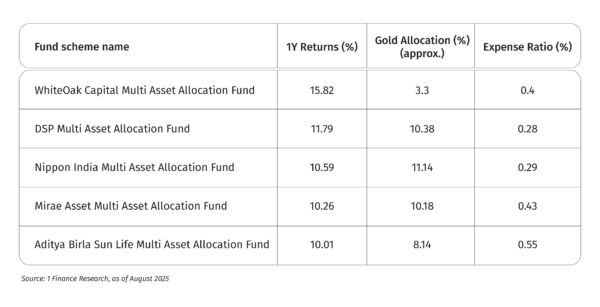
1 Finance analysed the multi-asset allocation funds available in the market and discovered the following:
Take a look at the gold allocation in top-performing multi-asset allocation funds (both direct and regular plans) along with their expense ratios.
Comparison of 1-year returns for multi-asset allocation funds (direct plans)
Comparison of 1-year returns for multi-asset allocation funds (regular plans)
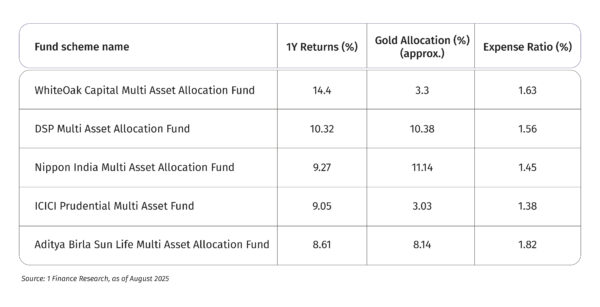
So, when you invest in multi-asset allocation funds to diversify your gold exposure, you may be paying a significantly higher expense ratio, and even then, your exposure to gold remains limited.
Gold exchange-traded funds (ETFs) are investment products that allow you to invest in gold without actually buying and storing physical gold. You can think of gold ETFs as a “drama-free” way to own gold. They typically invest in gold bullion, which refers to physical gold in the form of bars, coins, or ingots.
Each unit of a gold ETF typically represents one gram of gold. The ETF is listed on the stock exchange, allowing you to buy and sell it just like a stock. Investing in a gold ETF means you are investing in the value of gold without actually holding the physical asset. Instead, you own a share that reflects the gold held by the ETF. The value of the ETF moves in line with domestic gold prices; for example, if gold’s value increases by 5%, the value of the ETF is also expected to rise by a similar percentage.
One of the biggest advantages of gold ETFs is their lower expense ratio, which ranges from 0.30% to 0.80%, making them cost-effective.
Investors benefit from avoiding the hassles of storage, purity checks, and making charges.
Gold ETFs also offer complete transparency, as they track gold prices in real time.
Additionally, they provide higher liquidity since they are traded like stocks, meaning investors can buy or sell them easily at their convenience.
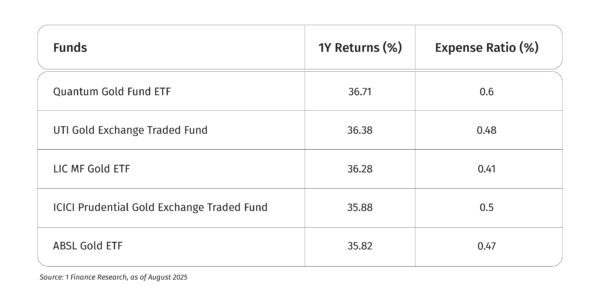
A quick clarification here. Do not confuse gold mutual funds with gold ETFs. Gold mutual funds may quote lower expense ratios but they actually invest in ETFs, bringing an extra layer of cost.
Read more about it in detail: Don’t be Fooled by Lower Expense Ratio of Gold Mutual Funds: You Pay Expense Ratio for Both Gold Mutual Funds, ETFs
The question now is which investment is better: multi-asset allocation funds or gold ETFs, if you plan to add gold to your portfolio. If you focus solely on returns, you will see that top-performing gold ETFs have provided higher returns than multi-asset allocation funds over the past year. However, returns should not be the only factor to consider when planning your investment.
It is important to note that if you want significant exposure to gold in your portfolio, gold ETFs are a more suitable option than multi-asset allocation funds. Since multi-asset allocation funds typically have an equity-heavy allocation, they tend to dilute the impact of gold during market volatility. Ultimately, the diversification that these funds market to offer is skewed, resulting in a portfolio that is primarily equity with a minimal amount of gold.
For those looking to benefit from gold and its rising prices, gold ETFs are a better option. Another advantage of gold ETFs is their transparency and lower expense ratios. Thus, when comparing multi-asset allocation funds and gold ETFs, gold ETFs emerge as the clear winner if your aim is to add gold to your portfolio.
If you are truly seeking diversification that aligns with your financial goals, it’s best to consult with a Qualified Financial Advisor (QFA). They can help you assess your risk appetite and asset mix to ensure your portfolio has all requirements and works in your favor.

The views in the article /blog are personal and that of the author. The idea is to create awareness and not intended to provide any product recommendations.


Get advice on investing, insurance, tax planning, loan management, etc, for free with a Qualifed Financial Advisor
Explore
Deciding between direct vs. regular mutual funds is one of the first dilemmas that ne...
The ongoing debate between active and passive funds has become a staple in the financ...

Discover the top mutual fund mistakes you should steer clear of to safeguard your fin...