



Benefit of opting for the New Tax Regime
Taxpayers are often confused when it comes to choosing between the new tax regime and...

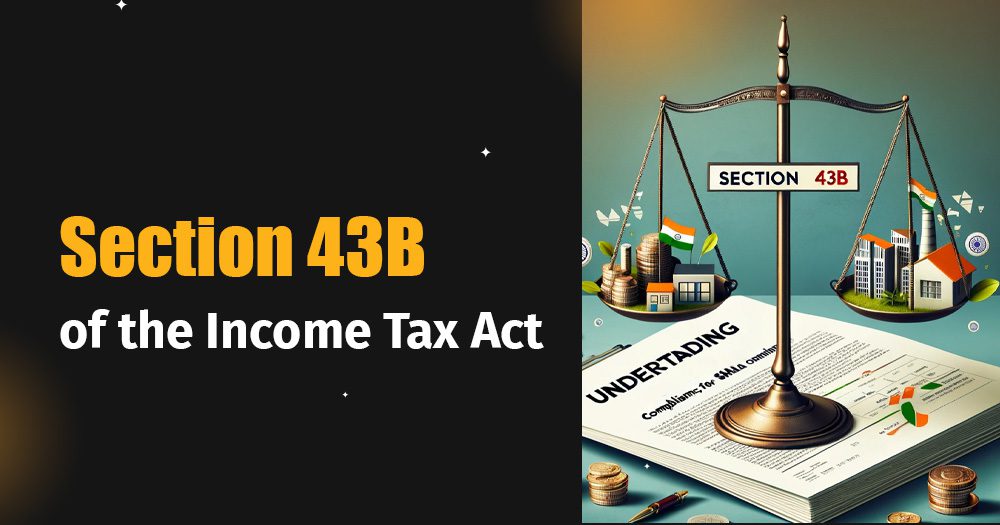
As a business owner or a self-employed taxpayer who isn’t on a monthly payroll, you’re probably always seeking ways to reduce tax liabilities and improve cash flow. If you are searching for a legal sidetrack to maximise your tax returns, you should look into section 43B of the Income Tax Act. This section helps businesses ensure that their liabilities are paid off timely and allows them to claim deductions upon completion of payments.
However, the tricky part is to comprehend exactly what section 43B covers, that is, which payments are eligible for deductions, and how your business can leverage this beneficial scheme by the government to stay compliant while optimising tax savings.
To put it simply, Section 43B allows taxpayers a provision so that they can claim deductions on specific expenses only when they have been paid. As a business owner, you must know how incurred expenses like charities, taxes, interests, and so on, are often claimed as deductible liabilities under the IT slabs, even when they are not paid. Section 43B ensures that the taxpayer only claims the expense deduction in the financial year the payment is made, regardless of when the liability was incurred.
Not all business expenses fall under Section 43B, but certain crucial categories do. Let’s break them down one by one:
Any sum payable by the assessee to the government in the form of tax – direct or indirect, duty fee, cess charges, and so on, qualifies under Section 43B. These include GST amounts, customs and excise duty, and other direct taxes. So, you can only claim a deduction on these amounts in the financial year of having completed payments for the same.
As an employer or a business, you are required to make contributions to employee welfare funds. These contributions include but are not limited to provident fund (PF), gratuity funds, and superannuation funds. Under Section 43B, you can only claim the deduction when these contributions have been paid within the prescribed time limits.
If you have taken loans from financial institutions or banks, the interest payable also falls under Section 43B. So, if you have paid the owed interest back, you qualify for deductions. This applies to both interests on loans and advances. This is also applicable to loans taken from public finance institutions or state corporations.
When you pay bonuses or commissions to employees, you can claim a deduction under Section 43B, but only if the payment is made before the due date for filing your income tax return.
Leave encashment is another employee-related expense covered under this section. Deduction for the same can be claimed when the leave encashment is paid.
Section 43B can work in favour of businesses in multiple ways. Some of its advantages are:
One of the biggest advantages of this provision is that it promotes the timely payment of taxes, employee dues, and loan interest. This not only helps businesses stay compliant but also reduces the risk of legal issues related to filing taxes late.
Now, since deductions are only allowed on actual payments, businesses can better manage their cash flows and plan their finances. So, this creates a clear link between cash outflows and tax benefits, helping you look through a bigger window to strategise your financial planning.
Besides helping businesses, Section 43B also enables the government to limit deductions made on actual payments. In this way, Section 43B prevents companies from inflating their expenses by claiming deductions for unpaid dues. This not only pushes for fair play in the system but also maintains a level playing field for all taxpayers.
There are a few conditions businesses need to be aware of to reap the most out of Section 43B. These include:
Let us break this down with an example:
Imagine ABC Pvt. Ltd. is a company with a tax liability of ₹1,00,000 for FY 2023-24. The company also owes ₹2,00,000 in provident fund contributions for its employees. In its financial statements for the year, these liabilities are shown as due.
However, if ABC Pvt. Ltd., fails to make the actual payments within the financial year, it cannot claim these as deductions when filing its income tax return. But, if it makes these payments before the ITR filing deadline for the same year, the amount will be fully deductible.
Preventing the abuse of tax deduction rules, Section 43B of the Income Tax Act ensures that businesses not only timely pay off their liabilities, but also claim deductions upon completion of payments only. Further, you must seek the help of a finance expert in order to prevent any potential errors while calculating taxes.

The views in the article /blog are personal and that of the author. The idea is to create awareness and not intended to provide any product recommendations.


Taxpayers are often confused when it comes to choosing between the new tax regime and...

Tax Deducted at Source, more popularly known as TDS, is often a tedious process for t...