


 Book a free consultation
What is a Financial Planning Centre?
Your financial future is a vital part of your life. It encompasses your dreams, your ...

 Book a free consulation
Get advice on investing, insurance, tax planning, loan management, etc, for free with a Qualifed Financial Advisor

Real Estate Investment Trusts (REITs) provide regular income to investors, as Securities and Exchange Board of India (SEBI) mandates that they must distribute at least 90% of their cash flow twice a year. However, this promise is broken when the money remains unclaimed. Unclaimed REIT funds sit in accounts, and many investors are unaware of their existence. Consider how much money is left untouched and why few people attempt to reclaim it.
This growing concern led SEBI to take action in November 2023. They issued a circular establishing a clear framework for managing unclaimed REIT distributions, applicable to all SEBI-listed REITs in India. Now, significant amounts could be involved for inactive unitholders, with organized alerts and claim periods set up to help recover these funds. It’s important to take action; check if you have unclaimed REIT money and follow SEBI’s guidelines to claim it.
To better understand why this issue of unclaimed REIT funds arose and how to prevent it, let’s examine the situation more closely.
SEBI says an unclaimed REIT amount is any distribution declared by the REIT manager, but left unpaid or unclaimed by the unitholder.
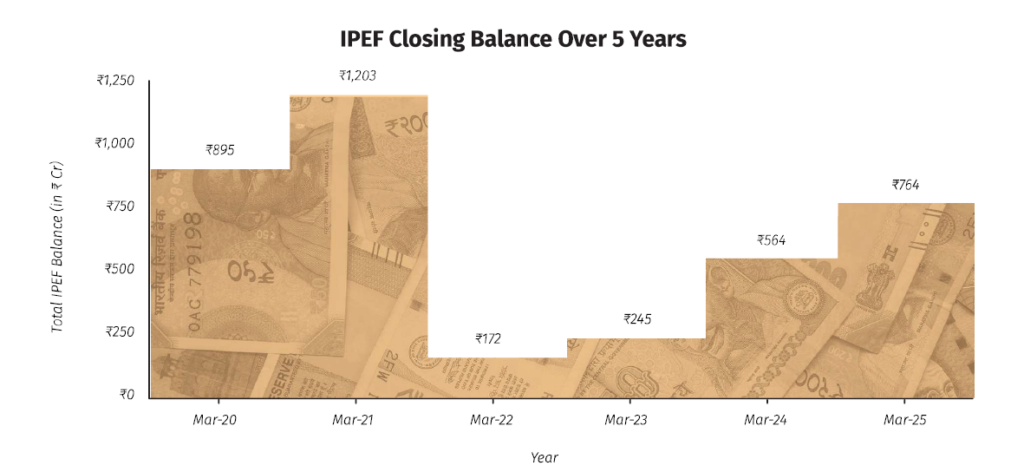
By March 2025, the Investor Protection and Education Fund (IPEF) closing account balance across REITs, InvITs, and NCDs, and other transactions had swelled to a staggering ₹764 crores. While this total, unlike the unclaimed amounts reported for mutual funds and shares, does not consist solely of unclaimed funds from these products; it reflects the overall IPEF balance. Even so, it points to an aggregate pool where your REIT distributions could lie dormant without your awareness. The scale of this pool over the past decade underscores both a massive opportunity and a wake-up call to reclaim what’s yours.
So, why does unclaimed money accumulate and become forgotten assets? Let’s find out.
REIT units in India are held in DEMAT form, which should make distributions seamless. Yet, unclaimed REIT income happens, and that too due to common reasons:
KYC details not updated correctly: There are mismatches in your name, PAN, or contact information between your DEMAT and REIT distribution records. Even a minor discrepancy in how your name appears can trigger a payment failure at the processing stage.
Inactive bank account linked to your DEMAT: If the bank account mapped to your depository participant (DP) is closed, frozen, or inactive, the credit instruction fails. Many investors change bank accounts without updating DEMAT records and the failure goes unnoticed until income distribution bounce alert is noticed (or isn’t).
DEMAT account dormancy: If your REIT units are in a DEMAT account you have not used in years, you might miss credit alerts or notifications from your DP.
Inherited or jointly held units: If a unitholder passes away and the surviving jointholder or nominee hasn’t yet gone through the formal transmission process with the DP, REIT income continues to be directed to the deceased holder’s old bank account, which obviously can’t receive the credit.
Technical failures during ECS/NACH credit: Even if your details are right, bank errors or account issues can stop payments from going through.
SEBI’s November 2023 circular (SEBI/HO/DDHS/DDHS-RAC-1/P/CIR/2023/177) sets a clear, time-bound process for all listed REITs when distributions go unpaid. Knowing this timeline matters, as it dictates what you can recover and how.
Days 1 to 15: The distribution window
From the date of declaration, the REIT has 15 days to credit income to all unitholders. If a payment fails within this window, it is flagged internally by the REIT Manager.
Days 16 to 22: Transfer to the Unpaid Distribution Account
Within 7 working days of the declaration, the REIT Manager must transfer unclaimed amounts to a dedicated escrow account, known as the Unpaid Distribution Account. The REIT Manager opens this at a scheduled bank on behalf of the REIT. A Nodal Officer (typically the CFO, Company Secretary, or Compliance Officer) serves as the key contact for all unitholder claims.
If the REIT Manager fails to transfer within the 7-day timeframe, interest accrues on the unpaid amount at an annual rate of 12%. This interest is a penalty borne solely by the REIT Manager and does not benefit unitholders. The REIT Manager is also prohibited from offsetting this penalty against management fees.
Within 30 days of transfer: Mandatory disclosure
Within 30 days of transferring unclaimed amounts to the Unpaid Distribution Account, the REIT Manager must publish all details on the REIT’s website.
Up to 7 years: Your window to claim directly
For up to 7 years from the date of declaration, you can claim your unpaid amount from the REIT. Contact the REIT Manager or the Nodal Officer. The process requires verifying your identity, DEMAT account, and bank details. The REIT must pay valid claims within 30 days of a complete application.
After 7 years: Transfer to IPEF
At the 7-year mark, the REIT Manager must transfer the full unclaimed corpus (principal plus any accrued interest) to SEBI’s Investor Protection and Education Fund within 30 days. There is no expiry on your right to claim it directly.
Defaulting on this transfer triggers penalties. The REIT Manager faces an initial fine of ₹1 lakh, plus a daily fine of ₹500 for each day of noncompliance, capped at a total of ₹10 lakh. They cannot recover these from other REIT fees.
Unfortunately, there’s no single, centralised search platform to check for unclaimed REIT distributions. But there are three reliable ways to find out.
Method 1: Check your DEMAT statement
Log into your DP account (the platform you use) and navigate to your distribution history for the REIT units you hold. Cross-check those amounts against your actual bank statement for the relevant dates.
If your bank account was active and a REIT distribution shows as credited in your DEMAT platform, but you don’t see the matching credit in your bank account, that’s a strong signal of a failed ECS/NACH mandate. Contact your DP immediately to update your bank details and flag the failed payout.
Method 2: Check the REIT’s official website
Below the unclaimed distribution section on each REIT’s website, you will see a search box. Enter your PAN or DEMAT details to check if any amount is pending in your name.
Quick links to check unclaimed distributions:
Each REIT also publicly lists the Nodal Officer’s contact details. Reach out directly; quote your DEMAT account or PAN to inquire about unclaimed amounts tied to your holdings.
Method 3: Contact the Registrar and Transfer Agent (RTA)
REITs use RTAs to maintain unit records and process distributions. Contact the relevant RTA for your REIT with your PAN and demat account number. Request a statement of all distributions, including any marked as unpaid or unclaimed.
Method 4: SEBI’s platform for unresolved grievances
If 7+ years unclaimed, you can confirm unclaimed money in two ways:
You still apply to the REIT, not SEBI directly; the IPEF part is handled by the Manager once your entitlement is verified.
Method 5: SEBI’s platform for unresolved grievances
If you believe a REIT distribution was declared, you never received it, and neither the REIT nor the RTA has resolved the issue despite your outreach, you can raise a formal complaint on SEBI’s SCORES (SEBI Complaints Redress System) portal. This escalates the matter to a regulatory level and requires a formal response from the REIT within defined timelines.
You can claim the amount in two distinct phases, depending on whether the unclaimed REIT money is still with the REIT or transferred to IPEF.
Before the IPEF transfer
Contact the REIT directly if distributions remain in their Unpaid Distribution Amount (within 7 years).
Step 1: Gather your documents
KYC documents (PAN or any other identity proof that shows your name appears on the REIT’s unclaimed REIT returns page; save a screenshot or PDF as supporting evidence).
You submit your documents directly to the REIT Manager (via email or through designated portal); check the REIT’s website for exact submission details. The manager then verifies your claim by checking three things: your identity, your DEMAT holdings on the relevant record dates, and whether the same unclaimed REIT amount is in the Unpaid Distribution Account under your folio.
If your documentation is incomplete, the REIT may send you a list of gaps to fill. Once your paperwork is in order, SEBI must credit funds to your account within 30 days of receiving a valid request.
Step 2: Write to the REIT’s nodal officer
Find the Nodal Officer’s contact on the REIT website. Include in your message:
After the IPEF transfer
1. Confirm IPEF status on the REIT website
Begin by searching the REIT’s unclaimed amounts using your name. If you see any listing marked “transferred to IPEF,” take note of the amount and date, as this information will guide your next steps.
2. Apply to the REIT, not to SEBI
If the amount is held by IPEF, submit an application to the REIT Manager. Follow the format and process given in the REIT’s claim policy. At this stage, do not file any claim directly with SEBI or the IPEF Authority. Be prepared to provide more detailed documentation, such as stronger proof of identity, entitlement, and bank details. Keep in mind that processing may take longer than a regular REIT-level claim.
3. REIT pays you first, then approaches IPEF
After your claim is verified, the REIT Manager will pay you. Only once you have been paid does the Manager begin the reimbursement process with IPEF by submitting SEBI’s Form B via mail and email.
4. SEBI refunds the REIT in the background
SEBI will then review the REIT’s application and supporting documents. It may request clarifications and will refund only up to the amount previously moved to IPEF for that unitholder. These actions occur solely between SEBI and the REIT; you continue to work only with the REIT Manager.

Contact a qualified financial advisor today.
Unclaimed REIT distributions are still yours, and a clear process for retrieval exists. The key is acting before the funds move further down the chain, as claims handled directly with the REIT are much easier to route.
Consulting a qualified financial advisor (QFA) can help you audit your REIT holdings across multiple folios and distribution periods. They can cross-check your records, flag any amounts you may have overlooked, and guide you through the IPEF documentation process.
Beyond recovery, they can streamline your overall financial planning with REITs. They can align unclaimed funds with retirement goals and build a holistic portfolio strategy, maximising your passive income.

The views in the article /blog are personal and that of the author. The idea is to create awareness and not intended to provide any product recommendations.


Get advice on investing, insurance, tax planning, loan management, etc, for free with a Qualifed Financial Advisor
Explore
Your financial future is a vital part of your life. It encompasses your dreams, your ...

In 2017, the Securities and Exchange Board of India (SEBI) introduced new guidelines ...

Money management in today’s world seems to be overwhelming, mainly because of t...