

Can I file ITR for the last 3 years?
ITR Filing
Dec 16, 2024

Plan Your Retirement with Our Qualified Financial Advisors

Your first financial plan is free
You sold some shares at a profit. You redeemed mutual fund units to meet a financial goal. Perhaps you sold gold or transferred a property that had appreciated over the years. The transactions are behind you—but before you file your income tax return, there’s one crucial step left.
You need to determine whether you have capital gains to report and, if so, how much tax you need to pay. The answer depends on several factors, including the type of asset, the period you held it, your cost of acquisition, the exemptions available to you, and the ITR form you file.
In this article, we explain the key rules governing capital gains tax and the important checks you should complete before filing your income tax return.
The holding period determines whether your capital gain is short-term or long-term, and the applicable tax treatment depends on that classification.
For listed shares and equity-oriented mutual funds, a holding period of more than 12 months generally results in a long-term capital gain. A holding period of 12 months or less generally results in a short-term capital gain.
For property, gold, and unlisted shares, the holding period is generally 24 months.
Short-term capital gains on property are added to your total income and taxed at the applicable slab rates. Long-term capital gains are taxed under the provisions that apply to long-term capital assets.
Use the purchase date and sale date in your records to determine the holding period before calculating your tax.
Your capital gain is calculated by subtracting your cost of acquisition from the sale price. Depending on the asset and the date of purchase, the cost of acquisition may differ from the original purchase price.
If you bought listed shares or equity-oriented mutual funds on or before 31 January 2018, the grandfathering provisions apply. For eligible assets, the cost of acquisition is determined under Section 55 using the higher of the actual purchase price or the lower of the fair market value as on 31 January 2018 and the sale price.
If you bought property, gold, or other long-term capital assets before 23 July 2024, transitional provisions under the Finance Act, 2024 may allow you to calculate tax under either of two methods, subject to the conditions in the law. Calculate your tax under both methods and use the one that results in the lower tax liability, if you qualify.
Use the correct cost of acquisition when calculating your capital gain.
Some capital gains are exempt if you meet the conditions in the Income Tax Act.
For long-term capital gains on listed equity shares and equity-oriented mutual funds taxable under Section 112A, the first ₹1.25 lakh of eligible gains in a financial year is exempt.
If you sold a residential property, you may be eligible for an exemption under Section 54 by purchasing another eligible residential property within two years or constructing one within three years from the date of transfer.
If you have not completed the purchase or construction before the due date for filing your return, you may be able to preserve the exemption by depositing the required amount in a Capital Gains Account Scheme before the due date for filing your return. For Assessment Year 2026-27, the due date for most individual taxpayers is 31 July 2026.
You may also qualify for an exemption under Section 54EC by investing up to ₹50 lakh in specified bonds within six months from the date of transfer.
Check the applicable time limits before filing your return.
Report any eligible capital losses in your income tax return. Capital losses can be set off against eligible capital gains, and unabsorbed losses may be carried forward if you file your return by the due date and satisfy the conditions in the Income Tax Act.
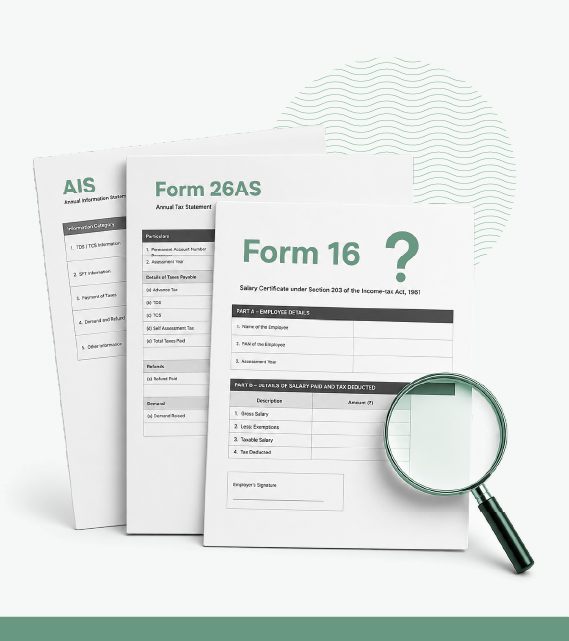
If you sold immovable property for more than ₹50 lakh, the buyer may have deducted TDS and deposited it against your PAN. Check Form 26AS before filing your return to confirm that the TDS has been credited.
Compare your capital gains with the transactions reported in the Annual Information Statement (AIS) before filing your return. Brokers, mutual funds, registrars, and other reporting entities submit transaction details to the Income Tax Department.
If your records differ from the information in the AIS, review the transactions and correct any errors before you submit your return.
If you have capital gains, file the ITR form that applies to your income and complete the capital gains schedule. Filing the wrong return form can result in a defective return under the Income Tax Act.
Capital gains reporting depends on the type of asset, the holding period, the applicable tax provisions, available exemptions, and the information reported to the Income Tax Department. Before you file, verify your calculations, supporting documents, Form 26AS, and the Annual Information Statement (AIS).
If you prefer professional assistance, you can file your return through planmytax.ai. Qualified tax professionals review your return, calculate capital gains, claim eligible exemptions and set-offs, reconcile your return with Form 26AS and the AIS, and assist with notices related to your filing, if required.
To get started, keep your purchase and sale documents, broker statements, and other supporting records ready.
Published on 20 Jul 2026, 1:53 pm IST

The views in the article /blog are personal and that of the author. The idea is to create awareness and not intended to provide any product recommendations.


Plan Your Retirement with Our Qualified Financial Advisors
Your first financial plan is free