


Can I file ITR for the last 3 years?
ITR Filing
Dec 16, 2024

Plan Your Retirement with Our Qualified Financial Advisors

Your first financial plan is free
Key takeaways
Few emails unsettle a salaried taxpayer quite like an income tax notice. It shows up weeks after filing with a section number in the subject line and little else, and most people immediately assume something in the return went wrong.
Behind most of these income tax notices is software rather than a person. The Income Tax Department checks every return against the information it already holds from your employer, your bank, and other reporting sources, and any figure that fails to match generates an automated message. Each notice has a clear route to settling it once you can tell which one has reached you.
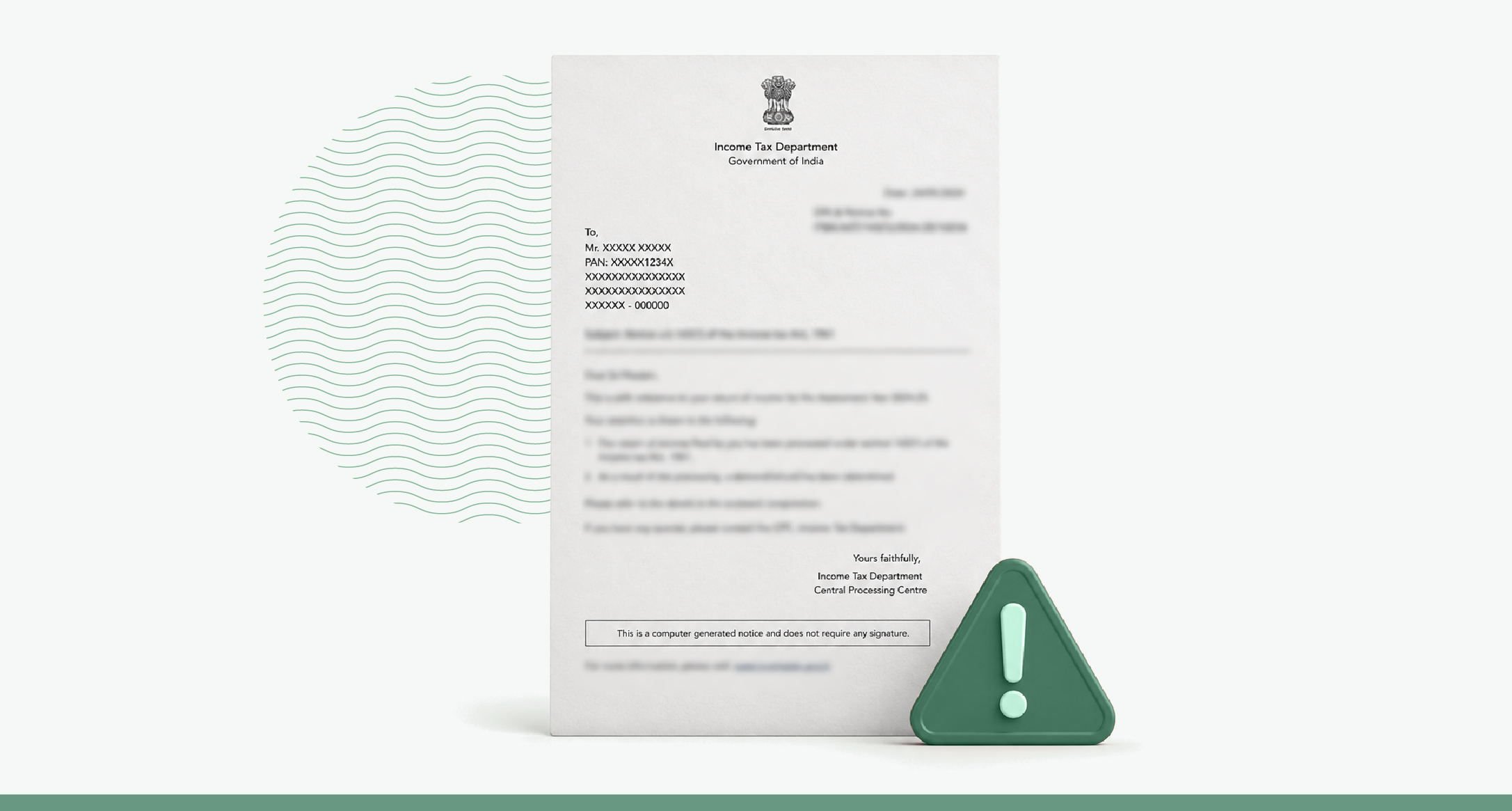
An income tax notice is an official communication from the Income Tax Department about your Income Tax Return (ITR). The department sends one to verify a figure, request information, point out an error, or raise a demand for tax due. Most of these communications are generated by software rather than written by an officer.
Every return you file is read against a second record the department already holds. Interest paid by your bank, salary and TDS reported by your employer, and share and mutual fund transactions reported by depositories all feed into a single record, your Annual Information Statement (AIS). The department’s system then compares your return with that statement line by line, and wherever your figures and its figures disagree, the mismatch produces a notice.
An income tax notice usually signals a difference in data, not suspicion of wrongdoing. A notice means the system found a difference, and every difference has a documented remedy.
Four notices account for almost everything a salaried or self-employed filer runs into after submitting a return.
An intimation under Section 143(1) is the automatic notice the department issues after processing your return, usually within nine months of the financial year end. It sets your figures against the department’s own calculation and reports the result. For most filers the two agree, and the intimation confirms the return is accepted.
It can also show a refund owed to you, paid automatically, or tax still due, which turns the intimation into an income tax demand notice under Section 156 payable within 30 days. Almost every processed return generates one, and receiving it is normal rather than a cause for concern.
A notice under Section 139(9) marks your return as defective, usually due to data missing or entered incorrectly. Common triggers include leaving a mandatory schedule blank, choosing the wrong ITR form for your type of income, or a mismatch between the income you declared and the tax you paid.
The notice gives you 15 days to correct the return on the portal and resubmit it. Leaving it unanswered carries a real cost, because a defective return that stays uncorrected is treated as though you never filed, which can bring late-filing consequences and cost you benefits tied to filing on time.
A scrutiny notice under Section 143(2) is far less common and signals that the department intends to examine your return in detail. Selection can be random or prompted by a specific flag, such as an unusually large deduction, a high-value transaction, or income that sits oddly against your profile.
The department must issue this notice within three months of the end of the financial year in which you filed. It opens a process in which you may be asked to produce documents and explanations for the entries in your return. A scrutiny notice asks you to substantiate what you filed rather than presuming any wrongdoing, though it does call for careful and timely replies.
A notice under Section 245 appears when a refund is due to you for one year while a tax demand from an earlier year remains unpaid. Instead of releasing the refund and separately pursuing the old demand, the department proposes to set one against the other and pay you only the balance.
The notice gives you a window, usually 30 days, to respond before the adjustment goes ahead. Accepting it settles a genuine old demand cleanly, and disagreeing lets you contest a demand you believe was already paid or wrongly raised, as long as you reply within the time given.
All income tax notices come with deadlines and purposes. The more practical question for most taxpayers is why these notices arrive at all.
Nearly every income tax notice traces back to one of five differences between your return and the department’s records.
Income left out of the return that the AIS already records. A fixed deposit that renews on its own, savings interest split across accounts, a dividend from a DEMAT account opened years ago, each reaches the AIS whether or not you recall it at filing time. Missing any of it produces the most common mismatch of all. The fix is a revised return under Section 139(5), and Budget 2026 extended the revised return last date to March 31st, 2027 for AY 2026-27, so a correction filed by December 31st, 2026 carries no fee.
TDS is shown in Form 16 but not in Form 26AS. Your employer deducted the tax, but an error in their quarterly filing kept part of it out of Form 26AS, and the department credits only what its own records hold. That is a tax credit mismatch, and matching Form 16 against Form 26AS shows exactly where the TDS credit mismatch sits. Ask whoever deducted the tax to correct their filing, then claim the credit once the record updates, a route covered step by step in how to resolve a TDS credit mismatch.
A deduction claimed without proof to support it. The department now tests claims against evidence, and its NUDGE campaign messages taxpayers whose deduction or donation figures look inflated, inviting a correction before any inquiry begins. Genuine claims backed by documentation need no action.
Advance tax that fell short of the tax you owed. Interest under Sections 234B and 234C inside an intimation means your quarterly instalments lagged your actual income, common in any year that brings a bonus, a property sale, or strong capital gains. The demand is arithmetic, so disputing it goes nowhere, and the fix belongs to next year. Splitting your liability across the four due dates with 1 Finance Advance Tax Calculator stops the interest before it starts.
A return made defective by the wrong form or a missing schedule. Using the wrong ITR form or leaving a mandatory schedule blank marks the return defective, with 15 days to correct it. Repaired in time, the return stands as though it were right from the start. Left alone, it counts as never filed, which brings a late fee of up to ₹5,000 and the loss of benefits tied to filing on time.
Once a notice reaches you, the first move is to find it on the portal and confirm it is real.
Verifying a notice takes only a few minutes.
Every communication the department has issued since October 1st, 2019 must carry a 20-character DIN. Fake refund messages circulate heavily during ITR filing season. The department never asks for card details or passwords through a link, so a message that fails the DIN check needs no response at all.
The section number tells you its type, the difference tells you what to prove, and the deadline tells you how long you have. Every reply goes through the e-Proceedings tab, where each submission generates an acknowledgement worth saving.
The reply itself follows one of three paths.
Most matters close on the portal, without an officer ever entering the exchange, as long as the response lands inside the window the notice sets.
Read the five reasons together and one thread runs through them. Each is a figure in your return that the department’s records describe differently, whether that is missed interest, unclaimed TDS credit, an unsupported deduction, or a short advance tax instalment. Preventing that difference is faster and cheaper than answering for it once a notice arrives.
If a notice is already sitting in your inbox, the deadline on it is the only thing that matters now, and responding early leaves room to fix a genuine error before it hardens into a demand. The larger win is next year’s return, where every income stream, deduction, and instalment can be reconciled against the department’s own data before you file. Building that complete picture takes time and a clear view of your whole financial year, far easier to assemble well ahead of the deadline than in the scramble of the final week.

The views in the article /blog are personal and that of the author. The idea is to create awareness and not intended to provide any product recommendations.


Plan Your Retirement with Our Qualified Financial Advisors
Your first financial plan is free